Cyber Insurance FAQs: What Policies Cover and Miss
See exactly what cyber insurance pays for, where it fails, and how to avoid common gaps that leave you exposed during a breach.

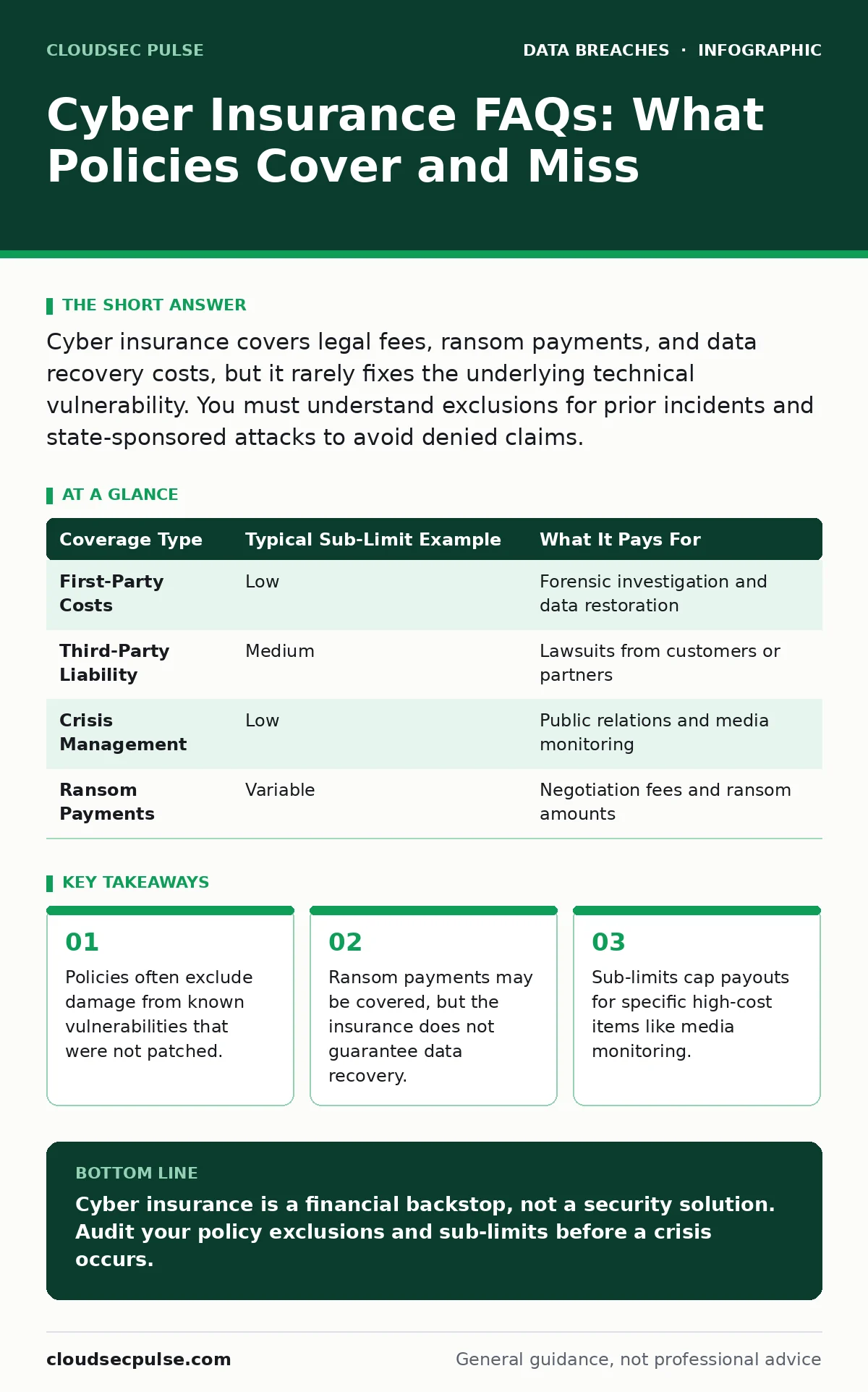
Cyber insurance covers legal fees, ransom payments, and data recovery costs, but it rarely fixes the underlying technical vulnerability. You must understand exclusions for prior incidents and state-sponsored attacks to avoid denied claims.
Does cyber insurance cover ransomware payments?
Most policies cover the cost of paying a ransom, but this coverage comes with strict conditions. Insurers typically require that you follow their prescribed incident response protocol before releasing funds. This often means involving a third-party negotiator approved by the insurance carrier. Paying the ransom does not guarantee you will receive your data back. Criminal groups may provide corrupted keys or simply disappear after receiving payment.
What happens if I ignore a security warning?
Insurers frequently deny claims if they can prove you ignored a known vulnerability. A known vulnerability is a weakness in software or hardware that has been publicly disclosed and for which a fix exists. If a patch was available and you did not apply it, the insurer may argue negligence. This is a common reason for claim denial in small business cases. You are expected to maintain a basic level of hygiene, such as updating operating systems.
Is there a waiting period before coverage starts?
Yes, most policies have a retroactive date and a waiting period for new incidents. The retroactive date is the day from which the policy covers incidents that may not have been discovered yet. If you have a new policy, incidents that occurred before this date are not covered. There is also a reporting window, which is the time you have to notify the insurer after discovering a breach. Missing this window can void your claim entirely.
How do sub-limits affect my payout?
Sub-limits are caps on specific types of losses within your total policy limit. Your total limit might be high, but the amount available for data recovery could be much lower. For example, you might have a million in total coverage, but only fifty thousand for forensic investigation. You must read the schedule of values to see these caps. Ignoring sub-limits leads to unexpected out-of-pocket expenses during a crisis.
| Coverage Type | Typical Sub-Limit Example | What It Pays For |
|---|---|---|
| First-Party Costs | Low | Forensic investigation and data restoration |
| Third-Party Liability | Medium | Lawsuits from customers or partners |
| Crisis Management | Low | Public relations and media monitoring |
| Ransom Payments | Variable | Negotiation fees and ransom amounts |
Does it cover state-sponsored attacks?
Standard cyber insurance policies generally exclude acts of war and terrorism. This exclusion often extends to state-sponsored cyber attacks. If a government entity is behind the attack, the insurer may deny the claim based on these exclusions. Some policies offer optional riders to cover these scenarios, but they are expensive and rare. You must check the specific wording of the exclusion clause.
See also: Exposure Management Explained: See Your Digital Attack Surface · Defense in Depth: How Layered Security Stops Breaches
What role does the insurer play in my response?
The insurer often assigns a preferred vendor list for incident response. These are law firms, forensic investigators, and public relations firms the insurer trusts. Using these vendors can speed up the claims process and ensure compliance with policy requirements. However, you are not always forced to use them unless the policy states otherwise. If you hire your own team, the insurer may scrutinize their work more closely.
Can I insure intellectual property theft?
Traditional cyber policies focus on data privacy and business interruption. They rarely cover the theft of trade secrets or intellectual property. This is because the value of intellectual property is difficult to quantify and prove. If your business relies on proprietary algorithms or designs, you need a separate policy or a specific endorsement. Standard coverage will not pay for the loss of your competitive advantage.
How does remote work change my coverage?
Remote work expands your attack surface, which can complicate insurance claims. If an employee uses an unsecured home network, the insurer may argue that you failed to enforce security controls. You must ensure your policy covers remote access and personal devices if you allow them. Many policies require multi-factor authentication for all remote connections. Without this, you risk having claims denied due to inadequate access controls.
Do I need to disclose past incidents?
You must disclose any past cyber incidents when applying for coverage. Hiding a previous breach is considered material misrepresentation. If the insurer discovers the hidden incident later, they can cancel your policy and deny future claims. This is a strict rule across the industry. Honesty during the application process is the only way to ensure your policy remains valid.
Key takeaways
- Policies often exclude damage from known vulnerabilities that were not patched.
- Ransom payments may be covered, but the insurance does not guarantee data recovery.
- Sub-limits cap payouts for specific high-cost items like media monitoring.
Cyber insurance is a financial backstop, not a security solution. Audit your policy exclusions and sub-limits before a crisis occurs.
Frequently asked questions
Does cyber insurance cover employee fraud?
Standard cyber policies usually exclude internal employee fraud. You typically need a separate crime insurance policy to cover theft by employees.
How long does it take to get a payout?
Payout times vary widely depending on the complexity of the claim. Simple claims may take weeks, while complex investigations can take months.
Can I buy cyber insurance if I had a breach last year?
You can buy coverage, but premiums will likely be higher. You must disclose the previous breach, and some insurers may decline to write the policy.
Does cyber insurance replace a security team?
No, insurance does not prevent attacks or fix vulnerabilities. It only provides financial compensation after a loss has occurred.
How this guide was produced: written by the CloudSec Pulse editorial team with AI assistance, checked against the public references listed below, and reviewed when the facts change. See our editorial policy or report an error.