Exposure Management Explained: See Your Digital Attack Surface
Most organizations miss hidden entry points because they manage assets instead of managing the digital surface those assets present to the internet.

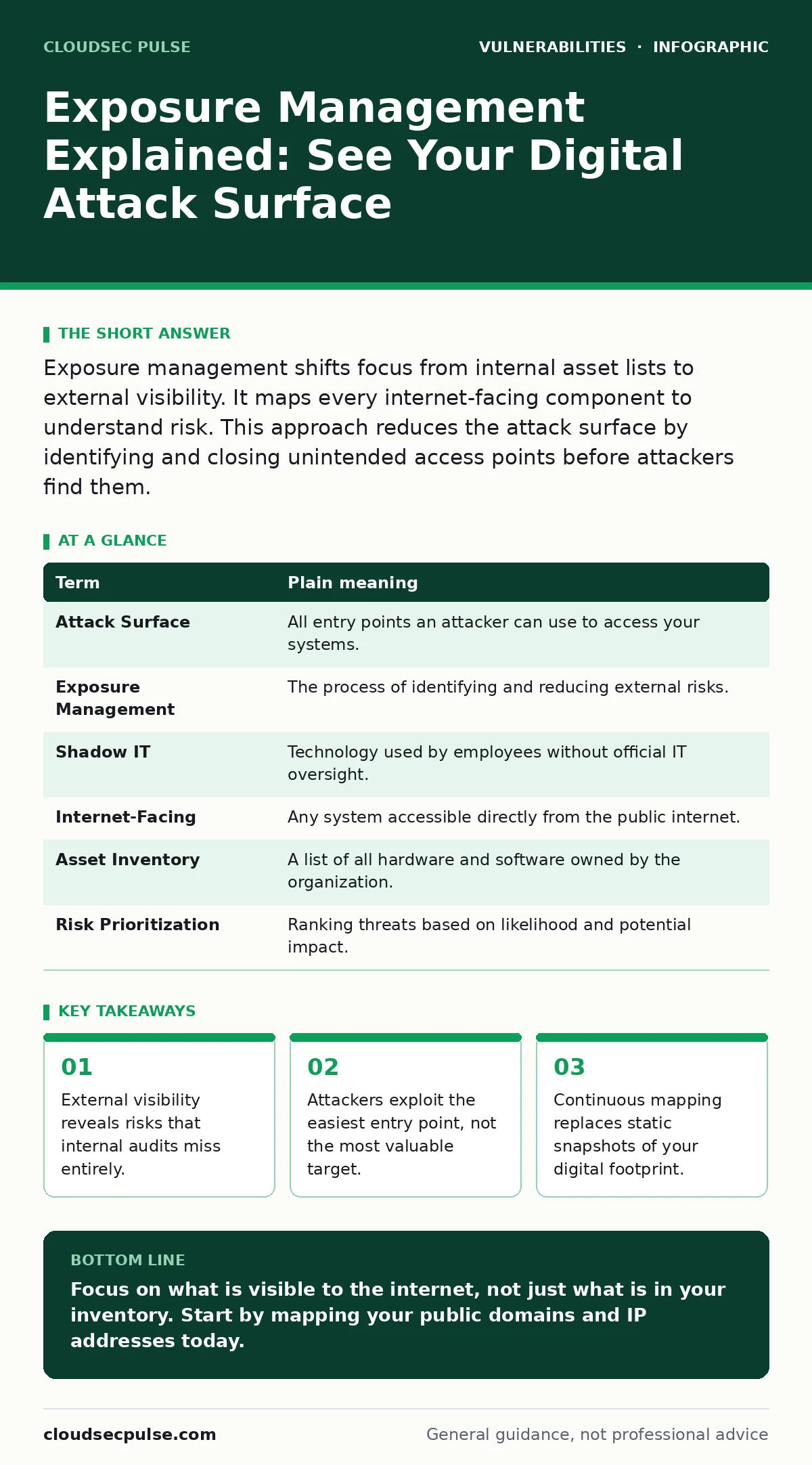
Exposure management shifts focus from internal asset lists to external visibility. It maps every internet-facing component to understand risk. This approach reduces the attack surface by identifying and closing unintended access points before attackers find them.
The Open Window Analogy
Imagine your business is a house. You lock the front door and install a security system for the interior. This is traditional security. You focus on what is inside the walls. However, you leave a basement window unlocked because you forgot it exists. A burglar does not need to pick the front door lock. They simply step through the open window.
Exposure management is the practice of walking around the outside of your house at night. You look for every window, door, and vent that connects the inside to the outside. You do not care about the furniture inside. You care only about the openings an intruder could use.
Defining the Attack Surface
Your attack surface is the sum of all points where an unauthorized user can try to enter your data environment. This includes web servers, email gateways, and forgotten test environments. It also includes shadow IT, which is software or services used by employees without IT approval.
Many teams focus on protecting the data inside the vault. They neglect the doors leading to the vault. Exposure management forces you to define the perimeter first. If you cannot see the door, you cannot secure it. This shift in perspective changes how you allocate security resources.
| Term | Plain meaning |
|---|---|
| Attack Surface | All entry points an attacker can use to access your systems. |
| Exposure Management | The process of identifying and reducing external risks. |
| Shadow IT | Technology used by employees without official IT oversight. |
| Internet-Facing | Any system accessible directly from the public internet. |
| Asset Inventory | A list of all hardware and software owned by the organization. |
| Risk Prioritization | Ranking threats based on likelihood and potential impact. |
The Hidden Cost of Internal Focus
Traditional security relies on an IT asset inventory. This list tells you what you bought and where it sits in your data center. It does not tell you what the internet can see. A server might be decommissioned but still have a public IP address. It might be off your inventory but still reachable by attackers.
This gap creates a false sense of security. You believe you are protected because your internal tools show no vulnerabilities. Meanwhile, an old application server sits exposed because it was never added to the monitoring list. This is where exposure management provides value. It starts from the outside and works inward.
Mapping What Is Visible
To map your exposure, you need to adopt an external view. You must scan your own digital footprint as an attacker would. This reveals subdomains, old APIs, and misconfigured cloud storage buckets. These are often the result of hard-coded credentials left in public code repositories.
This process is distinct from vulnerability scanning. Vulnerability scanning checks known weaknesses in software. Exposure management checks whether that software is even reachable. You can have a patch available for a flaw, but if the system is not exposed, the flaw is irrelevant. Conversely, a minor flaw on an internet-facing system is a critical risk.
Prioritizing Real Risks
Not all exposures are equal. An internal printer is less risky than a public-facing login page. You must prioritize based on context. This is where concepts like the EPSS score help. It provides a probability that a vulnerability will be exploited in the wild.
Combining exposure data with exploit probability allows for better vulnerability prioritization. You stop chasing every minor flaw. You focus on the flaws that are both exposed and likely to be attacked. This saves time and reduces alert fatigue. It turns a massive list of issues into a manageable action plan.
See also: Cloud Security Architecture in Cloud Computing: How to Build It Right · Attack Surface Reduction: Practical Steps for Small Business Security
Integrating With Other Controls
Exposure management does not replace other security practices. It complements them. For example, broken access control is a common issue where users can access data they should not see. Exposure management identifies the endpoints where this control might be failing.
It also highlights IoT device vulnerabilities. Smart cameras and sensors often have weak default settings. If these devices are internet-facing, they become easy entry points. By mapping these devices, you can isolate them or replace them. This reduces the overall risk without needing to secure every single device perfectly.
First Practical Steps
You do not need expensive tools to start. You need a process. Follow these steps to begin your exposure management journey.
- List your public assets. Gather all domain names, IP addresses, and cloud service endpoints. Use standard DNS lookups to find subdomains. This creates your baseline map.
- Identify unintended exposure. Check for services that should be internal but are public. Look for test environments or development servers that were never taken offline.
- Establish a review cycle. Internet exposure changes daily. New services are launched, and old ones are forgotten. Schedule monthly reviews of your external map to catch drift.
The Long-Term View
Exposure management is a continuous discipline. It requires constant monitoring and adjustment. As you mature, you will integrate this data with your broader security operations. You will link external exposure to internal vulnerability data.
This integration helps you understand the full picture. You see not just what is broken, but what is reachable. You move from reactive patching to proactive risk reduction. This approach builds a more resilient security posture over time. It ensures that your defenses match your actual digital footprint.
Key takeaways
- External visibility reveals risks that internal audits miss entirely.
- Attackers exploit the easiest entry point, not the most valuable target.
- Continuous mapping replaces static snapshots of your digital footprint.
Focus on what is visible to the internet, not just what is in your inventory. Start by mapping your public domains and IP addresses today.
Frequently asked questions
How is exposure management different from vulnerability scanning?
Vulnerability scanning checks for known software flaws. Exposure management identifies which systems are accessible from the internet.
Do I need special software to start?
No. You can begin with manual DNS lookups and public domain tools. Automation helps later.
How often should I review my exposure?
Monthly reviews are a good start. Critical infrastructure may require weekly checks.
What is the biggest risk of ignoring exposure management?
You may secure your internal network while leaving easy entry points open to attackers.
How this guide was produced: written by the CloudSec Pulse editorial team with AI assistance, checked against the public references listed below, and reviewed when the facts change. See our editorial policy or report an error.