Do I Need Cyber Insurance for My Business? Coverage Gaps Explained
Insurance covers financial loss after a breach but does not prevent the initial intrusion or restore your reputation with clients.

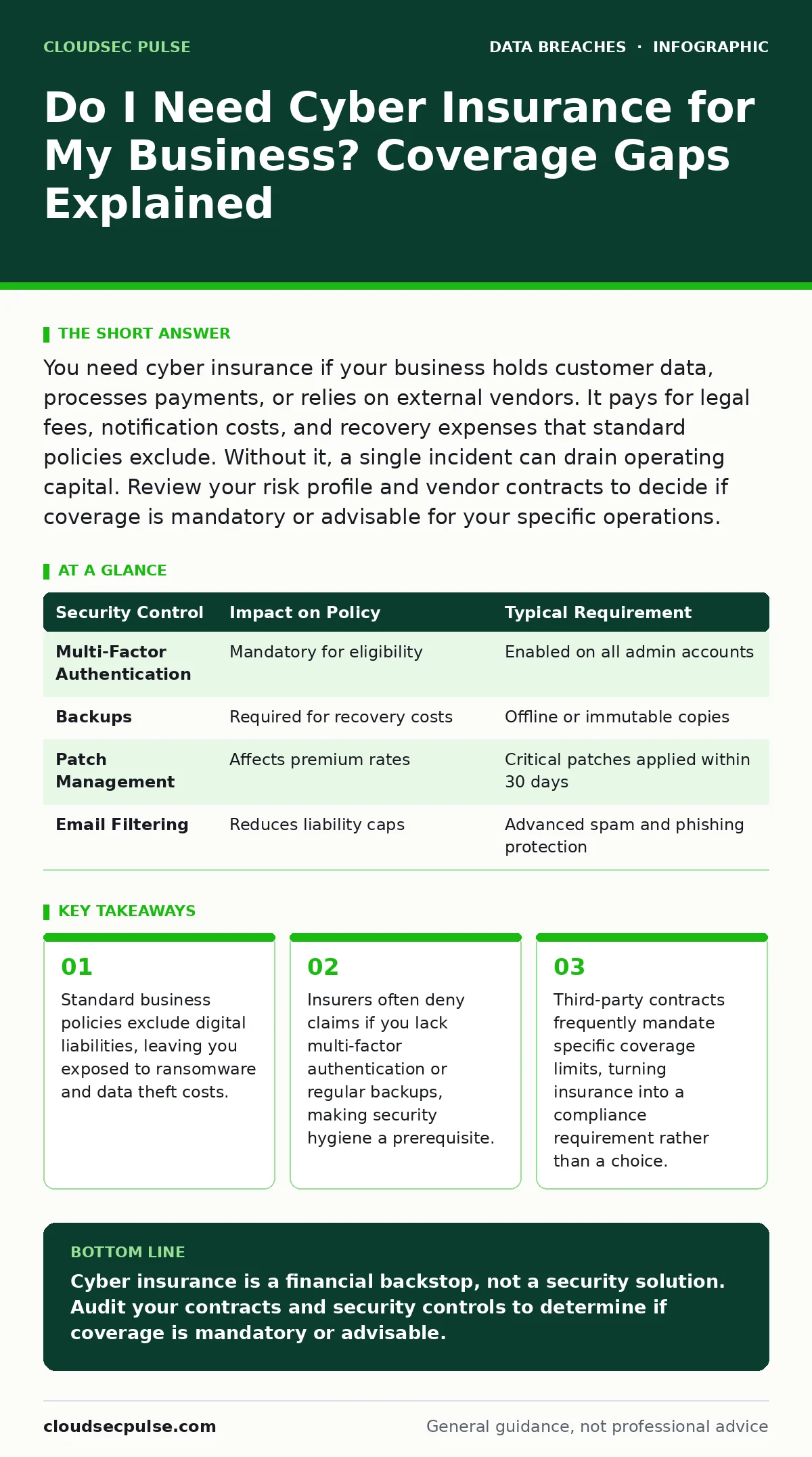
You need cyber insurance if your business holds customer data, processes payments, or relies on external vendors. It pays for legal fees, notification costs, and recovery expenses that standard policies exclude. Without it, a single incident can drain operating capital. Review your risk profile and vendor contracts to decide if coverage is mandatory or advisable for your specific operations.
Do I need cyber insurance for my business?
You need cyber insurance if your business holds digital records that, if lost or stolen, would cause financial harm or legal liability. Standard general liability policies explicitly exclude cyber incidents, meaning a data breach leaves you fully responsible for all associated costs. If you process credit cards, store employee records, or host client files, the financial risk of an outage or theft is significant. Insurance transfers that unpredictable risk to a carrier, ensuring your business can survive the immediate financial shock of a major incident.
What does cyber insurance actually cover?
Cyber insurance covers first-party costs you incur and third-party liabilities you owe others. First-party coverage pays for forensic investigators to find the breach, IT consultants to restore systems, and crisis management firms to handle public relations. It also covers business interruption losses when your systems are down. Third-party coverage pays for lawsuits from customers or partners whose data was exposed, as well as regulatory fines where insurable by law. Understanding this split helps you calculate the total potential loss of a single incident.
What are the common exclusions in policies?
Policies exclude losses that result from negligence, prior known vulnerabilities, or acts of war. A major exclusion is ransomware payments themselves; many carriers will not reimburse the ransom, only the negotiation fees. Another frequent exclusion is damage to intellectual property or brand value, which are difficult to quantify. Insurers also exclude coverage if you failed to apply critical security patches within a reasonable timeframe. These exclusions mean you must maintain active security practices to keep the policy valid and effective during a crisis.
How does security posture affect eligibility?
Your security posture determines whether you can buy insurance and what your premium costs. Insurers require evidence of multi-factor authentication, endpoint detection, and regular backups before issuing a policy. If you lack these controls, you may be denied coverage entirely or face significantly higher deductibles. This creates a hidden cost: you must invest in security infrastructure just to qualify for financial protection. The insurance market effectively forces small businesses to adopt enterprise-grade security standards, regardless of their size or budget constraints.
| Security Control | Impact on Policy | Typical Requirement |
|---|---|---|
| Multi-Factor Authentication | Mandatory for eligibility | Enabled on all admin accounts |
| Backups | Required for recovery costs | Offline or immutable copies |
| Patch Management | Affects premium rates | Critical patches applied within 30 days |
| Email Filtering | Reduces liability caps | Advanced spam and phishing protection |
Do vendor contracts require cyber insurance?
Many vendor contracts require you to carry cyber insurance as a condition of doing business. If you store their data or access their networks, they shift the risk of a breach to you. Failing to provide a certificate of insurance can void your contract or prevent you from bidding on new work. This contractual obligation makes insurance a baseline requirement for B2B relationships, not just a safety net.
See also: Exposure Management Explained: See Your Digital Attack Surface · Defense in Depth: How Layered Security Stops Breaches
How does data minimization reduce risk?
Data minimization reduces the amount of information you collect, store, and process, thereby lowering your potential liability. If you do not hold sensitive data, attackers have less incentive to target you, and a breach results in fewer regulatory penalties. By deleting unnecessary customer records and limiting access to only those who need it, you shrink your attack surface. This practice complements insurance by reducing the severity of potential claims, which can lead to lower premiums and fewer exclusions in your policy terms.
What happens during the claims process?
The claims process begins with immediate notification to your insurer, often within 24 hours of discovering an incident. You must preserve all evidence and avoid deleting logs or resetting passwords before investigators arrive. The insurer will appoint a forensic team to determine the scope and cause of the breach. They will then review your security logs to ensure you complied with policy requirements. If you failed to follow prescribed security measures, the insurer may deny the claim, leaving you to pay all recovery costs out of pocket.
How do third-party breaches impact coverage?
Third-party breaches occur when a vendor or partner suffers an incident that exposes your data. Your cyber insurance may cover the costs of responding to the breach, but it often excludes liability for the vendor's negligence. You may need to pursue legal action against the vendor to recover losses, which is slow and uncertain. This gap highlights the importance of vetting your partners' security practices. Even if you are secure, a weak link in your supply chain can trigger a crisis that your insurance only partially addresses.
Key takeaways
- Standard business policies exclude digital liabilities, leaving you exposed to ransomware and data theft costs.
- Insurers often deny claims if you lack multi-factor authentication or regular backups, making security hygiene a prerequisite.
- Third-party contracts frequently mandate specific coverage limits, turning insurance into a compliance requirement rather than a choice.
Cyber insurance is a financial backstop, not a security solution. Audit your contracts and security controls to determine if coverage is mandatory or advisable.
Frequently asked questions
Does cyber insurance cover ransomware attacks?
Most policies cover the costs of recovery, negotiation, and business interruption, but they rarely cover the ransom payment itself due to legal and ethical concerns.
How much cyber insurance do I need?
Coverage limits depend on your data volume, revenue, and contract requirements. Start by reviewing vendor mandates and estimating the cost of a full system restoration.
Can I get cyber insurance if I have no security tools?
Unlikely. Insurers require basic controls like multi-factor authentication and backups. Implementing these is a prerequisite for obtaining coverage.
Does cyber insurance replace a security team?
No. Insurance pays for damages after an incident. It does not prevent attacks. You still need active security measures to protect your systems and data.
How this guide was produced: written by the CloudSec Pulse editorial team with AI assistance, checked against the public references listed below, and reviewed when the facts change. See our editorial policy or report an error.