Hacktivism Explained: Defining Motives, Methods, and Mitigation
Hacktivism blends political protest with technical intrusion, creating attacks that are difficult to distinguish from standard cybercrime without behavioral context.

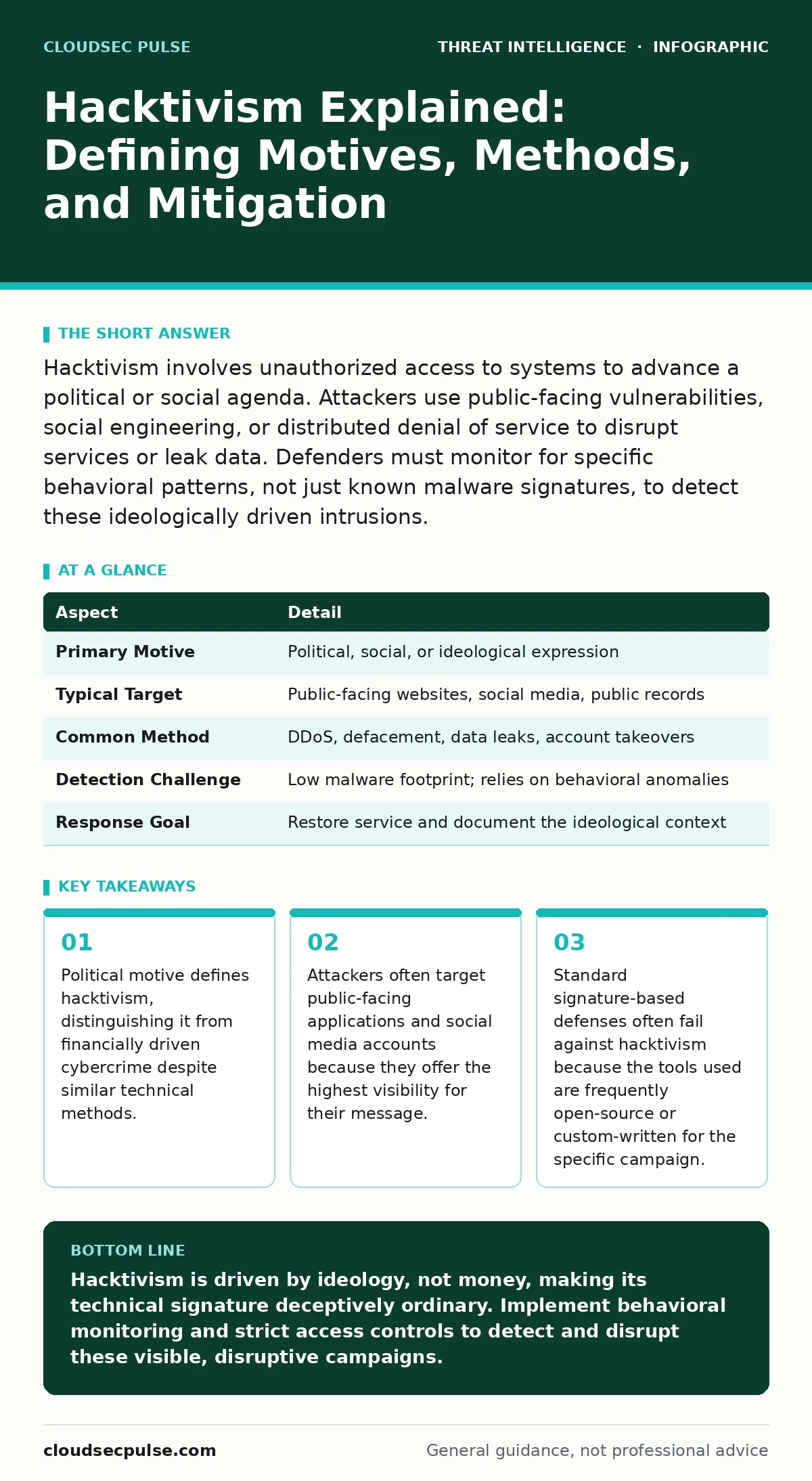
Hacktivism involves unauthorized access to systems to advance a political or social agenda. Attackers use public-facing vulnerabilities, social engineering, or distributed denial of service to disrupt services or leak data. Defenders must monitor for specific behavioral patterns, not just known malware signatures, to detect these ideologically driven intrusions.
The Digital Town Square Analogy
Imagine a physical protest where demonstrators block a main road to force drivers to notice their banners. Hacktivism operates on the same principle. The goal is not to steal cash from a vault, but to disrupt normal operations so that the public and the media pay attention to a cause. The attacker uses the victim’s infrastructure as a billboard.
The disruption itself is the message. If a website goes offline, the attacker wants you to ask why it happened. This intent shapes every technical decision they make. They prioritize speed, visibility, and simplicity over stealth or complex data exfiltration.
| Aspect | Detail |
|---|---|
| Primary Motive | Political, social, or ideological expression |
| Typical Target | Public-facing websites, social media, public records |
| Common Method | DDoS, defacement, data leaks, account takeovers |
| Detection Challenge | Low malware footprint; relies on behavioral anomalies |
| Response Goal | Restore service and document the ideological context |
Defining the Ideological Intruder
Hacktivism is unauthorized access to computer systems with the intent to further a political or social agenda. Unlike cybercriminals who seek profit, hacktivists seek attention. This distinction matters because their tools and timelines differ. They may use brute force attacks, which try many password combinations, against a login portal because the goal is immediate disruption, not long-term persistence.
They often operate in loose groups rather than hierarchical organizations. This structure makes them unpredictable. One group may focus on leaking emails, while another focuses on taking down servers. The lack of a central command means tactics shift rapidly based on the current news cycle.
The definition is not always clean. Some groups start with political goals and shift to financial motives when they find vulnerable systems. Conversely, financially motivated attackers may pose as hacktivists to distract defenders. You must look at the evidence, not just the claim, to determine the true intent.
How Hacktivists Execute Their Campaigns
Attackers rarely write custom malware for hacktivism. Instead, they use readily available tools. This makes their technical footprint look like a standard intrusion. They often begin with reconnaissance, scanning for open ports or outdated software versions. Once they find an entry point, they move quickly to make their mark.
Defacement is a common first step. This involves replacing the homepage of a website with a political statement. It is visually obvious and forces immediate response. More sophisticated groups may exfiltrate data and publish it online. This creates pressure on the victim to change their stance or apologize.
Distributed denial of service attacks are also frequent. These flood a server with traffic, making it unavailable to legitimate users. Hacktivists often recruit volunteers to participate in these floods using simple scripts. The sheer volume of traffic overwhelms the target’s bandwidth.
Who Bears the Brunt
Hacktivists choose targets based on visibility and symbolic value. Large corporations, government agencies, and news outlets are frequent victims. These entities have the public profiles that amplify the attacker’s message. Small businesses are less common targets but can be chosen if they are associated with a larger controversial entity.
The impact is rarely financial loss from stolen funds. It is reputational damage and operational downtime. If your service is unavailable, you lose trust. If your data is leaked, you lose privacy for your users. The psychological pressure on staff to respond correctly adds to the cost.
Supply chain partners can also suffer. If a major vendor is targeted, their smaller partners may face collateral damage. Attackers may seek out less secure partners to breach the larger organization indirectly. This means your security posture affects your partners, and vice versa.
Common Mistakes in Detection
Many defenders assume that hacktivism looks different from other attacks. This is false. The initial intrusion often uses the same techniques as a criminal hacker. Relying solely on reputation lists or known malicious IP addresses will miss most hacktivist activity. The attackers often use clean infrastructure or compromised legitimate accounts.
Another error is focusing only on the endpoint. Hacktivists may not install malware on a server. They might simply upload a defacement page or copy files to a cloud storage bucket. If your monitoring does not include file integrity monitoring, which checks for unauthorized changes to critical files, you will miss the event.
Defenders also fail to monitor social media for early warnings. Hacktivists often announce their intentions publicly before striking. Ignoring these signals means you are reacting rather than preparing. You must integrate threat intelligence from open sources with your technical logs.
See also: Tactical Threat Intelligence: Practical Indicators for Small Business Defense · What Is the Difference Between STIX and TAXII? A Structural Breakdown
Reducing the Risk
You cannot stop someone from wanting to protest against you. You can, however, make it harder for them to succeed. Start by hardening your public-facing applications. Patch known vulnerabilities in web servers and content management systems regularly. Use web application firewalls, which filter HTTP traffic, to block common attack patterns.
Limit access to administrative interfaces. Use multi-factor authentication, which requires two forms of verification, for all privileged accounts. This prevents attackers from using stolen passwords to gain control. Even if they guess the password, they cannot log in without the second factor.
Monitor your network traffic for unusual spikes. Sudden increases in traffic volume can indicate a distributed denial of service attempt. Have an incident response plan that includes steps for mitigating traffic floods. This might involve redirecting traffic through a scrubbing service that filters out malicious requests.
The Role of Behavioral Analytics
Traditional security tools look for known bad signatures. Hacktivists often use unknown or modified tools. You need to look for anomalies in behavior. User and entity behavior analytics can help here. This technology establishes a baseline for normal activity and flags deviations.
For example, if a database is accessed at an unusual time or from an unusual location, the system can alert you. This does not prove an attack, but it warrants investigation. Combine this with network traffic analysis to see where the data is going. If large amounts of data are being sent to an external server, it may indicate data exfiltration.
Do not rely on this alone. False positives in threat detection are common with behavioral tools. A legitimate employee working late might trigger an alert. You need a process to investigate alerts quickly. This is where incident triage skills become valuable. You must be able to distinguish between a glitch and a genuine threat.
Key takeaways
- Political motive defines hacktivism, distinguishing it from financially driven cybercrime despite similar technical methods.
- Attackers often target public-facing applications and social media accounts because they offer the highest visibility for their message.
- Standard signature-based defenses often fail against hacktivism because the tools used are frequently open-source or custom-written for the specific campaign.
- Effective detection relies on identifying changes in user behavior and access patterns rather than waiting for a confirmed breach notification.
Hacktivism is driven by ideology, not money, making its technical signature deceptively ordinary. Implement behavioral monitoring and strict access controls to detect and disrupt these visible, disruptive campaigns.
Frequently asked questions
Is hacktivism illegal?
Yes, unauthorized access to computer systems is illegal in most jurisdictions, regardless of the attacker's political or social motives. The intent does not negate the criminal act of intrusion.
Can hacktivists steal money?
While their primary goal is not financial gain, they may facilitate theft by disrupting security systems or leaking credentials that others can exploit for profit. The initial motive is ideological, but the secondary effects can be financial.
How do I report a hacktivist attack?
Document all evidence, including logs and screenshots of defacement. Contact your local law enforcement cybercrime unit and relevant industry reporting bodies. Do not engage with the attackers or negotiate publicly, as this amplifies their message.
Does firewalls stop hacktivism?
Firewalls can block some automated attacks, but they cannot stop determined attackers who use legitimate credentials or exploit application-level vulnerabilities. You need layered security, including application firewalls and behavioral monitoring, for effective protection.
How this guide was produced: written by the CloudSec Pulse editorial team with AI assistance, checked against the public references listed below, and reviewed when the facts change. See our editorial policy or report an error.