Difference Between RCE and Command Injection: Clear Definitions
Command injection is a specific mechanism that leads to remote code execution, which is the broader outcome an attacker seeks to achieve.

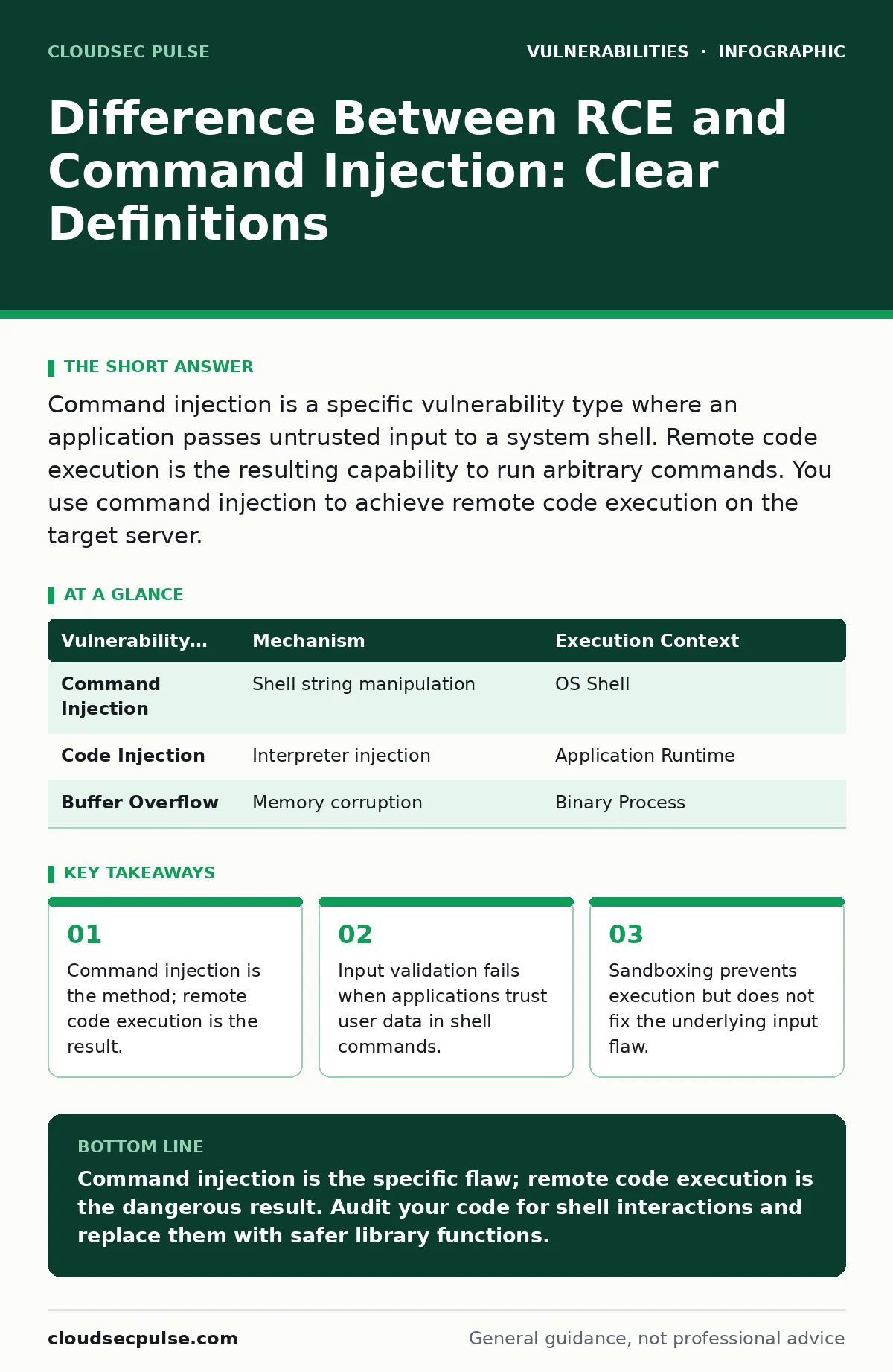
Command injection is a specific vulnerability type where an application passes untrusted input to a system shell. Remote code execution is the resulting capability to run arbitrary commands. You use command injection to achieve remote code execution on the target server.
What is the difference between rce and command injection?
Remote code execution is the capability to run arbitrary instructions on a target system. Command injection is the specific vulnerability that allows an attacker to insert those instructions into a system call. The distinction matters because not all remote code execution vulnerabilities are command injection flaws. Some stem from buffer overflows, while others arise from insecure deserialization. Command injection specifically requires the application to invoke a system shell.
How does command injection actually work?
An application accepts user input and passes it directly to a system shell function. The shell interprets the input as part of a command line. An attacker inserts special characters that separate the original command from their own malicious payload. This payload executes with the same privileges as the application process. The server performs the requested action and then runs the attacker's code.
The mechanism relies on the application failing to sanitize input before handing it to the operating system. This is different from server-side request forgery, where the server makes HTTP requests. Here, the server executes local binary commands. Understanding this flow helps you identify where the trust boundary breaks.
When is remote code execution not command injection?
Remote code execution occurs whenever an attacker runs code on a target. Command injection is only one path to this outcome. Other paths include exploiting memory corruption bugs in compiled software. These bugs allow an attacker to overwrite memory and redirect execution flow. Another path is exploiting flawed logic in a web framework. This might allow an attacker to upload a script file that the server then executes.
| Vulnerability Type | Mechanism | Execution Context |
|---|---|---|
| Command Injection | Shell string manipulation | OS Shell |
| Code Injection | Interpreter injection | Application Runtime |
| Buffer Overflow | Memory corruption | Binary Process |
Why do developers miss these flaws?
Developers often assume that input validation at the front end is sufficient. They forget that any input can be bypassed or modified by an attacker using network tools. They also rely on allowlists that are incomplete or poorly maintained. A common mistake is escaping special characters incorrectly. Different shells use different escape sequences. If the application uses a generic escape function, it may fail to block all dangerous characters.
What are the hidden costs of fixing this?
Fixing command injection often requires changing how an application interacts with the operating system. This is not just a code patch. It may require replacing system calls with safer library functions. This change can break existing functionality that relied on specific shell behaviors. Testing must verify that new logic handles all edge cases correctly. The cost includes development time, testing effort, and potential downtime during deployment.
How do you prioritize this vulnerability?
Use the EPSS score to understand the likelihood of exploitation. A high score indicates that exploit code is available and being used in the wild. Combine this with the severity rating from the National Vulnerability Database. This database provides standard identifiers for known flaws. Prioritize patches for vulnerabilities that allow remote code execution without authentication. These flaws offer the highest reward to attackers with the least effort.
What about NoSQL injection and command injection?
NoSQL injection targets database queries rather than system shells. It allows an attacker to manipulate data retrieval or modification. Command injection targets the operating system directly. The consequences differ significantly. NoSQL injection might expose sensitive data or alter records. Command injection can lead to full system compromise. Both require input validation, but the defense mechanisms differ. You must understand the specific technology stack to apply the right fix.
How does output encoding help here?
Output encoding is primarily a defense against cross-site scripting. It ensures that data rendered in a browser is treated as text, not code. It does not prevent command injection. Command injection happens on the server side, before any output is sent to the browser. You cannot encode your way out of a shell command execution flaw. You must prevent the input from reaching the shell in the first place.
What should you do next?
Audit your code for any calls that pass user input to system shells. Replace these calls with direct library functions where possible. If you must use a shell, use a strict allowlist of permitted inputs. Never pass raw user input to a shell command. Implement strict input validation that rejects anything not explicitly allowed. This approach reduces the attack surface significantly.
Key takeaways
- Command injection is the method; remote code execution is the result.
- Input validation fails when applications trust user data in shell commands.
- Sandboxing prevents execution but does not fix the underlying input flaw.
Command injection is the specific flaw; remote code execution is the dangerous result. Audit your code for shell interactions and replace them with safer library functions.
Frequently asked questions
Is command injection the same as SQL injection?
No. SQL injection manipulates database queries, while command injection manipulates operating system shell commands.
Can a firewall prevent command injection?
A web application firewall can block known attack patterns, but it cannot prevent novel or obfuscated payloads.
Does using a microservice architecture fix this?
No. Microservices isolate components, but each service can still suffer from command injection flaws internally.
Should I worry about hard-coded credentials?
Yes. Hard-coded credentials often accompany other flaws and can exacerbate the impact of a successful injection.
How this guide was produced: written by the CloudSec Pulse editorial team with AI assistance, checked against the public references listed below, and reviewed when the facts change. See our editorial policy or report an error.