Use EPSS Scores to Prioritize Vulnerability Patching
EPSS predicts exploitation likelihood, letting you ignore low-risk CVEs and focus on threats that attackers actually use in the wild.

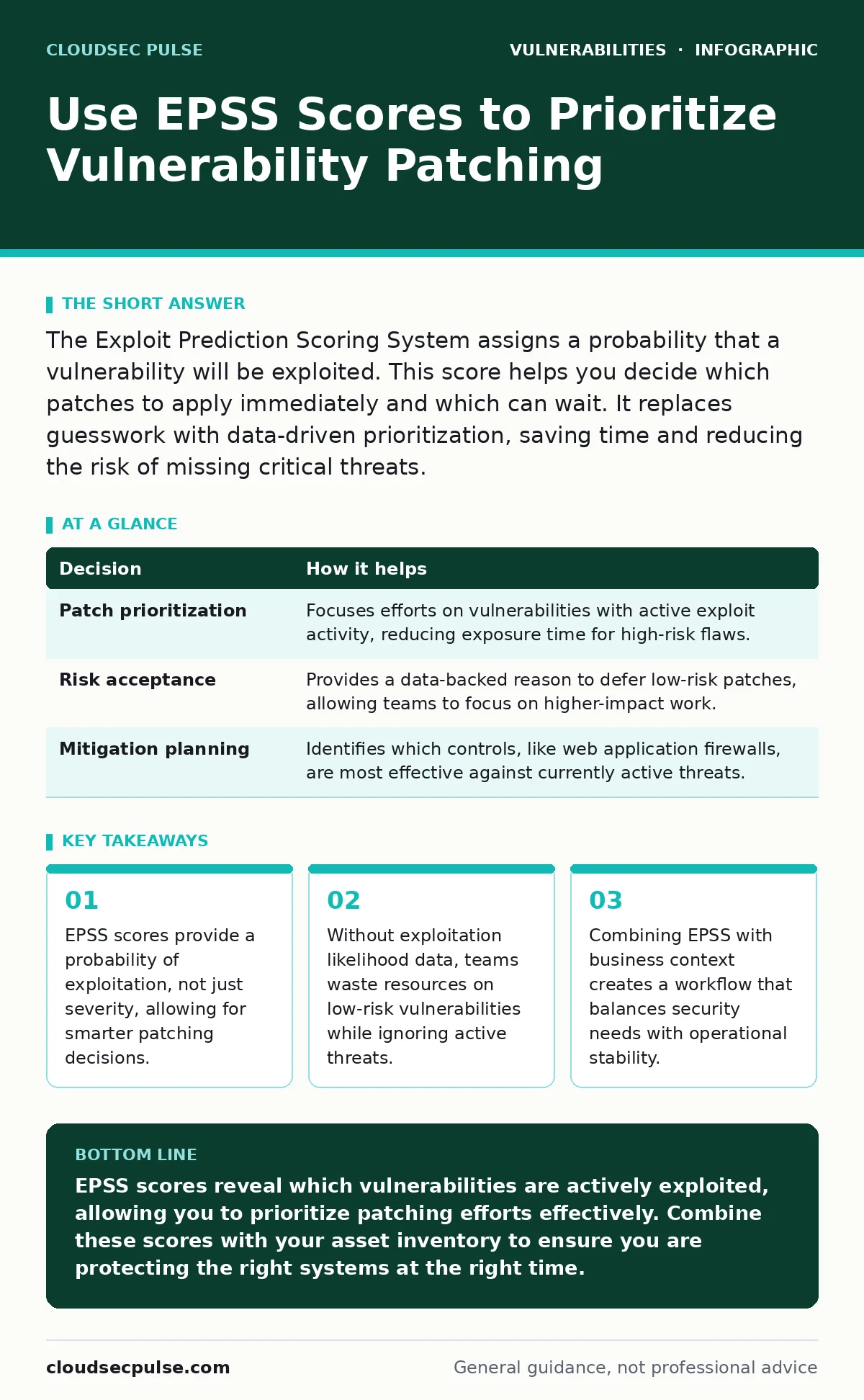
The Exploit Prediction Scoring System assigns a probability that a vulnerability will be exploited. This score helps you decide which patches to apply immediately and which can wait. It replaces guesswork with data-driven prioritization, saving time and reducing the risk of missing critical threats.
The Problem with Severity Alone
Traditional vulnerability management relies heavily on severity ratings. These ratings, often derived from the Common Vulnerability Scoring System, measure the theoretical maximum impact of a flaw. They assume an attacker has all the necessary conditions to exploit the code. This assumption fails in practice.
Most vulnerabilities are never exploited in the wild. Thousands of new flaws are published monthly, but attackers only target a tiny fraction. If you patch everything in order of severity, you spread your resources thin. You might spend weeks fixing a high-severity bug that no one uses, while a lower-severity bug with active exploit kits remains open.
Understanding the Exploit Probability Model
The Exploit Prediction Scoring System provides a daily probability that a vulnerability will be exploited in the wild. It uses machine learning models trained on historical data. The model looks at factors like the number of days since disclosure, the presence of proof-of-concept code, and the technical complexity of the exploit.
This score is independent of the severity rating. A low-severity bug might have a high EPSS score if it is easy to exploit and widely used. Conversely, a high-severity bug might have a low score if it requires specific conditions that rarely occur. This distinction allows you to separate theoretical risk from actual threat.
Decisions Informed by Exploitation Data
Knowing the likelihood of exploitation changes how you allocate engineering hours. You can defer patching for vulnerabilities with low scores, knowing they are unlikely to be targeted soon. This is not negligence; it is risk management. You still track these items, but they do not demand immediate attention.
For high-score vulnerabilities, you move fast. You prioritize these for immediate patching or mitigation. This approach ensures that your limited security budget addresses the threats that matter most. It shifts the focus from "fixing everything" to "fixing what gets us hacked."
| Decision | How it helps |
|---|---|
| Patch prioritization | Focuses efforts on vulnerabilities with active exploit activity, reducing exposure time for high-risk flaws. |
| Risk acceptance | Provides a data-backed reason to defer low-risk patches, allowing teams to focus on higher-impact work. |
| Mitigation planning | Identifies which controls, like web application firewalls, are most effective against currently active threats. |
What Goes Wrong Without It
Imagine a team that patches only by severity. They spend three weeks remediating a complex, high-severity memory corruption bug. During that time, a simpler, medium-severity authentication bypass is exploited. Attackers use this bypass to gain access. The high-severity bug was never used.
This scenario highlights the hidden cost of ignoring exploitation likelihood. You create a false sense of security by closing high-severity doors that no one is trying to enter. Meanwhile, the unlocked side door lets attackers in. This misalignment leads to breaches that feel preventable in hindsight.
How Teams Use EPSS in Practice
Effective teams integrate EPSS scores into their workflow. They pull scores from public sources and combine them with their own asset data. This combination is vital. A vulnerability on an internet-facing server is more dangerous than the same vulnerability on an isolated internal machine.
Teams set thresholds for action. These thresholds can be adjusted based on the sensitivity of the data. Critical customer data might lower the threshold for action.
See also: Vulnerability Prioritization: Fix What Actually Breaks Your Business · National Vulnerability Database Explained: How NVD Works for You
The Hidden Cost of Context Blindness
EPSS scores are global. They do not know your specific environment. They cannot tell you if a vulnerable server is decommissioned or if a patch will break your application. This is the trade-off for automation. You gain speed but lose nuance.
To compensate, you must combine EPSS with a detailed IT asset inventory. You need to know what you have and where it is. Without this context, you might patch a system that is no longer in use or fail to patch a critical one because it is misclassified. The score tells you the risk of the flaw; your inventory tells you the risk to your business.
Integrating with Existing Frameworks
EPSS fits into broader security frameworks. It works alongside other data sources to create a complete picture. For instance, you might use the National Vulnerability Database to find the initial details of a flaw. Then you use EPSS to decide if you need to act on it today.
This layered approach prevents alert fatigue. You are not drowning in notifications. You are receiving actionable intelligence. You can also cross-reference EPSS with other risk factors. For example, if a vulnerability involves broken access control, you might prioritize it even if the EPSS score is moderate, because access control issues are often targeted in specific attack vectors.
Moving Beyond Reactive Patching
The goal is not just to patch faster. It is to patch smarter. By using EPSS, you shift from a reactive stance to a predictive one. You anticipate which flaws will be weaponized. This allows you to plan maintenance windows and resource allocation more effectively.
You also gain confidence in your risk decisions. When a stakeholder asks why you did not patch a specific flaw, you can show the data. You can explain that the exploitation probability was low and that your resources were better spent elsewhere. This transparency builds trust and aligns security with business objectives.
Key takeaways
- EPSS scores provide a probability of exploitation, not just severity, allowing for smarter patching decisions.
- Without exploitation likelihood data, teams waste resources on low-risk vulnerabilities while ignoring active threats.
- Combining EPSS with business context creates a workflow that balances security needs with operational stability.
EPSS scores reveal which vulnerabilities are actively exploited, allowing you to prioritize patching efforts effectively. Combine these scores with your asset inventory to ensure you are protecting the right systems at the right time.
Frequently asked questions
Does a low EPSS score mean a vulnerability is safe to ignore?
No. It means exploitation is unlikely in the near term. You should still monitor it and patch it eventually, especially if the asset is critical or exposed.
How often are EPSS scores updated?
Scores are updated daily. This frequency ensures that new data on exploit activity is reflected quickly, allowing for responsive prioritization.
Can EPSS scores replace severity ratings?
No. They complement them. Severity tells you the impact if exploited; EPSS tells you the likelihood of exploitation. Both are needed for a complete risk assessment.
Is EPSS data free to access?
Yes. The core data and models are open and publicly available. You can integrate this data into your tools without licensing fees, though some commercial platforms may offer enhanced features.
How this guide was produced: written by the CloudSec Pulse editorial team with AI assistance, checked against the public references listed below, and reviewed when the facts change. See our editorial policy or report an error.