National Vulnerability Database Explained: How NVD Works for You
The NVD acts as a universal translator for security flaws, turning raw technical data into a standardized format that automated tools can process and prioritize.

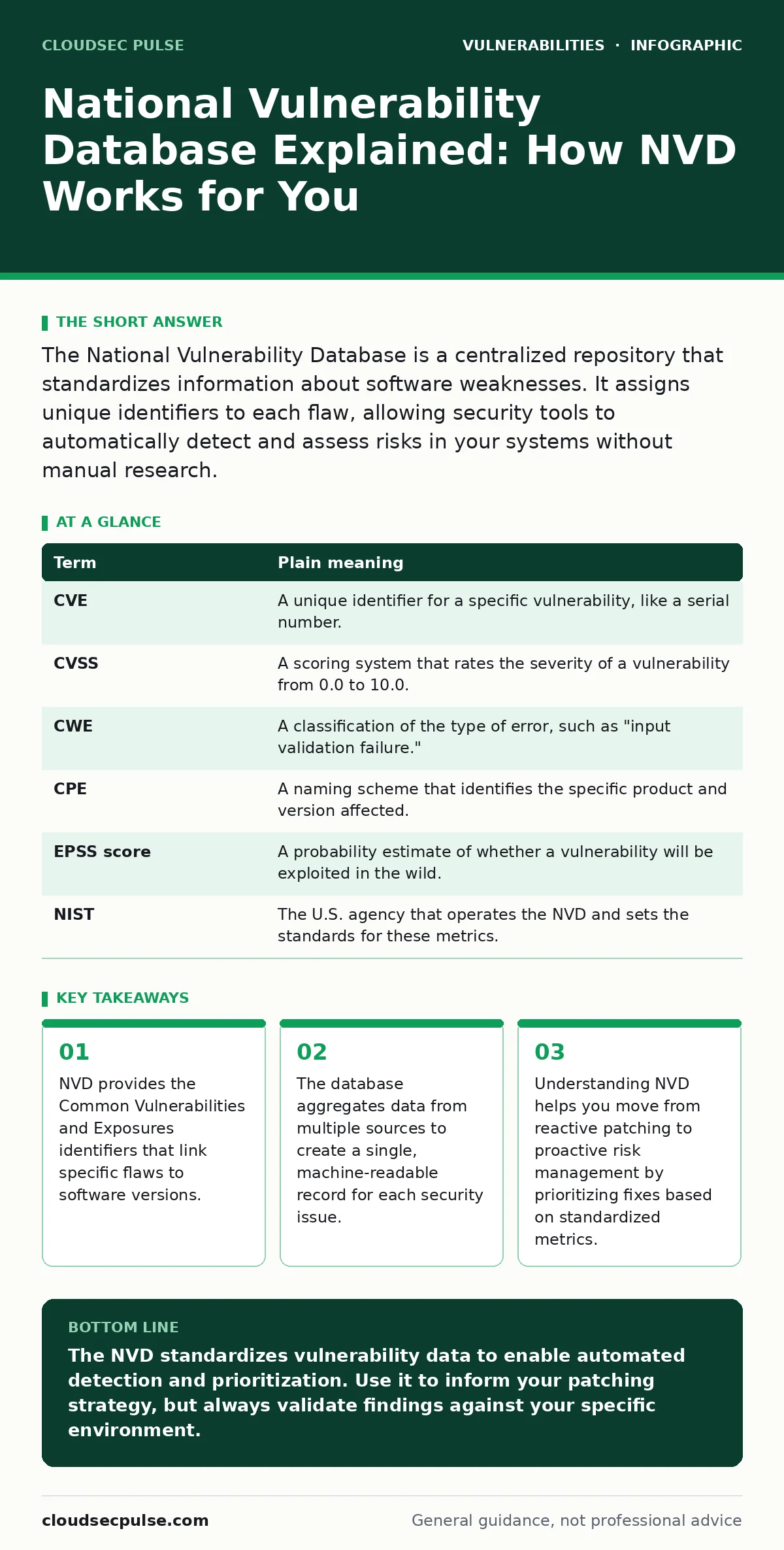
The National Vulnerability Database is a centralized repository that standardizes information about software weaknesses. It assigns unique identifiers to each flaw, allowing security tools to automatically detect and assess risks in your systems without manual research.
The Library of Broken Things
Imagine a massive library where every book represents a specific flaw in a piece of software. Without a catalog, finding the right book to understand a problem would take forever. The National Vulnerability Database (NVD) acts as that catalog. It does not fix the books or rewrite the stories. Instead, it organizes every known weakness into a consistent format. This structure allows your security tools to look up a problem quickly. You do not need to read every page of every manual. The NVD gives you the table of contents for global software risks.
Standardizing the Chaos
Software vendors report flaws in different ways. One company might describe a memory error as a "buffer overflow," while another calls it a "stack corruption." The NVD normalizes these descriptions. It ensures that a flaw in a web server is described the same way whether it comes from a Linux distributor or a proprietary vendor. This standardization is the foundation of automated security. Without it, your tools would not know that two different reports describe the same underlying problem. You would waste time investigating duplicate alerts. The NVD eliminates this noise by providing a single source of truth.
The Language of Flaws
To communicate effectively, the security industry uses a shared vocabulary. The NVD relies on several key terms that appear in every record. Understanding these terms helps you interpret the data correctly.
| Term | Plain meaning |
|---|---|
| CVE | A unique identifier for a specific vulnerability, like a serial number. |
| CVSS | A scoring system that rates the severity of a vulnerability from 0.0 to 10.0. |
| CWE | A classification of the type of error, such as "input validation failure." |
| CPE | A naming scheme that identifies the specific product and version affected. |
| EPSS score | A probability estimate of whether a vulnerability will be exploited in the wild. |
| NIST | The U.S. agency that operates the NVD and sets the standards for these metrics. |
Why Identifiers Matter
The Common Vulnerabilities and Exposures (CVE) ID is the most critical part of the NVD. It is a string like CVE-2023-12345. This ID links the NVD record to vendor advisories, patch notes, and security tools. When you see a CVE in a log file, you can look it up in the NVD to get the full story. Without this unique ID, you would have to guess which patch fixes which problem. This guessing game is dangerous. It leads to missed patches and false confidence. The CVE ID ensures you are patching the exact flaw your scanner detected.
Beyond the Severity Score
Many people look only at the CVSS score to decide what to fix. A score of 9.8 looks worse than a 5.0. This is a common mistake. The CVSS score measures the theoretical impact of a flaw. It does not tell you if anyone is actually trying to exploit it. This is where the EPSS score becomes valuable. It estimates the likelihood of exploitation. A high CVSS score with a low EPSS score might be a theoretical risk that no one is attacking. Conversely, a moderate CVSS score with a high EPSS score is a target right now. Combining these two metrics allows for better vulnerability prioritization. You can focus your limited resources on the threats that matter most.
See also: Use EPSS Scores to Prioritize Vulnerability Patching · Vulnerability Prioritization: Fix What Actually Breaks Your Business
Hidden Costs of Data
The NVD is free, but using it effectively has hidden costs. The data is raw and technical. Interpreting it requires skill. If you rely solely on the NVD without context, you may miss critical details. For example, a vulnerability might be listed as critical, but it might require specific conditions to trigger. These conditions might not exist in your environment. This is where exposure management comes into play. You must map the NVD data to your actual assets. If you do not have the affected software, the vulnerability does not matter to you. Ignoring this context leads to alert fatigue. You will spend time patching systems that are not at risk.
Integrating with Your Workflow
The NVD is designed for machines, not just humans. Your vulnerability scanners and patch management tools pull data directly from it. This automation is powerful but requires configuration. You must ensure your tools are using the latest NVD feeds. Outdated feeds lead to missed detections. You should also review how your tools interpret CVSS scores. Some tools apply custom rules that override the NVD data. This can be helpful if it aligns with your risk tolerance. It can also be harmful if it hides critical flaws. Regularly audit your tool configurations. Ensure they reflect your actual security posture.
Common Points of Confusion
Many users confuse the NVD with the CVE list. The CVE list is just the index of identifiers. The NVD is the detailed record for each identifier. Another confusion is the source of the data. The NVD aggregates data from many sources. It does not conduct its own research. It relies on vendors and researchers to report flaws. This means there can be a delay between a flaw being discovered and it appearing in the NVD. During this window, you may have no official record of the risk. This is why keeping your systems updated is vital. You cannot wait for the NVD to confirm a threat. You must trust your vendor advisories.
Try This Now
- Find a recent CVE ID from your security scanner logs.
- Look up that CVE in the NVD to read the full description and CVSS vector.
- Check the EPSS score for that CVE to assess the likelihood of exploitation.
Moving Forward
The NVD is a powerful tool for understanding software risks. It provides a standardized way to identify and prioritize vulnerabilities. However, it is only one part of your security strategy. You must combine NVD data with your own context. This includes your asset inventory and your risk tolerance. By doing so, you turn raw data into actionable intelligence. You stop reacting to every alert. You start managing your risk proactively. This approach saves time and reduces exposure. It makes your security program more efficient and effective.
Key takeaways
- NVD provides the Common Vulnerabilities and Exposures identifiers that link specific flaws to software versions.
- The database aggregates data from multiple sources to create a single, machine-readable record for each security issue.
- Understanding NVD helps you move from reactive patching to proactive risk management by prioritizing fixes based on standardized metrics.
The NVD standardizes vulnerability data to enable automated detection and prioritization. Use it to inform your patching strategy, but always validate findings against your specific environment.
Frequently asked questions
Is the NVD only for U.S. government agencies?
No, the NVD is freely available to anyone. It is a public resource used by organizations worldwide.
How often is the NVD updated?
It is updated continuously as new vulnerabilities are discovered and reported.
Can I trust the CVSS scores in the NVD?
You can trust them as a baseline, but you should adjust for your specific context and risk tolerance.
Does the NVD tell me how to fix a vulnerability?
No, it describes the flaw. You must consult vendor advisories or security guides for remediation steps.
How this guide was produced: written by the CloudSec Pulse editorial team with AI assistance, checked against the public references listed below, and reviewed when the facts change. See our editorial policy or report an error.