NoSQL Injection Mistakes That Expose Your Database
NoSQL injection occurs when application code treats user input as database queries, allowing attackers to bypass authentication and extract sensitive records without traditional SQL syntax.

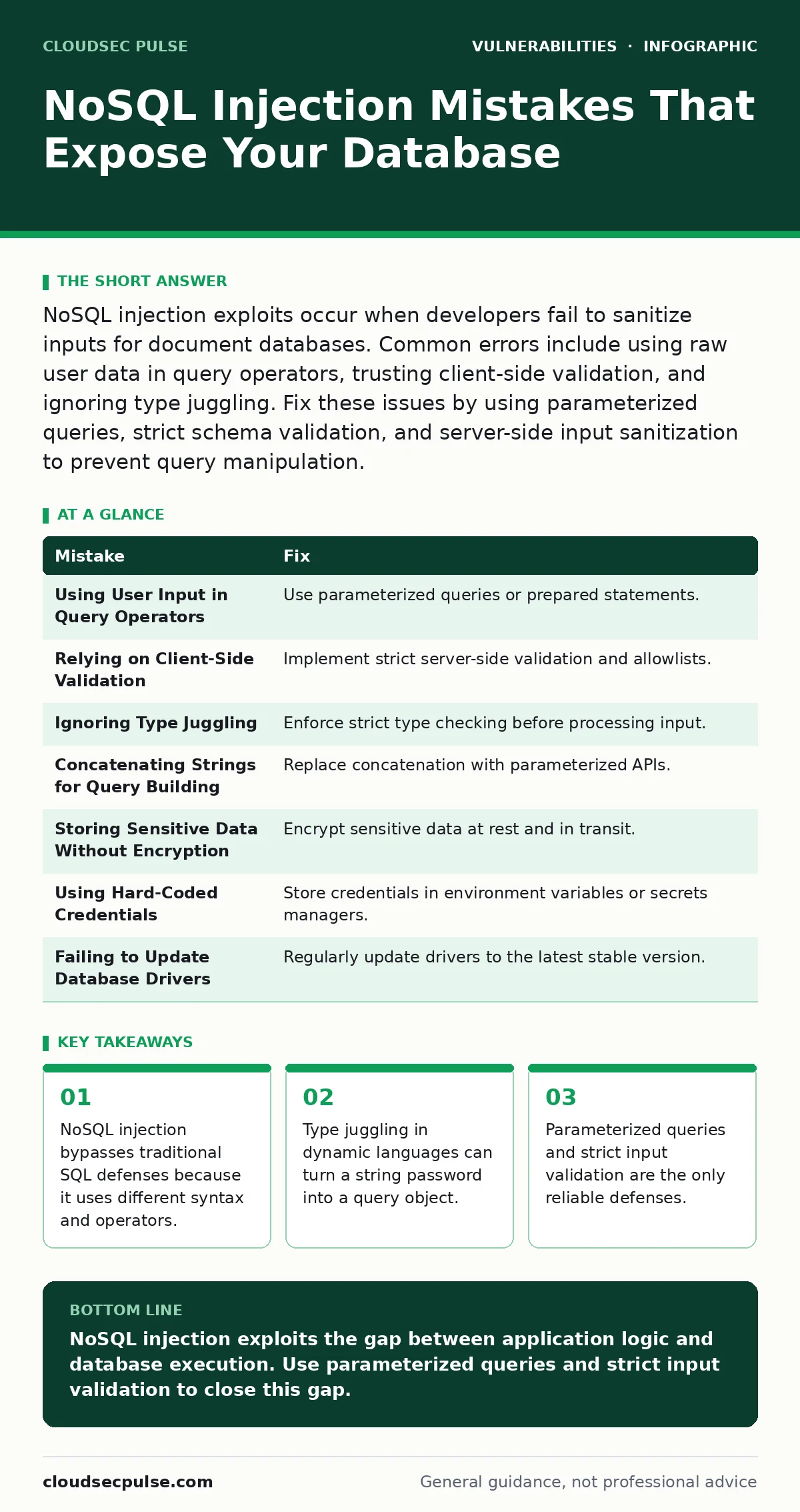
NoSQL injection exploits occur when developers fail to sanitize inputs for document databases. Common errors include using raw user data in query operators, trusting client-side validation, and ignoring type juggling. Fix these issues by using parameterized queries, strict schema validation, and server-side input sanitization to prevent query manipulation.
Mistake 1: Using User Input in Query Operators
Directly inserting user-supplied values into database query objects creates an immediate execution path for attackers. Many NoSQL drivers allow passing objects as query parameters. When you merge user input into these objects without inspection, the database interprets the input as a command rather than data. This bypasses standard string escaping mechanisms.
Why it hurts:
An attacker can inject logical operators like $ne (not equal) or $gt (greater than). A simple login form becomes a backdoor. If the application passes the password field directly into the query, an attacker sends a JSON object instead of a string. The database evaluates the object as a condition that is always true, granting access without a valid password.
The fix:
Use parameterized queries or prepared statements provided by your database driver. These methods separate the query structure from the data values. The driver sends the query template and the data separately to the database server. The server treats the data as literal values, not executable code. This prevents any injected operators from being interpreted as logic.
Mistake 2: Relying on Client-Side Validation
Many developers assume that front-end checks are sufficient for security. JavaScript libraries can validate that a username contains only letters or that an email address has the correct format. However, network traffic between the browser and the server is not secure by default. Tools can intercept and modify this traffic before it reaches your application.
Why it hurts:
An attacker bypasses front-end rules by sending raw HTTP requests. They can modify the payload to include special characters or JSON structures that the client-side code never saw. The server receives this malicious data and processes it. If the server trusts this input implicitly, it executes the injection. This mistake ignores the fundamental principle that user input is always untrusted.
The fix:
Implement strict server-side validation for every input field. Define allowed characters, length limits, and data types explicitly. Reject any input that does not match the expected schema before it reaches the database layer. Use a allowlist approach rather than a blocklist. Allowlists specify exactly what is permitted, reducing the attack surface significantly.
Mistake 3: Ignoring Type Juggling in Dynamic Languages
Dynamic languages like JavaScript or Python do not enforce strict data types at compile time. A variable can change from a string to an object during execution. This flexibility is useful for development but dangerous for security. If your code expects a string password but receives an object, the language may coerce the types automatically.
Why it hurts:
An attacker exploits this coercion by sending a structured object that matches the internal query format. The application code might treat this object as a valid password string during comparison. The database driver then uses this object as a query condition. This results in a successful authentication bypass. The error is subtle because the code appears to handle strings correctly in standard tests.
The fix:
Enforce strict type checking before processing any input. Verify that the data type matches the expected type exactly. If a field expects a string, reject any input that is an object, array, or number. Use static typing tools or runtime type guards to catch these mismatches early. This prevents the language from implicitly converting malicious objects into executable queries.
Mistake 4: Concatenating Strings for Query Building
Building database queries by concatenating strings is a legacy practice that persists in many codebases. Developers often append user input directly to a query string or object. This method is convenient but highly dangerous. It mixes code and data, making it impossible for the system to distinguish between them.
Why it hurts:
An attacker injects query syntax into the concatenated string. The resulting query contains both the original intent and the attacker’s commands. The database executes the combined query. This can lead to data exfiltration, modification, or deletion. The damage depends on the permissions of the database user. Even read-only access can leak sensitive information through crafted queries.
The fix:
Replace string concatenation with parameterized APIs. Most modern NoSQL drivers provide methods that accept query templates and separate parameters. Use these methods exclusively. If your driver lacks this feature, consider switching to a driver that supports it. Avoid manual string building for any query that includes user input. This ensures that data is always treated as data.
Mistake 5: Storing Sensitive Data Without Encryption
NoSQL databases often store data in a flexible schema. This flexibility encourages storing large amounts of data without strict structure. Developers sometimes store sensitive information like passwords or personal details in plain text. They assume that the database access controls are sufficient. This assumption fails when injection vulnerabilities exist.
Why it hurts:
If an attacker successfully injects a query, they can read any data the application has access to. Plain text data is immediately usable. The attacker does not need to crack hashes or bypass additional layers. They simply extract the data. This amplifies the impact of a successful injection. The breach becomes catastrophic because the stolen data requires no further processing to exploit.
The fix:
Encrypt sensitive data at rest and in transit. Use strong encryption algorithms and manage keys securely. Never store passwords in plain text. Use established hashing functions with unique salts. This adds a layer of protection even if an attacker accesses the database directly. Encryption limits the damage of a successful injection by rendering the stolen data unreadable.
See also: Difference Between RCE and Command Injection: Clear Definitions
Mistake 6: Using Hard-Coded Credentials in Applications
Some applications store database credentials directly in the source code. This practice simplifies deployment but creates a severe security risk. If the source code is exposed, the credentials are exposed too. Attackers can use these credentials to access the database directly, bypassing application logic entirely.
Why it hurts:
An attacker with access to the codebase can connect to the database directly. They do not need to exploit an injection vulnerability. They simply use the hard-coded credentials to log in. This grants them full access to the data. The injection vulnerability becomes irrelevant because the attacker has a direct path. This mistake undermines all other security measures.
The fix:
Store credentials in environment variables or a secure secrets manager. Never commit credentials to version control. Use a service that rotates credentials automatically. This limits the window of exposure if a secret is compromised. Ensure that only authorized services can access the secrets manager. This practice separates configuration from code, reducing the risk of accidental exposure.
Mistake 7: Failing to Update Database Drivers
Database drivers are software components that translate application requests into database commands. Like any software, they contain bugs and vulnerabilities. Developers often install a driver once and forget to update it. This leaves known vulnerabilities unpatched. Attackers exploit these known flaws to gain access.
Why it hurts:
An outdated driver may have a known injection vulnerability that has been fixed in newer versions. Attackers scan for these specific versions. They craft payloads that exploit the known flaw. The application executes the malicious query. The damage occurs because the driver fails to sanitize the input correctly. This is a preventable risk that many organizations ignore.
The fix:
Regularly update database drivers to the latest stable version. Subscribe to security advisories for your specific driver. Test updates in a staging environment before deploying to production. Automate the update process where possible. This ensures that you benefit from security patches quickly. Keeping dependencies current is a fundamental security hygiene practice.
| Mistake | Fix |
|---|---|
| Using User Input in Query Operators | Use parameterized queries or prepared statements. |
| Relying on Client-Side Validation | Implement strict server-side validation and allowlists. |
| Ignoring Type Juggling | Enforce strict type checking before processing input. |
| Concatenating Strings for Query Building | Replace concatenation with parameterized APIs. |
| Storing Sensitive Data Without Encryption | Encrypt sensitive data at rest and in transit. |
| Using Hard-Coded Credentials | Store credentials in environment variables or secrets managers. |
| Failing to Update Database Drivers | Regularly update drivers to the latest stable version. |
Key takeaways
- NoSQL injection bypasses traditional SQL defenses because it uses different syntax and operators.
- Type juggling in dynamic languages can turn a string password into a query object.
- Parameterized queries and strict input validation are the only reliable defenses.
NoSQL injection exploits the gap between application logic and database execution. Use parameterized queries and strict input validation to close this gap.
Frequently asked questions
Is NoSQL injection the same as SQL injection?
No, they target different database types and use different syntax. NoSQL injection exploits document-based queries, while SQL injection targets relational database commands.
Can a WAF prevent NoSQL injection?
A Web Application Firewall can block some known patterns but cannot stop all variants. Server-side validation and parameterized queries are more reliable defenses.
Do I need to change my database to fix this?
No, the fix is in your application code. Changing how you construct queries and validate input addresses the root cause without altering the database.
How do I test for NoSQL injection?
Use automated scanning tools designed for NoSQL and manual testing with crafted payloads. Ensure you have permission to test before running scans.
How this guide was produced: written by the CloudSec Pulse editorial team with AI assistance, checked against the public references listed below, and reviewed when the facts change. See our editorial policy or report an error.