Formjacking Myths: Why Standard Security Fails Against Script Attacks
Formjacking bypasses traditional perimeter defenses by operating within the browser, rendering standard firewall rules and server-side filters largely ineffective against data theft.

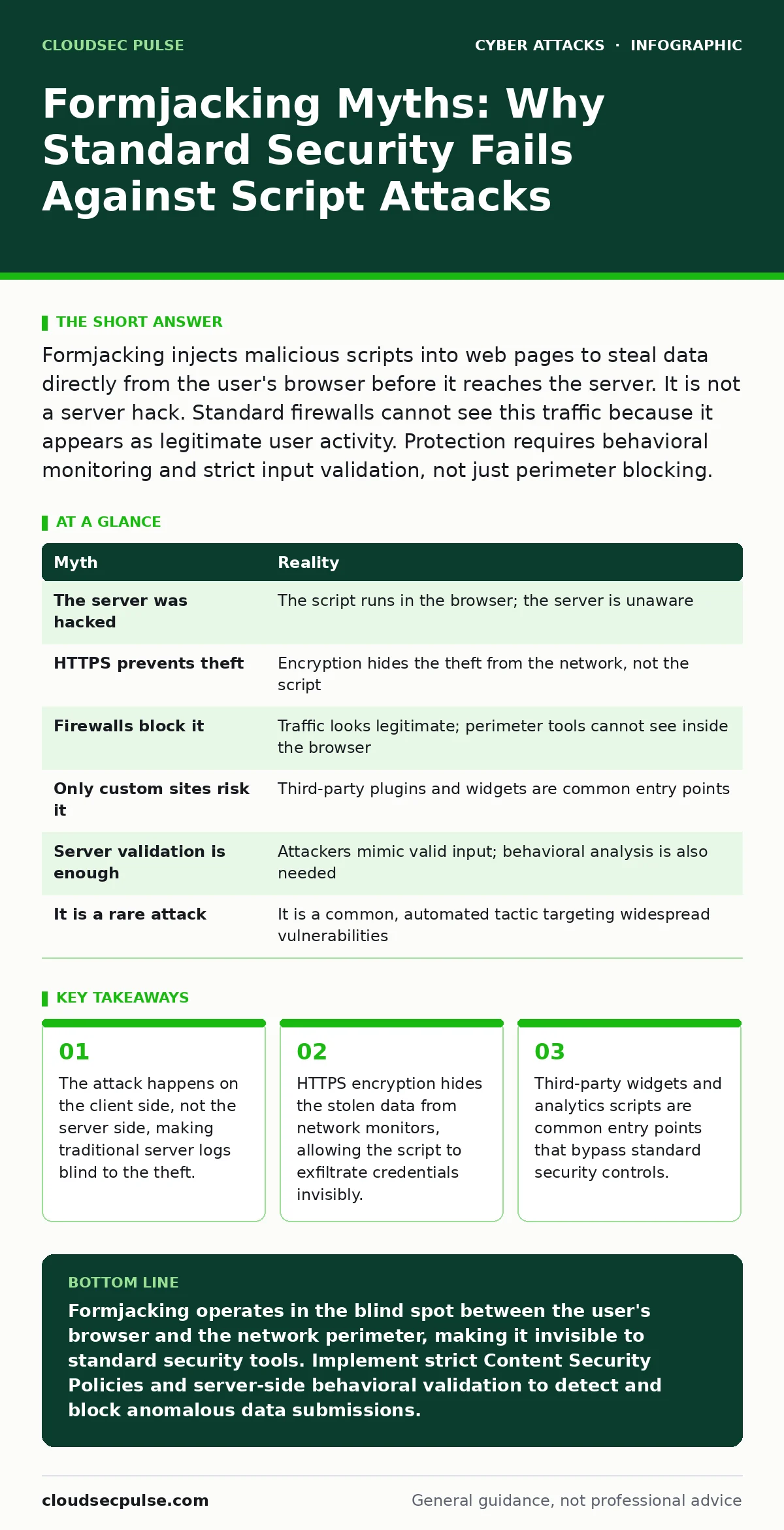
Formjacking injects malicious scripts into web pages to steal data directly from the user's browser before it reaches the server. It is not a server hack. Standard firewalls cannot see this traffic because it appears as legitimate user activity. Protection requires behavioral monitoring and strict input validation, not just perimeter blocking.
Myth: The server was hacked to steal the data
Reality: The server is rarely the initial point of compromise in a formjacking attack. The attacker does not break into the database or the web application server to extract records. Instead, they inject a malicious JavaScript snippet into the web page itself. This script runs in the visitor's browser. When you type your credit card number, the script captures it from the form field before you click submit.
It then sends that data to an attacker-controlled server while simultaneously allowing the legitimate transaction to proceed. The server receives the data twice: once from the script and once from the actual form submission. To the server, the transaction looks normal. The theft occurs entirely in the client environment. This distinction matters because securing the server perimeter does not stop the script from running in the user's browser.
Myth: HTTPS encryption prevents data theft
Reality: Encryption protects data in transit from network eavesdroppers, but it does not protect you from the application you are visiting. HTTPS ensures that no one on the network can read the packet containing your credit card number. However, the malicious script runs inside the browser, which has already decrypted the page to render it. The script reads the input fields directly from the Document Object Model, the structure the browser uses to display the page.
It captures the plaintext data before encryption even begins. The script then sends the stolen data to the attacker, often over a separate encrypted channel. You see the padlock icon and assume safety, but the padlock only guarantees that the connection to the website is secure, not that the website is safe. The trust model assumes the content is benign, which is the flaw the attacker exploits.
Myth: Firewalls block formjacking attacks
Reality: Traditional firewalls inspect network traffic for known malicious signatures or suspicious patterns. Formjacking traffic often looks like normal web browsing. The exfiltration of stolen data usually happens via HTTP POST requests to domains that appear legitimate or are newly registered to look benign. The firewall sees a user sending data to a web server and allows it.
It cannot distinguish between a user legitimately submitting a checkout form and a script stealing that form's data. The attack vector is application-layer logic, not network-layer intrusion. Relying on perimeter defenses gives a false sense of security. You need application-level controls that understand the expected structure of data submissions. A firewall is a gatekeeper for the network, not a monitor for browser behavior.
Myth: Only custom-built websites are at risk
Reality: Many organizations believe that using major e-commerce platforms or content management systems makes them immune. These platforms often rely on third-party plugins, analytics tools, and payment widgets. An attacker can compromise one of these third-party services and inject the malicious script into all sites that use it. This is a supply chain attack.
The main website code is clean, but the widget it loads contains the theft mechanism. Even if you do not write code, you import code. If you import a tracking pixel or a social media button from a compromised source, you inherit the risk. The attack surface extends to every external script your page loads. Trusting a platform does not mean trusting its entire ecosystem of dependencies.
Myth: Input validation on the server is enough
Reality: Server-side validation is necessary, but it is often insufficient on its own. Attackers design their scripts to mimic legitimate user input. They send the stolen data in the exact format the server expects. If the server only checks that a credit card number is 16 digits, it passes. The server cannot tell if the number came from your keyboard or from a hidden script. However, strict validation can catch anomalies.
For example, if the server receives data from a form field that should be read-only, or if it receives data faster than a human could type, it can flag the request. You must combine server-side validation with behavioral analysis. Check the timing of submissions and the source of the data. If the data arrives without the expected user interaction signals, reject it. This adds friction to the attack but does not eliminate it.
See also: Host Header Injection Response: Recovery and Prevention Steps · Server-Side Template Injection Prevention Checklist for Secure Code
Myth: Formjacking is a rare, sophisticated attack
Reality: Formjacking is a common tactic because it is low-effort and high-reward. Attackers do not need to develop complex malware. They need to find one vulnerability in a widely used plugin or a small business website. Once injected, the script can harvest thousands of records automatically. The barrier to entry is low. The impact is immediate.
Small businesses are frequent targets because they often lack the resources for advanced application security testing. They may use outdated plugins or ignore security patches. The myth of rarity leads to complacency. You assume you are not a big enough target, but the automated nature of the attack means you are targeted by volume, not by selection. The cost of a breach far exceeds the cost of basic hygiene.
| Myth | Reality |
|---|---|
| The server was hacked | The script runs in the browser; the server is unaware |
| HTTPS prevents theft | Encryption hides the theft from the network, not the script |
| Firewalls block it | Traffic looks legitimate; perimeter tools cannot see inside the browser |
| Only custom sites risk it | Third-party plugins and widgets are common entry points |
| Server validation is enough | Attackers mimic valid input; behavioral analysis is also needed |
| It is a rare attack | It is a common, automated tactic targeting widespread vulnerabilities |
Key takeaways
- The attack happens on the client side, not the server side, making traditional server logs blind to the theft.
- HTTPS encryption hides the stolen data from network monitors, allowing the script to exfiltrate credentials invisibly.
- Third-party widgets and analytics scripts are common entry points that bypass standard security controls.
- Server-side validation is the only reliable method to catch data anomalies caused by injected form fields.
Formjacking operates in the blind spot between the user's browser and the network perimeter, making it invisible to standard security tools. Implement strict Content Security Policies and server-side behavioral validation to detect and block anomalous data submissions.
Frequently asked questions
How can I tell if my website has formjacking malware?
You likely cannot tell from server logs alone. Look for unexpected outbound network connections from your web pages or audit your JavaScript files for obfuscated code that does not match your known libraries.
Does using a payment gateway API prevent formjacking?
It reduces risk significantly. If the payment gateway handles the input via a secure iframe, the merchant's site never sees the card data, so there is nothing for a script to steal from the main page.
What is the difference between formjacking and phishing?
Phishing tricks you into visiting a fake site. Formjacking infects a legitimate site you trust. In formjacking, the URL is correct, but the content has been altered to include a theft script.
Should I block all third-party scripts?
Blocking all third-party scripts may break functionality. Instead, use a strict Content Security Policy to allow scripts only from verified, trusted domains and monitor for changes to those domains.
How this guide was produced: written by the CloudSec Pulse editorial team with AI assistance, checked against the public references listed below, and reviewed when the facts change. See our editorial policy or report an error.