Why Firewalls Are Important: The Hidden Costs of Missing Filters
Firewalls block automated scans that precede attacks, reducing the noise that hides real intrusions and lowering your operational costs.

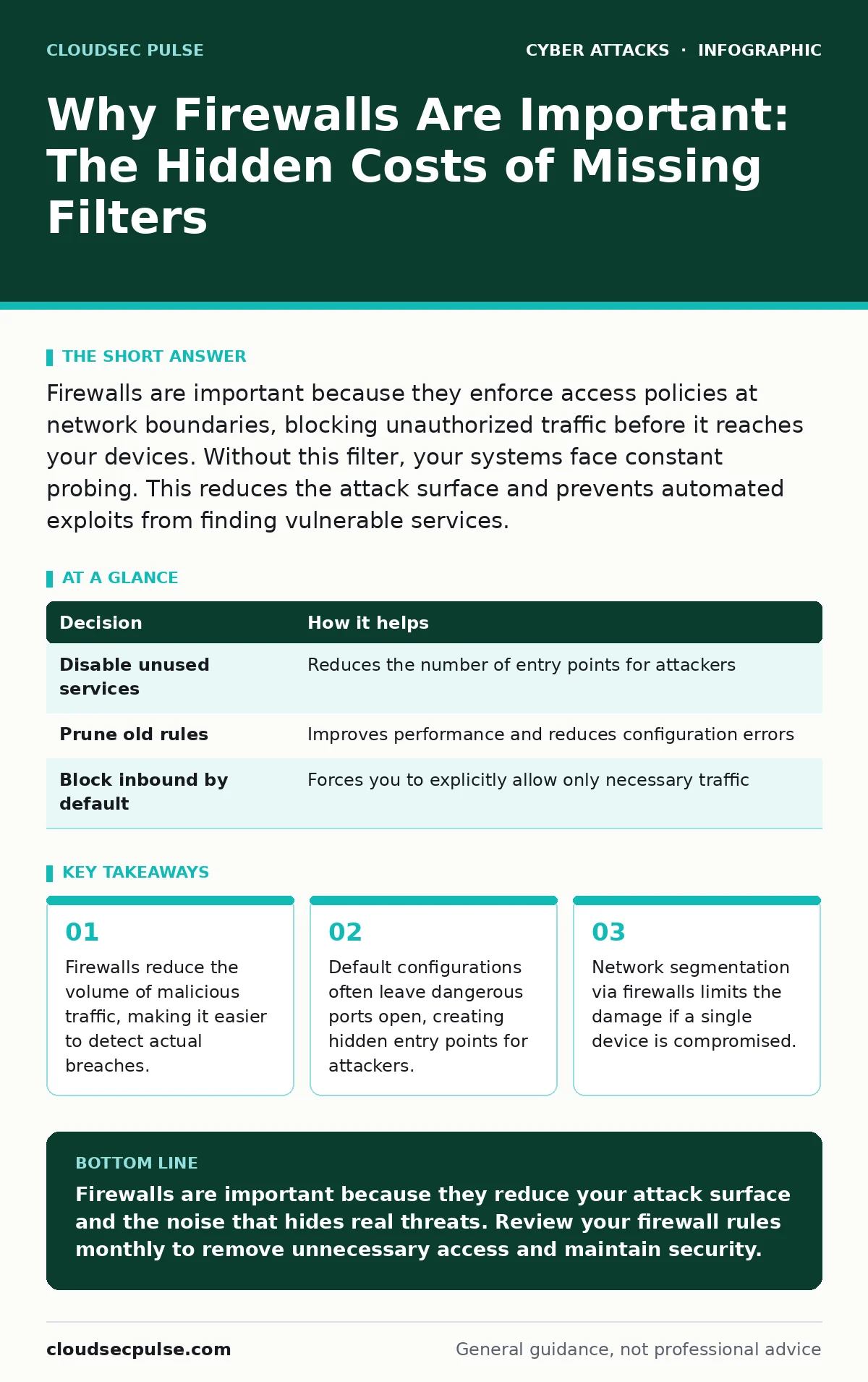
Firewalls are important because they enforce access policies at network boundaries, blocking unauthorized traffic before it reaches your devices. Without this filter, your systems face constant probing. This reduces the attack surface and prevents automated exploits from finding vulnerable services.
Why Firewalls Are Important for Your Business
You type "why firewalls are important" because you need to justify the cost and complexity of network security. The answer lies in traffic control. A firewall is a network security device that monitors and filters incoming and outgoing network traffic based on predetermined security rules. It acts as a barrier between your trusted internal network and untrusted external networks, such as the internet. Without this barrier, every service you run is exposed to the world. This exposure invites automated scanning tools that look for vulnerabilities. The firewall blocks these scans, reducing the noise that security teams must analyze.
The primary reason firewalls matter is attack surface reduction. Every open port is a potential entry point. By closing unused ports, you remove opportunities for attackers. This is not just about stopping hackers; it is about reducing the workload on your security systems. Less malicious traffic means your logs are cleaner. Cleaner logs make it easier to spot real threats. This efficiency saves time and money in the long run.
How Default Configurations Fail You
Most organizations fail to configure firewalls correctly. They rely on default settings, which often allow more traffic than necessary. This is a common mistake. Default rules are designed for ease of use, not security. They assume you will tighten restrictions later. You often do not. This leaves dangerous ports open. Attackers target these known defaults. They use automated tools to exploit common misconfigurations. This is where password spraying becomes effective. Attackers guess credentials for exposed services. If the firewall does not block the service, the attack succeeds.
You must review your firewall rules regularly. Look for rules that allow all traffic. Look for rules that have not been used in months. Delete them. This process is called rule pruning. It reduces complexity and risk. It also improves performance. Firewalls process rules in order. Fewer rules mean faster processing. This helps your network run smoother.
| Decision | How it helps |
|---|---|
| Disable unused services | Reduces the number of entry points for attackers |
| Prune old rules | Improves performance and reduces configuration errors |
| Block inbound by default | Forces you to explicitly allow only necessary traffic |
The Hidden Cost of Noise
Security teams face a constant stream of alerts. Most of these alerts are false positives. They are caused by benign traffic that looks suspicious. Firewalls reduce this noise by blocking known bad traffic at the edge. This allows your intrusion detection systems to focus on real threats. Without a firewall, your detection systems are overwhelmed. They generate too many alerts. Your team cannot keep up. They miss real attacks because they are busy filtering noise. This is a hidden cost of not using firewalls. It is not just about blocking attacks. It is about enabling effective monitoring.
This connects to cyber hygiene. Good hygiene involves keeping your systems updated and your configurations tight. Firewalls are part of this hygiene. They enforce your policies. They ensure that only authorized traffic enters your network. This consistency is vital for maintaining security over time. It prevents drift. Drift is when your security posture slowly degrades. Firewalls stop this drift by enforcing rules automatically.
Understanding Stateful Inspection
Modern firewalls use stateful inspection. This means they track the state of active connections. They remember where packets came from and where they are going. This allows them to make smarter decisions. They can block packets that do not belong to an established connection. This is more effective than simple packet filtering. Simple filters look at individual packets. They do not understand the context. Stateful firewalls understand the context. They can stop attacks that try to hijack existing connections. This is a key reason why firewalls are important. They provide deeper inspection. They look beyond just the source and destination.
This technology helps against certain types of attacks. For example, it can stop port scanning. Scanners send packets to many ports to see which are open. A stateful firewall drops these packets because they do not match an established connection. This hides your open ports from scanners. It makes your network less visible. This visibility reduction is a powerful defense. It forces attackers to work harder. Hard work deters many attackers.
Segmentation and Internal Threats
Firewalls are not just for the edge. You should use them internally too. This is called network segmentation. You divide your network into smaller zones. Each zone has its own firewall rules. This limits the spread of attacks. If an attacker compromises one device, they cannot easily move to others. This is a core principle of zero trust security. You do not trust any device by default. You verify each request. Internal firewalls enforce this verification. They ensure that devices only talk to the services they need. This reduces the impact of insider threats. It also limits the damage from malware.
Imagine a laptop gets infected with ransomware. Without segmentation, the ransomware spreads to all devices. With segmentation, it stays in the laptop zone. It cannot reach the server zone. This containment saves your data. It buys you time to respond. This is why internal firewalls matter. They are your last line of defense. They protect your most critical assets. They ensure that a single breach does not become a disaster.
See also: Snort and Suricata Rules Checklist for Network Defense · Implement Zero Trust Security: A Step-by-Step Execution Plan
Maintaining Your Firewall Rules
Firewalls are not set and forget. They require ongoing maintenance. Rules accumulate over time. They become complex and hard to manage. This complexity leads to errors. Errors create vulnerabilities. You must review your rules regularly. Look for redundant rules. Look for conflicting rules. Delete what you do not need. Simplify what you can. This process is ongoing. It is part of your security routine. It ensures that your firewall remains effective. It also helps with compliance. Many regulations require regular reviews of security controls. Firewalls are a key control. Keeping them clean helps you meet these requirements.
This maintenance also supports tabletop exercises. When you simulate an attack, you need to know how your firewall responds. If your rules are messy, you do not know. Clean rules give you confidence. They help you predict outcomes. This prediction is vital for planning. It helps you prepare for real incidents. It reduces uncertainty. Uncertainty is the enemy of security.
Integrating with Broader Security
Firewalls work best as part of a larger strategy. They are one layer in defense in depth. Other layers include endpoint protection and user training. Firewalls block network-based attacks. Endpoint protection blocks malware on devices. User training stops social engineering. These layers complement each other. If one fails, others catch the threat. This redundancy is key. It ensures that you have multiple chances to stop an attack. It reduces the risk of a single point of failure. It makes your security posture more resilient.
You should also consider phishing. Phishing often leads to credential theft. Credential theft bypasses firewalls. Attackers use valid credentials to access your network. Firewalls cannot stop this if the traffic looks legitimate. This is why you need multi-factor authentication. It adds another layer. It ensures that stolen credentials are not enough. This combination of firewall and MFA is powerful. It covers both network and identity risks. It provides a more complete defense. It addresses the limitations of each tool.
Key takeaways
- Firewalls reduce the volume of malicious traffic, making it easier to detect actual breaches.
- Default configurations often leave dangerous ports open, creating hidden entry points for attackers.
- Network segmentation via firewalls limits the damage if a single device is compromised.
Firewalls are important because they reduce your attack surface and the noise that hides real threats. Review your firewall rules monthly to remove unnecessary access and maintain security.
Frequently asked questions
Do firewalls stop all viruses?
No, firewalls filter network traffic based on rules. They do not scan files for malware. You need endpoint protection to detect and block viruses on devices.
Can a firewall stop phishing emails?
No, firewalls operate at the network level. Phishing emails arrive via email protocols. You need email security filters and user training to stop phishing.
Is a hardware firewall better than software?
Hardware firewalls are dedicated devices that handle high traffic. Software firewalls run on individual devices. Both have uses. Hardware protects the network edge. Software protects the device.
How often should I update firewall rules?
You should review rules quarterly. Update them whenever you change services. Delete unused rules immediately. This keeps your configuration tight and effective.
How this guide was produced: written by the CloudSec Pulse editorial team with AI assistance, checked against the public references listed below, and reviewed when the facts change. See our editorial policy or report an error.