Data Breach Myths: Why Common Security Beliefs Fail
Correcting false assumptions about data breaches reveals hidden risks in standard defenses and shows where real protection gaps exist.

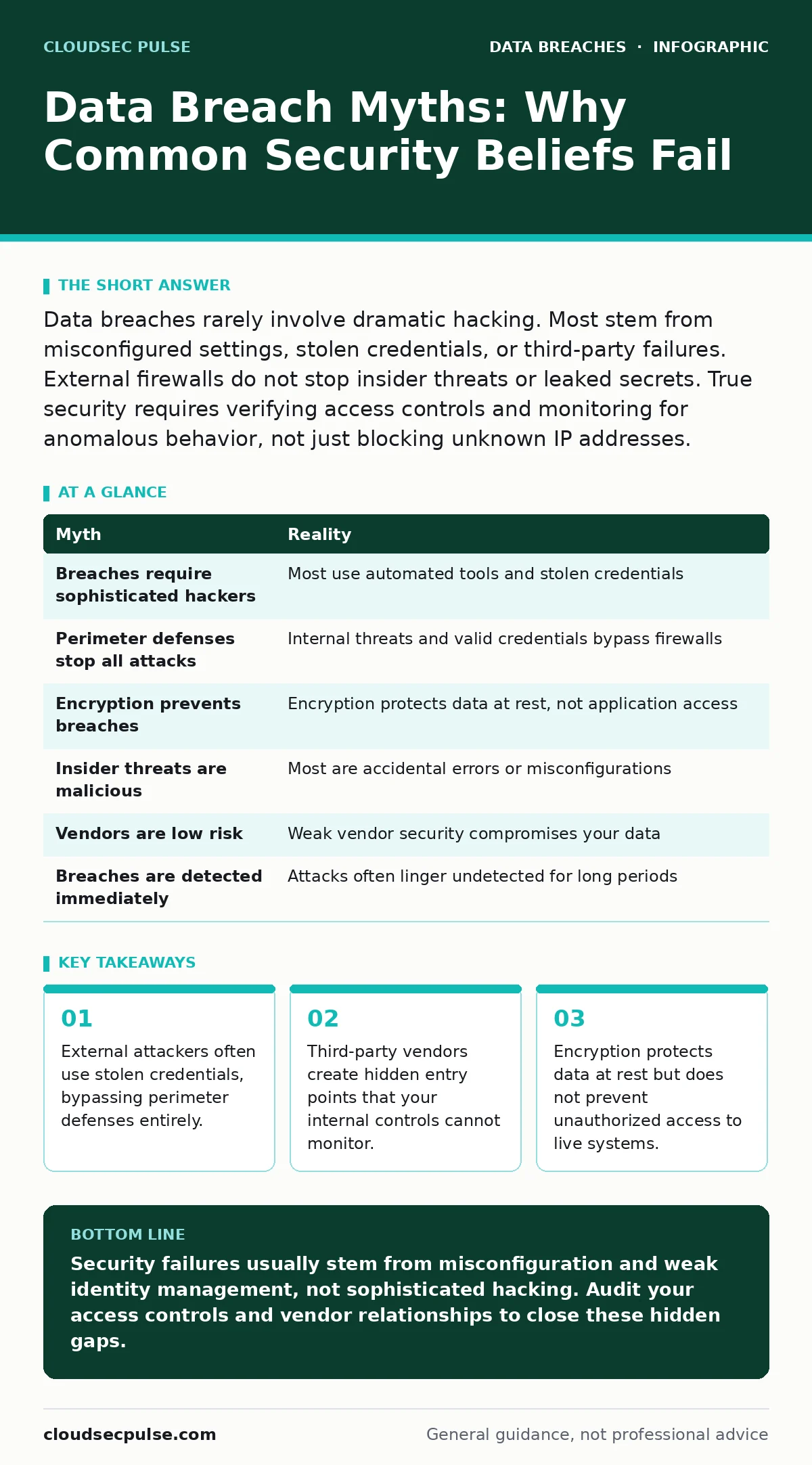
Data breaches rarely involve dramatic hacking. Most stem from misconfigured settings, stolen credentials, or third-party failures. External firewalls do not stop insider threats or leaked secrets. True security requires verifying access controls and monitoring for anomalous behavior, not just blocking unknown IP addresses.
Myth: A Breach Requires a Sophisticated Hacker
Reality: Most data breaches do not involve complex malware or zero-day exploits. They occur because standard defenses are misconfigured or credentials are compromised. You might believe that only state-sponsored actors or elite criminal groups can breach your systems. This assumption leads to neglecting basic hygiene in favor of expensive, complex tools.
Attackers frequently use automated tools to test for common weaknesses. They look for default passwords, unpatched software, or exposed administrative interfaces. These methods are inexpensive and require minimal skill. Your defense does not need to defeat a genius; it needs to defeat a script.
Suppose you install a high-end firewall but leave a database accessible to the public internet. An attacker does not need to break through the firewall. They simply query the exposed database directly. The breach happens not because the perimeter failed, but because the asset was left open.
Myth: Perimeter Defenses Stop All Attacks
Reality: Firewalls and intrusion detection systems protect the network edge, not the data inside. Once an attacker gains valid credentials, they appear as legitimate traffic. The perimeter assumes that everything inside is trusted. This trust model fails when the threat originates from within the network.
Modern environments rely on remote access and cloud services. Users connect from various locations, blending with normal traffic. A firewall cannot easily distinguish between a legitimate user accessing a file and a compromised account exfiltrating data. The boundary is porous, not a wall.
Imagine an employee’s laptop is stolen. The attacker uses the saved credentials to log in from a new location. The firewall sees a valid login and allows access. The attack succeeds because the identity was valid, even though the device was unauthorized. Perimeter tools check the door, not the person.
Myth: Encryption Prevents Data Breaches
Reality: Encryption protects data while it is stored or transmitted, but it does not prevent unauthorized access to the system. If an attacker gains access to your application, they can read the data in its decrypted state. Encryption is a shield for the data, not the application.
You might encrypt your database and assume the data is safe if the server is hacked. However, the application must decrypt the data to use it. If the application logic is flawed or the credentials are stolen, the encryption becomes irrelevant. The attacker interacts with the system as a user would.
Suppose you store passwords in an encrypted database. If your web application has a vulnerability that allows an attacker to reset passwords or view user profiles, the encryption of the stored password hash does not stop the account takeover. The breach occurs at the logic layer, bypassing the storage protection.
Myth: Insider Threats Are Always Malicious
Reality: Most insider incidents are accidental, not malicious. Employees often mishandle data due to confusion, fatigue, or lack of training. They may send sensitive information to the wrong recipient or misconfigure a cloud storage bucket. These errors are far more common than sabotage.
You might focus on monitoring employee behavior for signs of theft. This approach misses the majority of risks. A well-meaning employee trying to help a customer may upload a file to a public folder. The intent was good, but the outcome was a breach.
Imagine a developer pushing code to a public repository. They accidentally include a configuration file with database passwords. They did not intend to leak secrets. They simply made a mistake in their workflow. Detection requires monitoring for data exposure, not just malicious intent.
Myth: Third-Party Vendors Are Low Risk
Reality: Your security is only as strong as your weakest vendor. Attackers often target smaller vendors with weaker defenses to access your data. You may have strict controls, but your vendor might not. They can see your data, and so can anyone who breaches them.
You assume that signing a contract with a vendor ensures their security meets your standards. Contracts do not enforce technical controls. The vendor may use outdated software or share access with subcontractors. You often have no visibility into their internal security posture.
Suppose you use a cloud provider for email. If the provider suffers a breach, your emails are exposed. You did nothing wrong, but your data was compromised. You must verify that vendors follow strict access controls and encryption standards. Relying on their reputation is not enough.
See also: How Database Activity Monitoring Works: The Mechanics and Limits · Encryption Key Management Explained: Protecting Your Digital Keys
Myth: Breaches Are Always Detected Immediately
Reality: Many breaches remain undetected for months or years. Attackers move slowly to avoid triggering alarms. They establish persistence and escalate privileges gradually. By the time you notice, they have already exfiltrated data or destroyed evidence.
You might rely on antivirus software to detect breaches. Modern attacks use legitimate tools to move laterally. They do not leave malware signatures. They look like normal administrative activity. Detection requires behavioral analysis, not just signature matching.
Imagine an attacker gains access to a low-privilege account. They wait weeks, observing network patterns. Then they slowly copy small amounts of data. Your systems do not see a spike in traffic. The breach is silent until the data appears on the dark web.
| Myth | Reality |
|---|---|
| Breaches require sophisticated hackers | Most use automated tools and stolen credentials |
| Perimeter defenses stop all attacks | Internal threats and valid credentials bypass firewalls |
| Encryption prevents breaches | Encryption protects data at rest, not application access |
| Insider threats are malicious | Most are accidental errors or misconfigurations |
| Vendors are low risk | Weak vendor security compromises your data |
| Breaches are detected immediately | Attacks often linger undetected for long periods |
Key takeaways
- External attackers often use stolen credentials, bypassing perimeter defenses entirely.
- Third-party vendors create hidden entry points that your internal controls cannot monitor.
- Encryption protects data at rest but does not prevent unauthorized access to live systems.
Security failures usually stem from misconfiguration and weak identity management, not sophisticated hacking. Audit your access controls and vendor relationships to close these hidden gaps.
Frequently asked questions
How do I know if my credentials are compromised?
Monitor for login attempts from unusual locations or devices. Use multi-factor authentication to block access even if passwords are stolen.
Is multi-factor authentication enough?
It significantly reduces risk but does not stop all attacks. If an attacker compromises your session token or uses social engineering, MFA can be bypassed.
How often should I review vendor security?
Review vendor security controls annually or after any significant change in their service. Ensure they provide evidence of compliance with current standards.
What is the first step after a suspected breach?
Isolate affected systems to prevent further spread. Preserve logs for analysis and notify relevant stakeholders immediately.
How this guide was produced: written by the CloudSec Pulse editorial team with AI assistance, checked against the public references listed below, and reviewed when the facts change. See our editorial policy or report an error.