Cloud Encryption Defined: How Data Scrambling Protects Your Assets
Encryption transforms readable data into unreadable code, ensuring that even if attackers bypass network defenses, they cannot understand the stolen information.

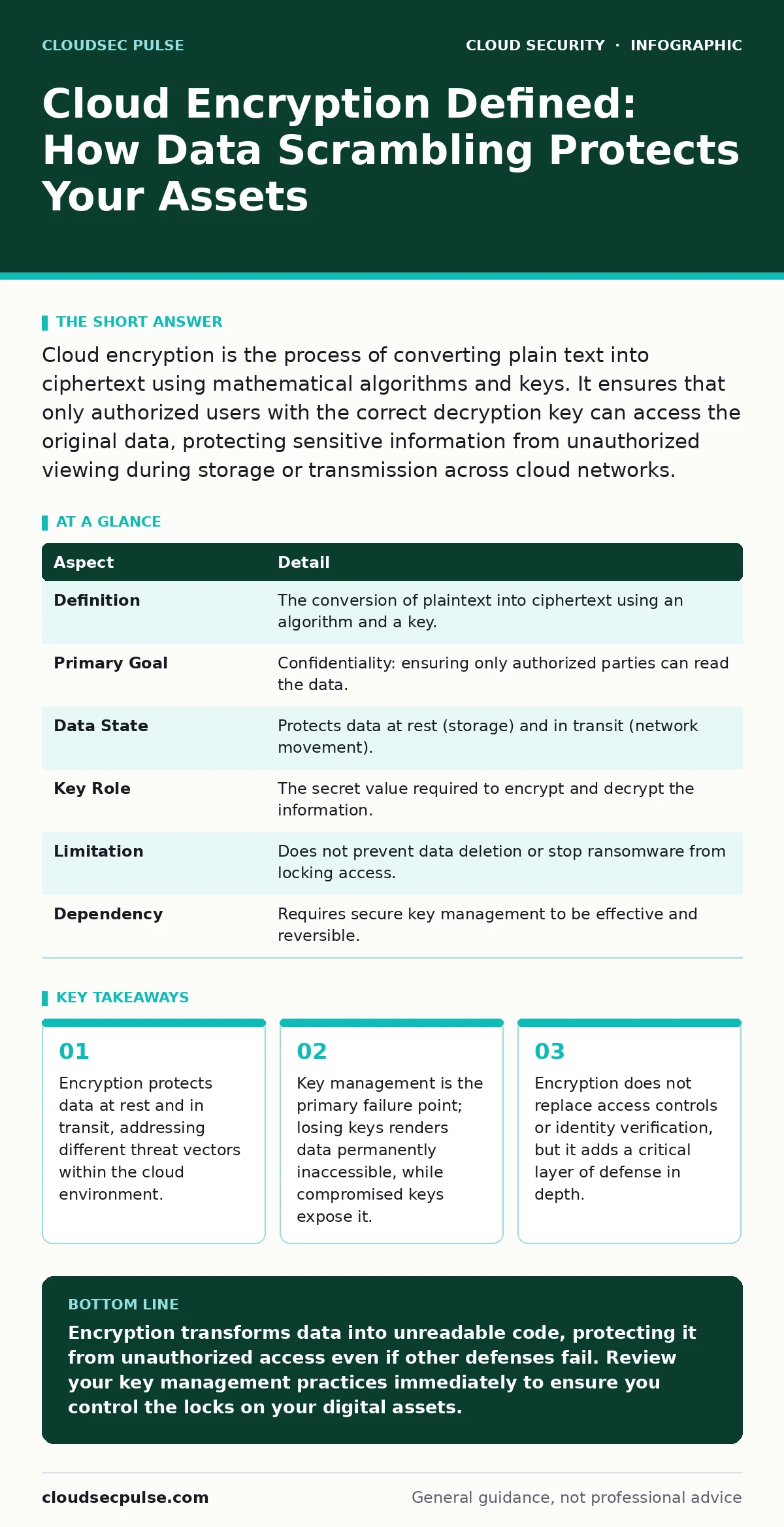
Cloud encryption is the process of converting plain text into ciphertext using mathematical algorithms and keys. It ensures that only authorized users with the correct decryption key can access the original data, protecting sensitive information from unauthorized viewing during storage or transmission across cloud networks.
The Digital Envelope Analogy
Imagine sending a confidential letter. You place the letter in an envelope, seal it, and hand it to a courier. The courier can see the envelope, handle it, and even lose it, but they cannot read the contents. Encryption works similarly for your digital data. It wraps your information in a mathematical lock that only the intended recipient can open. Without the specific key, the data remains a jumbled mess of characters.
This analogy helps clarify why encryption is distinct from other security measures. A firewall is like a guard at the door of a building. It stops unauthorized people from entering. Encryption, however, is the lock on the diary inside the office. If someone sneaks past the guard, they still cannot read the diary. Both are necessary, but they solve different problems.
What Encryption Actually Solves
The primary problem encryption solves is exposure during unauthorized access. In cloud environments, data moves across shared infrastructure. It sits on physical disks owned by the cloud provider and travels through networks you do not control. Encryption ensures that even if an attacker gains low-level access to these physical or virtual storage systems, they cannot interpret the data.
It also solves the problem of insider threats. A system administrator with broad permissions might be able to see that a file exists. However, if the data is encrypted with keys they do not possess, they cannot view the actual content. This separation of duties reduces the risk of malicious insiders or compromised administrative accounts exposing sensitive business information.
| Aspect | Detail |
|---|---|
| Definition | The conversion of plaintext into ciphertext using an algorithm and a key. |
| Primary Goal | Confidentiality: ensuring only authorized parties can read the data. |
| Data State | Protects data at rest (storage) and in transit (network movement). |
| Key Role | The secret value required to encrypt and decrypt the information. |
| Limitation | Does not prevent data deletion or stop ransomware from locking access. |
| Dependency | Requires secure key management to be effective and reversible. |
The Core Components of Encryption
Encryption relies on three main components: the algorithm, the key, and the mode of operation. The algorithm is the mathematical formula used to scramble the data. Common standards include AES (Advanced Encryption Standard). The key is the unique value that drives the algorithm. Without the correct key, the algorithm cannot reverse the process.
The mode of operation determines how the algorithm handles large blocks of data. Some modes are more secure than others against specific types of attacks. Understanding these parts helps you evaluate whether your current setup is secure. It is not enough to simply turn on encryption. You must ensure the algorithm is modern, the key is strong, and the mode is appropriate for your use case.
Encryption at Rest vs. In Transit
Data exists in two primary states in the cloud: at rest and in transit. Data at rest sits on storage devices, such as hard drives or database servers. Encryption at rest protects this data from physical theft or unauthorized access to the storage layer. It ensures that if a disk is stolen or a backup tape is lost, the data remains unreadable.
Data in transit moves between your device and the cloud, or between services within the cloud. Encryption in transit, often implemented via TLS (Transport Layer Security), protects data from interception. It prevents attackers on the network from reading or altering the data as it travels. Both forms are necessary. Encrypting only one state leaves the other vulnerable to distinct attack methods.
The Hidden Cost of Key Management
The most common failure in cloud encryption is not weak algorithms, but poor key management. Keys are the weakest link. If an attacker obtains the key, the encryption is useless. If you lose the key, the data is gone forever. This creates a significant operational burden. You must store keys securely, rotate them regularly, and ensure they are available for authorized decryption.
Many organizations use managed key services provided by their cloud vendor. This simplifies the process but introduces a dependency. The vendor holds the keys. While this is convenient, it means the vendor can theoretically access your data. For highly sensitive data, you may need to bring your own keys. This gives you more control but increases the complexity of your security operations. You must balance convenience with control.
See also: Do I Need Cyber Insurance for My Business? Coverage Gaps Explained · How Database Activity Monitoring Works: The Mechanics and Limits
What People Usually Get Wrong
A common misconception is that encryption prevents data loss. It does not. Encryption protects confidentiality, not availability or integrity. If a ransomware attack encrypts your data with a key you do not have, you cannot read it. This is a form of encryption used against you. Understanding this distinction is vital for planning your response to cloud ransomware incidents.
Another mistake is assuming that encrypting everything solves all security problems. It does not. You still need strong identity and access management. If an attacker logs in as a legitimate user, they can decrypt and view the data. Encryption is a layer of defense, not a silver bullet. It works best when combined with other controls, such as those discussed in service account security and SaaS access reviews.
Integrating with Other Defenses
Encryption fits into a broader security strategy. It complements network security, identity management, and application security. It does not replace them. For example, cloud penetration testing might reveal that your encryption keys are stored in plaintext in a configuration file. This is a critical vulnerability that encryption alone cannot fix. You must secure the keys themselves.
It also interacts with cloud compliance requirements. Many regulations require data to be encrypted. However, compliance is not the same as security. Meeting the checkbox requirement does not mean your implementation is robust. You must understand the technical details to ensure true protection. Ignoring the nuances can lead to false confidence.
Practical Steps for Implementation
Start by identifying your most sensitive data. Not all data requires the same level of protection. Focus on data that would cause significant harm if exposed. Then, ensure that this data is encrypted both at rest and in transit. Use strong, standard algorithms and avoid custom cryptographic solutions.
Next, review your key management strategy. Determine who has access to the keys and how they are stored. Implement key rotation policies to limit the impact of a compromised key. Finally, test your decryption process. Ensure that you can recover your data in an emergency. If you cannot decrypt your data, your encryption strategy has failed.
Key takeaways
- Encryption protects data at rest and in transit, addressing different threat vectors within the cloud environment.
- Key management is the primary failure point; losing keys renders data permanently inaccessible, while compromised keys expose it.
- Encryption does not replace access controls or identity verification, but it adds a critical layer of defense in depth.
Encryption transforms data into unreadable code, protecting it from unauthorized access even if other defenses fail. Review your key management practices immediately to ensure you control the locks on your digital assets.
Frequently asked questions
Does encryption stop hackers from stealing my data?
No, encryption does not prevent data theft. It prevents hackers from reading the stolen data. If they cannot decrypt it, the data has little value to them.
Can I use the same encryption key for all my data?
You can, but it is not recommended. Using a single key increases risk. If that key is compromised, all your data is exposed. Use unique keys for different datasets or applications.
Is cloud encryption expensive?
The direct cost is often low or included in service fees. The indirect cost lies in key management and operational complexity. Poorly managed encryption can lead to data loss or breach, which is far more expensive.
Do I need to encrypt data in transit within the cloud?
Yes, data moving between services within the cloud network can be intercepted. Encrypting internal traffic adds a layer of security, especially in multi-tenant environments.
How this guide was produced: written by the CloudSec Pulse editorial team with AI assistance, checked against the public references listed below, and reviewed when the facts change. See our editorial policy or report an error.