How Database Activity Monitoring Works: The Mechanics and Limits
Database activity monitoring decodes encrypted traffic to reveal malicious queries, but it struggles to distinguish between automated maintenance and a slow data exfiltration attempt.

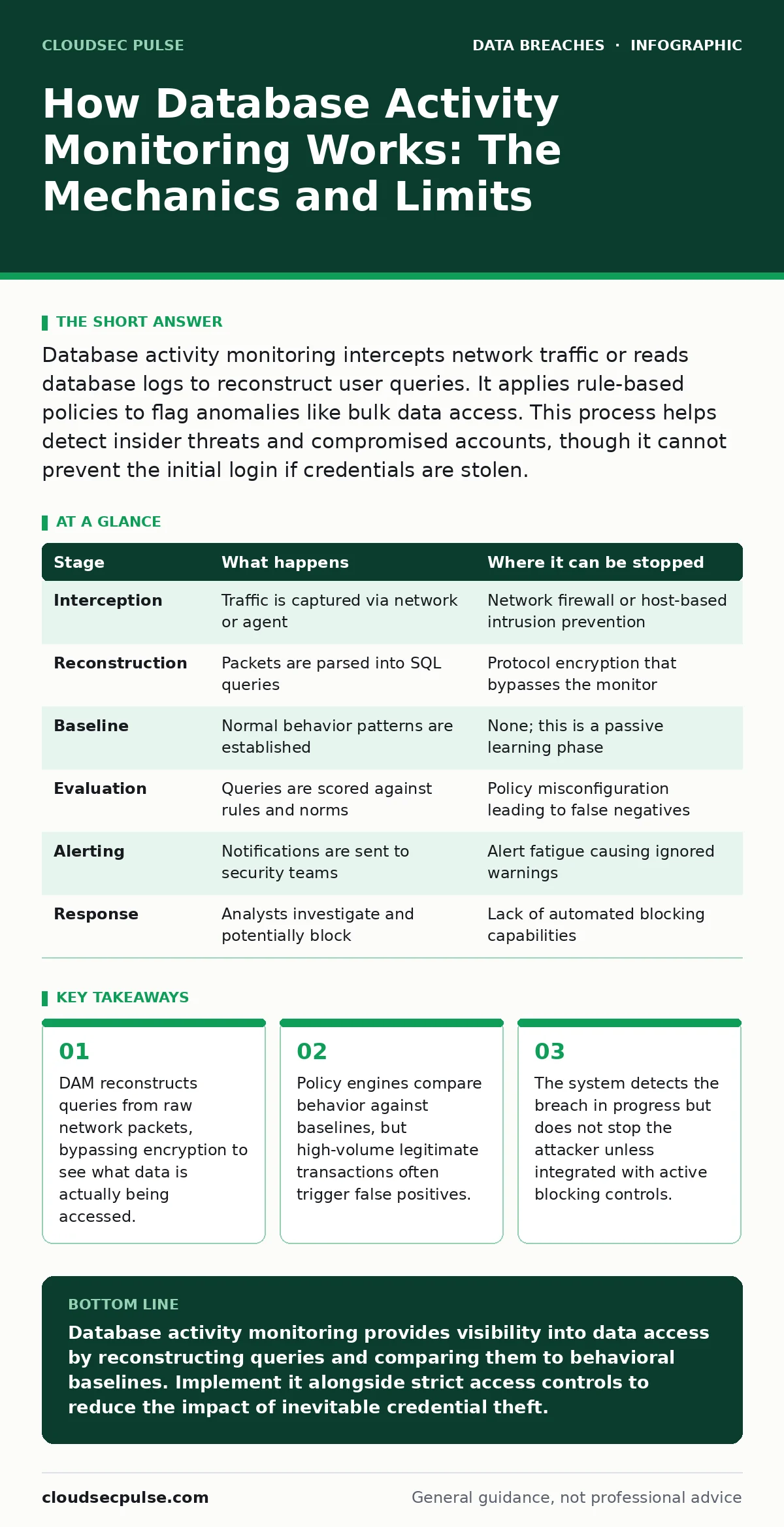
Database activity monitoring intercepts network traffic or reads database logs to reconstruct user queries. It applies rule-based policies to flag anomalies like bulk data access. This process helps detect insider threats and compromised accounts, though it cannot prevent the initial login if credentials are stolen.
The Interception Layer
Database activity monitoring begins before the database engine processes the request. You must capture the data in motion or at rest to analyze it. Most systems use one of two methods: network packet capture or agent-based logging. Network capture sits between the application server and the database. It copies packets without altering them. This method is transparent to the infrastructure. Agent-based logging installs a small program directly on the database server. It reads the operating system calls made by the database process. This method is more accurate but adds overhead to the server.
Query Reconstruction
Once the data is captured, the system must make sense of it. Raw network packets are binary noise. The monitoring engine decrypts the traffic if it holds the private keys. It then parses the protocol, such as TDS for SQL Server or MySQL protocol. The engine reconstructs the original SQL statement from these fragments. This step is critical. It turns invisible traffic into readable text. If the reconstruction fails, the monitoring tool sees nothing. You lose visibility into exactly which tables were touched. Reconstruction also identifies the user session. It maps the IP address to a specific database account. This linkage is necessary for attribution.
Behavioral Baseline Creation
Detection requires a definition of normal behavior. The system builds a baseline by observing routine operations over time. It learns which users access which tables. It notes the typical volume of data retrieved. It records the time of day for common jobs. For example, a payroll script might run nightly and access fifty thousand rows. The system memorizes this pattern.
It does not judge the activity yet. It simply stores the statistical norm. This baseline is dynamic. It updates as your business grows. New applications change the pattern. The system must adapt to avoid flagging every new feature as a threat. This learning phase can take weeks. During this time, you have little protection against novel attacks.
Policy Evaluation and Scoring
With the query reconstructed and the baseline established, the engine evaluates the action. It checks the query against a list of static rules. These rules flag obvious dangers. They look for commands that drop tables or bypass authentication. They also check for sensitive data patterns. If a query returns a column known to hold credit card numbers, it triggers an alert. The system then applies behavioral analysis.
It compares the current action to the baseline. If a user who usually reads ten rows suddenly reads ten thousand, the system assigns a risk score. This score reflects the deviation from the norm. High scores indicate potential compromise. Low scores indicate routine work. The system balances sensitivity against noise. Too many alerts cause alert fatigue. Too few let breaches slip through.
Alert Generation and Response
When the risk score crosses a threshold, the system generates an alert. This alert contains the query, the user, the timestamp, and the reason for the flag. It is sent to a security information and event management system or a dashboard. At this stage, the monitoring tool has done its job. It has identified the anomaly. It has not stopped the attack. Stopping the attack requires integration. Some systems can block the connection.
They send a command to the firewall or the database to drop the session. This is active defense. It is rare because it risks blocking legitimate business processes. Most organizations rely on human review. An analyst sees the alert and investigates. They decide if it is a mistake or a breach. This delay is the main weakness. The attacker may have already stolen the data by the time you see the alert.
See also: Encryption Key Management Explained: Protecting Your Digital Keys · Data Breach Myths: Why Common Security Beliefs Fail
The Limits of Visibility
Database activity monitoring is not a silver bullet. It has blind spots. It cannot protect data that is already inside the database and accessed via direct disk access. If an attacker gains operating system level access, they bypass the database engine. The monitoring tool sees nothing. It also struggles with encrypted columns. If you encrypt specific fields inside the database, the monitoring tool sees only gibberish.
It cannot tell if those fields were accessed. It only sees the query structure. This limits its ability to detect subtle exfiltration. You must combine DAM with other controls. Data minimization reduces the amount of sensitive data available. If there is less data to steal, the impact of a breach is lower. Database security policies ensure that users only have the permissions they need. This limits the damage even if monitoring fails.
| Stage | What happens | Where it can be stopped |
|---|---|---|
| Interception | Traffic is captured via network or agent | Network firewall or host-based intrusion prevention |
| Reconstruction | Packets are parsed into SQL queries | Protocol encryption that bypasses the monitor |
| Baseline | Normal behavior patterns are established | None; this is a passive learning phase |
| Evaluation | Queries are scored against rules and norms | Policy misconfiguration leading to false negatives |
| Alerting | Notifications are sent to security teams | Alert fatigue causing ignored warnings |
| Response | Analysts investigate and potentially block | Lack of automated blocking capabilities |
Integration with Broader Security
Monitoring databases in isolation is inefficient. You must correlate events with other sources. A spike in database access might coincide with a login from a new country. This context comes from identity logs. It helps distinguish between a stolen credential and a legitimate remote worker. Credential exposure is a common precursor to database breaches. If you detect leaked passwords on the dark web, you can tighten database monitoring for those accounts. This proactive step reduces the window of opportunity. Third-party data breaches also pose a risk. Vendors often have database access.
You must monitor their connections as closely as your own. Data sovereignty laws may require you to log where data moves. DAM helps prove compliance. It shows that data did not leave authorized regions. Cyber insurance policies often require continuous monitoring. Having DAM in place can lower premiums. It demonstrates that you have technical controls to detect breaches. Customer breach notification letters become less likely if you catch the issue early. However, DAM does not replace the need for a response plan. It only shortens the time to detection.
Key takeaways
- DAM reconstructs queries from raw network packets, bypassing encryption to see what data is actually being accessed.
- Policy engines compare behavior against baselines, but high-volume legitimate transactions often trigger false positives.
- The system detects the breach in progress but does not stop the attacker unless integrated with active blocking controls.
Database activity monitoring provides visibility into data access by reconstructing queries and comparing them to behavioral baselines. Implement it alongside strict access controls to reduce the impact of inevitable credential theft.
Frequently asked questions
Does database activity monitoring slow down my database?
Network-based monitoring adds no load to the database server. Agent-based monitoring consumes some CPU and memory, but modern agents are optimized to minimize impact.
Is DAM enough to prevent data theft?
No. DAM detects theft in progress. It does not prevent the initial compromise. You need strong authentication and least-privilege access to stop the attacker at the door.
How this guide was produced: written by the CloudSec Pulse editorial team with AI assistance, checked against the public references listed below, and reviewed when the facts change. See our editorial policy or report an error.