Why Credential Exposure Drives Security Strategy and Risk
Unprotected login data allows attackers to bypass perimeter defenses entirely, forcing teams to rebuild trust and access controls from the ground up.

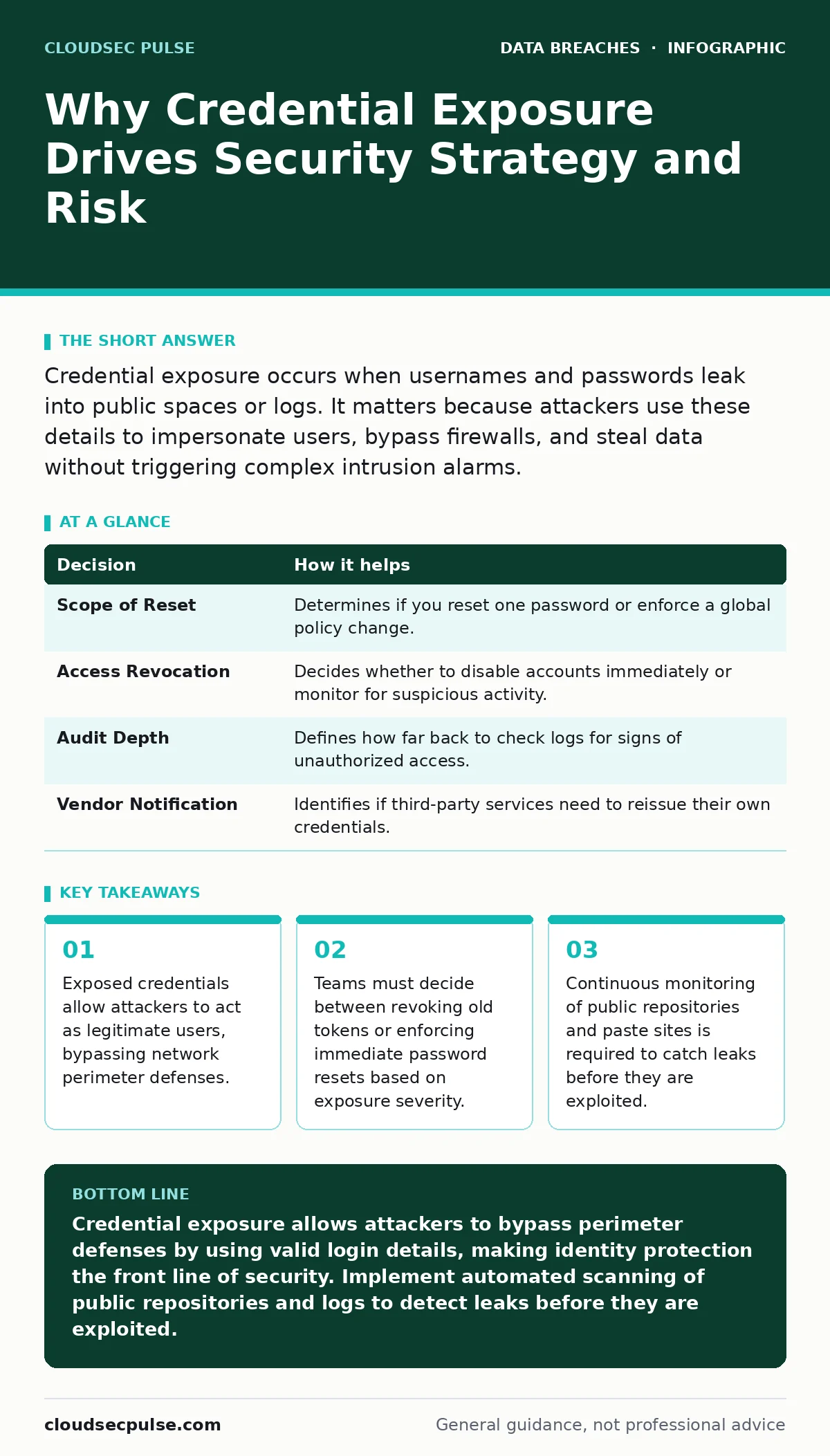
Credential exposure occurs when usernames and passwords leak into public spaces or logs. It matters because attackers use these details to impersonate users, bypass firewalls, and steal data without triggering complex intrusion alarms.
The Anatomy of Silent Access
Credential exposure happens when authentication secrets leave your secure storage. This is not limited to database hacks. It includes developers accidentally committing private keys to public code repositories. It includes support staff printing passwords on sticky notes that get photographed. It includes configuration files uploaded to cloud storage buckets with public read permissions.
When these secrets appear in plain text, they become a commodity. Attackers do not need to break encryption or exploit software vulnerabilities. They simply need to find the key to the front door. This shifts the attack surface from your infrastructure to your operational habits. The cost of this shift is high because standard security tools often fail to detect legitimate-looking logins.
A firewall checks if a connection is allowed. It does not check if the user is who they claim to be. If an attacker uses a stolen password, the firewall sees valid traffic. The intrusion detection system sees a successful login. The damage occurs before any alert triggers. This is why credential exposure is distinct from a traditional data breach. It is a loss of identity control.
Contrast in Response Timing
This contrast highlights the hidden cost of delay. The longer a credential remains exposed, the more likely it is to be automated into an attack chain. Attackers scrape public sources continuously. They do not wait for permission to test stolen data. Your response time determines whether the exposure is a footnote in a quarterly report or a headline in a news article.
Decisions Informed by Exposure Data
Knowing that credentials are exposed forces specific operational choices. You cannot treat all leaks as equal. A leaked employee password requires a different response than a leaked service account token. The severity depends on the privilege level of the account and the environment it accesses.
| Decision | How it helps |
|---|---|
| Scope of Reset | Determines if you reset one password or enforce a global policy change. |
| Access Revocation | Decides whether to disable accounts immediately or monitor for suspicious activity. |
| Audit Depth | Defines how far back to check logs for signs of unauthorized access. |
| Vendor Notification | Identifies if third-party services need to reissue their own credentials. |
These decisions rely on accurate context. If you assume a leaked password is old, you might skip a full audit. If it is current, you must assume compromise. The decision matrix helps teams allocate resources without panicking. It turns a vague fear into a structured workflow.
What Goes Wrong Without Detection
Without a way to detect exposure, teams operate in blind spots. You assume your secrets are safe until a customer complains. By then, the attacker has already mapped your network. They have escalated privileges. They have established persistence.
The most dangerous outcome is false confidence. You believe your encryption is strong. You believe your firewalls are configured correctly. But if the attacker has your admin password, these controls are irrelevant. This is why credential exposure undermines the entire security stack. It renders technical controls useless if the identity layer is broken.
Teams without detection often react late. They wait for a breach report to realize their secrets were public for months. This delay allows attackers to move laterally. They use the initial access to reach other systems. The initial leak becomes a gateway for deeper intrusion. This chain of events is difficult to break once it starts.
How Teams Use Exposure Signals
Effective teams treat credential exposure as a signal for continuous improvement. They do not just fix the leak. They analyze why it happened. Was it a lack of training? A misconfigured tool? A flawed development process?
They integrate exposure checks into their development lifecycle. Before code is merged, automated tools scan for secrets. This prevents leaks from reaching production. They also monitor external sources for their domain names and employee emails. This external view catches leaks that internal tools miss.
This approach requires coordination. Engineering teams must work with security. Support staff must understand the risk of sharing credentials. Everyone plays a role in keeping secrets private. The goal is to make exposure rare and detection immediate. This reduces the window of opportunity for attackers.
Integration with Broader Controls
Credential exposure does not exist in a vacuum. It intersects with other security domains. If you practice data minimization, you reduce the value of a compromised account. The attacker has less data to steal. If you implement data loss prevention, you can stop exfiltration even if the attacker logs in.
Encryption key management is closely related. If your keys are exposed, your encrypted data is useless. You must protect keys with the same rigor as passwords. Often more so. This is why many organizations use hardware security modules or cloud key management services. These tools add a layer of protection that passwords alone cannot provide.
Consider how you handle data breaches. If a breach occurs, you must send customer breach notification letters. The content of those letters depends on what was exposed. If only passwords were leaked, the message is different than if financial data was stolen. Clear records of exposure help you communicate accurately and legally.
The Role of Monitoring and Insurance
Continuous monitoring is the only way to stay ahead. Database activity monitoring can help detect unusual queries that suggest a compromised account is being used. It provides visibility into what happens after the login. This helps you catch the misuse before it spreads.
Cyber insurance can mitigate the financial impact of a breach. However, insurers often require evidence of proactive security measures. If you cannot prove you monitor for credential exposure, your claim may be denied. Insurers look for maturity in your security program. They want to see that you are doing due diligence.
This financial incentive drives better practices. It forces teams to move beyond basic password policies. It encourages investment in identity governance and monitoring tools. The result is a more resilient organization. You are better prepared for the inevitable attempts to steal your secrets.
Building a Resilient Identity Layer
The goal is not to eliminate all risk. That is impossible. The goal is to reduce the time between exposure and detection. The shorter this window, the less damage an attacker can do. This requires a combination of technology, process, and culture.
Technology provides the tools for detection and prevention. Process ensures that responses are consistent and documented. Culture ensures that everyone understands the importance of keeping secrets private. When these elements align, credential exposure becomes a manageable risk rather than a catastrophic event.
You must accept that secrets will leak. The question is how quickly you find out. By treating credential exposure as a critical signal, you can protect your organization. You can maintain trust with your customers. You can keep your business running even in the face of determined attacks.
Key takeaways
- Exposed credentials allow attackers to act as legitimate users, bypassing network perimeter defenses.
- Teams must decide between revoking old tokens or enforcing immediate password resets based on exposure severity.
- Continuous monitoring of public repositories and paste sites is required to catch leaks before they are exploited.
Credential exposure allows attackers to bypass perimeter defenses by using valid login details, making identity protection the front line of security. Implement automated scanning of public repositories and logs to detect leaks before they are exploited.
Frequently asked questions
How do I know if my credentials are exposed?
Use automated tools that scan public code repositories, paste sites, and dark web forums for your domain and employee emails.
Is multi-factor authentication enough to stop credential exposure?
It adds a layer of protection, but if an attacker has your password and can bypass MFA via SIM swapping or phishing, exposure still leads to access.
Should I rotate all passwords if one is exposed?
Only if they are reused. If passwords are unique, rotating the exposed one is sufficient. Reuse requires a broader reset.
Does encryption protect me if credentials are leaked?
Encryption protects data at rest, but if an attacker logs in with valid credentials, they can access the data in plain text within the application.
How this guide was produced: written by the CloudSec Pulse editorial team with AI assistance, checked against the public references listed below, and reviewed when the facts change. See our editorial policy or report an error.