Customer Breach Notification Letters: The Legal and Trust Checklist
Notification letters shape legal liability and customer retention, yet most organizations treat them as an afterthought rather than a primary defense mechanism.

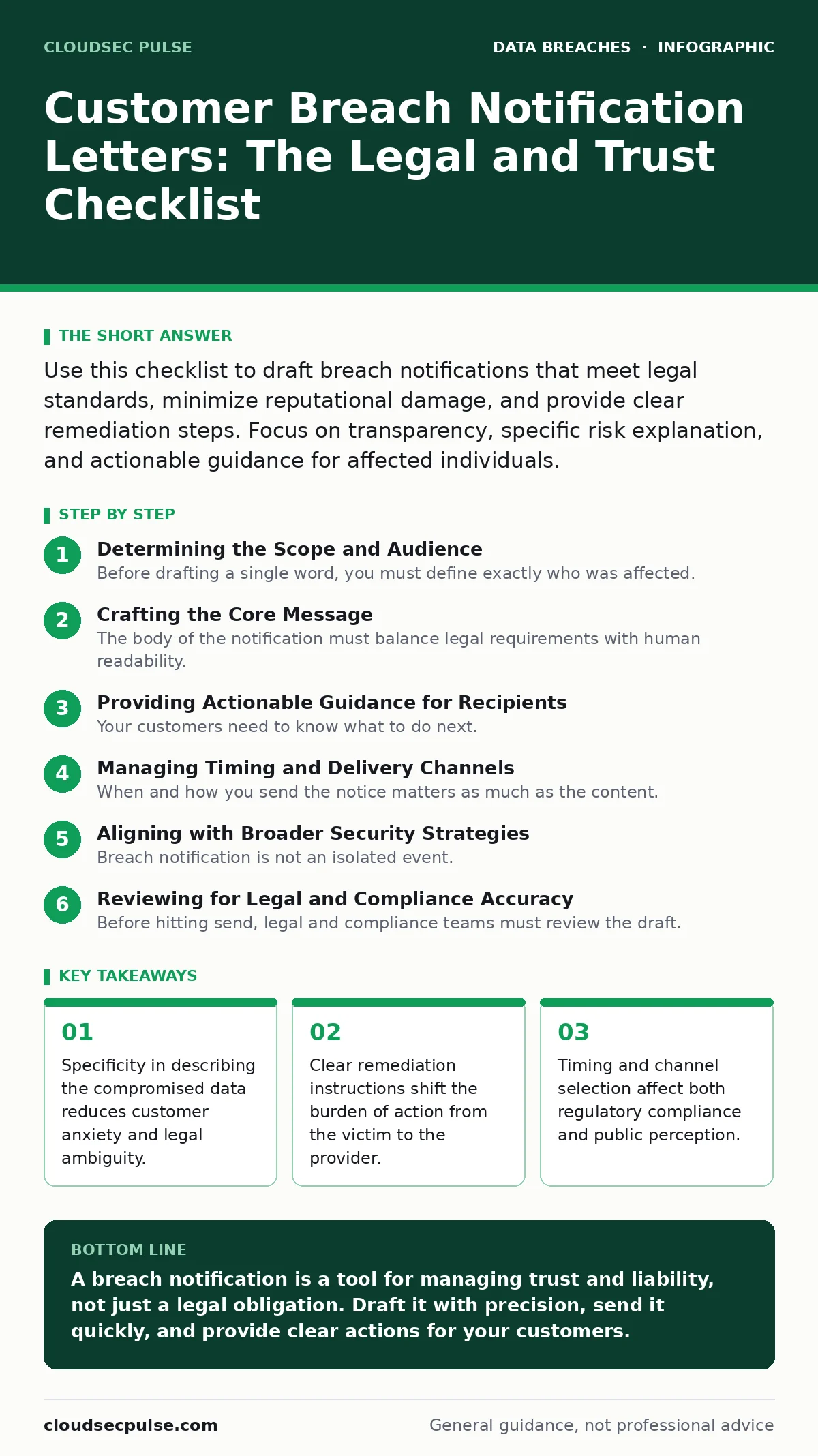
Use this checklist to draft breach notifications that meet legal standards, minimize reputational damage, and provide clear remediation steps. Focus on transparency, specific risk explanation, and actionable guidance for affected individuals.
Determining the Scope and Audience
Before drafting a single word, you must define exactly who was affected. This is not merely a list of names but a precise mapping of data elements to individuals. You need to identify which records contain personal identifiers, financial details, or sensitive health information.
- Define the exact data categories exposed: Knowing whether emails, passwords, or payment tokens were lost dictates the severity of the response.
- Segment the affected population: Grouping users by data type allows for tailored messaging and prevents unnecessary panic among low-risk accounts.
- Verify the timeline of exposure: Establishing when the data was accessible helps determine the window of potential misuse.
Imagine a scenario where you notify all users because one record was compromised. This broad brushstroke erodes trust more than a targeted, accurate alert would. Precision here limits the blast radius of the crisis.
Crafting the Core Message
The body of the notification must balance legal requirements with human readability. You are writing for a person who is worried, not a lawyer who is litigating. Avoid jargon that obscures meaning. Use plain language to describe what happened, when it happened, and what you are doing about it.
- State the incident clearly without speculation: Admitting the breach factually prevents rumors from filling the void with worse scenarios.
- Explain the potential risk to the individual: Abstract threats feel manageable; specific risks like identity theft require concrete action.
- Detail the remediation steps you have taken: Showing that you have secured the environment builds confidence that the problem is contained.
A common mistake is hiding behind technical explanations. If you say "unauthorized access occurred via a zero-day exploit," the reader hears nothing but complexity. Say instead that a flaw in your system allowed outsiders to view certain records.
Providing Actionable Guidance for Recipients
Your customers need to know what to do next. Vague advice like "be vigilant" is useless. You must provide specific, step-by-step instructions that match the type of data exposed. This shifts the burden of defense to the customer, but it also empowers them.
- Recommend password changes if credentials were exposed: Immediate rotation prevents attackers from using stolen login details elsewhere.
- Suggest credit monitoring if financial data was involved: Early detection of fraudulent activity limits financial damage to the victim.
- Provide contact information for support: A dedicated channel for questions reduces confusion and shows you are available to help.
Consider the difference between telling a user to "watch their statements" and telling them to "place a fraud alert with credit bureaus." The latter is a concrete action with a clear outcome.
Managing Timing and Delivery Channels
When and how you send the notice matters as much as the content. Laws often mandate notification within a specific timeframe after discovery. Delaying to "perfect" the letter can violate regulations and anger customers who feel kept in the dark.
- Send notifications via primary communication channels: Email or postal mail ensures the message reaches the person directly associated with the compromised data.
- Publish a public statement on your website: A visible acknowledgment shows transparency to those who may not receive direct notice or who are following the news.
- Coordinate with regulatory bodies simultaneously: Parallel communication ensures you meet legal deadlines while managing public relations.
Suppose you wait two weeks to draft the perfect letter. In that time, attackers may already be using the data. Speed, combined with accuracy, is the priority.
Aligning with Broader Security Strategies
Breach notification is not an isolated event. It is the visible tip of a larger security posture. Your response should reflect the maturity of your underlying security practices. If you have strong controls, your notification will be shorter and less alarming.
- Reference your data minimization practices: Explaining that you do not store full credit card numbers reduces the perceived severity of the breach.
- Mention existing encryption key management: Stating that data was encrypted at rest limits the utility of stolen files for attackers.
- Highlight your data loss prevention efforts: Showing that you detected the breach quickly demonstrates proactive monitoring.
For deeper context on reducing the amount of data you hold, see our guide on data minimization. Understanding how you manage access is also critical; refer to credential exposure for strategies on limiting account compromise.
See also: Tabletop Exercises: Real Benefits and Hidden Costs · Digital Forensics and Incident Response: 8 Field-Proven Practices
Reviewing for Legal and Compliance Accuracy
Before hitting send, legal and compliance teams must review the draft. This is not just about avoiding fines; it is about ensuring consistency across all communications. Inconsistent messages create confusion and legal vulnerability.
- Verify compliance with regional regulations: Different jurisdictions have different rules on what must be disclosed and when.
- Ensure consistency with internal records: The public letter must match the internal incident report to avoid contradictions later.
- Document the decision-making process: Keeping records of why certain phrases were chosen protects the organization during audits or litigation.
For organizations navigating complex liability, cyber insurance policies often dictate specific notification wording. Check your policy requirements before finalizing the text.
Key takeaways
- Specificity in describing the compromised data reduces customer anxiety and legal ambiguity.
- Clear remediation instructions shift the burden of action from the victim to the provider.
- Timing and channel selection affect both regulatory compliance and public perception.
A breach notification is a tool for managing trust and liability, not just a legal obligation. Draft it with precision, send it quickly, and provide clear actions for your customers.
Frequently asked questions
How long do I have to send a breach notification?
Timelines vary by jurisdiction and industry, often ranging from 72 hours to 60 days after discovery. Check local laws and your insurance policy for specific deadlines.
Should I include technical details about the attack?
Include only what is necessary to explain the risk. Excessive technical detail can confuse users and potentially aid attackers in understanding your defenses.
What if I am not sure who was affected?
If the scope is unclear, notify all potentially affected users and explain the uncertainty. Transparency about uncertainty is better than silence.
Can I use a template for breach notifications?
Templates are a starting point, but each breach is unique. Customize the template to reflect the specific data, timeline, and remediation steps of your incident.
How this guide was produced: written by the CloudSec Pulse editorial team with AI assistance, checked against the public references listed below, and reviewed when the facts change. See our editorial policy or report an error.