How Data Loss Prevention Works: The Mechanics Behind the Controls
DLP systems function by establishing a baseline of normal behavior, then blocking anomalies that deviate from that pattern, rather than simply scanning for specific file types.

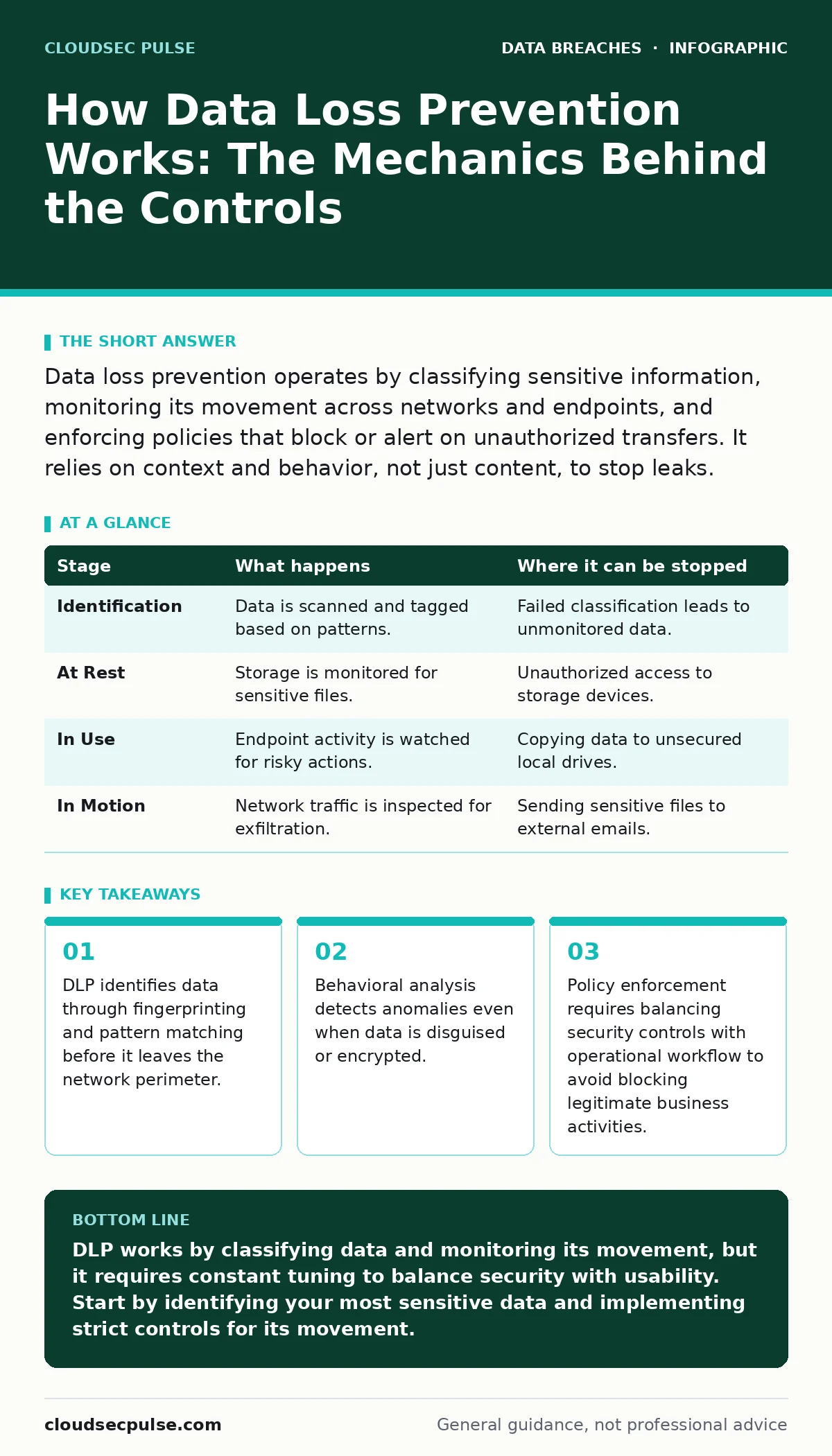
Data loss prevention operates by classifying sensitive information, monitoring its movement across networks and endpoints, and enforcing policies that block or alert on unauthorized transfers. It relies on context and behavior, not just content, to stop leaks.
The Foundation of Data Identification
Data loss prevention begins long before a file is moved. The system must first know what it is looking for. This process is called data classification. Without accurate classification, the system cannot distinguish between a public marketing brochure and a confidential client list.
You define sensitive data by creating patterns. These patterns might include credit card number formats, social security number structures, or specific keywords. The system scans your storage repositories to find these items. It tags them so they are recognized everywhere they appear.
This step is often the most difficult. If your classification is too broad, the system generates noise. If it is too narrow, sensitive data slips through. You must map your data inventory thoroughly. This mapping informs every subsequent stage of the process.
Monitoring Data at Rest
Data at rest refers to information stored on disks, servers, or cloud buckets. Monitoring this data involves continuous scanning of storage locations. The system checks new files as they are created and existing files as they are modified.
The engine looks for matches against your defined patterns. It also examines file metadata. Metadata includes creation dates, author names, and access permissions. This context helps determine if a file is sensitive.
If a match is found, the system applies a label. This label travels with the file. It ensures that even if the file is moved to a different folder, the system still recognizes its sensitivity. This persistence is key to maintaining control over your assets.
Controlling Data in Use
Data in use is information currently open in an application or being edited by a user. This is the hardest data to monitor because it exists in memory, not on disk. The system uses endpoint agents to watch user activity.
These agents monitor copy-and-paste actions, print jobs, and screenshots. They check if sensitive data is being moved to an unsecured application. For instance, copying a password from a secure manager to a web browser might be flagged.
The system evaluates the context. Is the user authorized to view this data? Are they using a sanctioned application? If the behavior deviates from the norm, the system can block the action. It prevents the data from leaving the secure environment.
Securing Data in Motion
Data in motion is information traveling across a network. This includes emails, file transfers, and web uploads. The DLP system inspects traffic at the network gateway. It decrypts encrypted traffic where legally permitted to inspect the content.
The engine applies policies to this traffic. If a user tries to email a file tagged as confidential to an external address, the system intervenes. It checks the recipient against allow lists. It also checks the volume of data being sent.
Large transfers are often suspicious. The system may block the transfer entirely or quarantine the file for review. This step stops data from leaving your organization’s control. It acts as the final checkpoint before data exits your network.
The Policy Enforcement Engine
The core of any DLP solution is the policy engine. This component holds the rules that dictate what is allowed and what is not. Policies are not static. They must adapt to your business needs.
You define actions for different scenarios. A low-risk event might generate an alert. A high-risk event might block the action and notify security staff. The engine evaluates each event against these rules in real time.
This evaluation requires low latency. If the system slows down network traffic, users will find ways around it. You must tune the policies carefully. Overly strict rules cause operational friction. They lead to users disabling protections or finding workarounds.
See also: Snort and Suricata Rules Checklist for Network Defense · Implement Zero Trust Security: A Step-by-Step Execution Plan
Understanding the Hidden Costs
Implementing DLP is not just a technical task. It has organizational costs. Users may feel monitored. This can impact morale and trust. You must communicate why these controls are in place.
False positives are a significant risk. A false positive occurs when the system blocks a legitimate action. This disrupts work and erodes confidence in the system. You need a process to review and correct these errors quickly.
The system also requires ongoing maintenance. Patterns change. New file types emerge. You must update your classification rules regularly. Neglecting this leads to coverage gaps. The system becomes blind to new threats.
Limits of Detection
DLP systems are not perfect. They rely on patterns and behavior. If data is sufficiently obfuscated, the system may miss it. For example, splitting a document into many small images might bypass text-based detection.
Human error remains a major vulnerability. A user might accidentally delete a file. DLP cannot prevent accidental deletion unless configured for backup integration. It focuses on unauthorized movement, not accidental loss.
Encrypted data is another challenge. If you cannot decrypt the traffic, you cannot inspect it. You must balance privacy concerns with security needs. Legal restrictions may limit your ability to inspect certain types of communication.
| Stage | What happens | Where it can be stopped |
|---|---|---|
| Identification | Data is scanned and tagged based on patterns. | Failed classification leads to unmonitored data. |
| At Rest | Storage is monitored for sensitive files. | Unauthorized access to storage devices. |
| In Use | Endpoint activity is watched for risky actions. | Copying data to unsecured local drives. |
| In Motion | Network traffic is inspected for exfiltration. | Sending sensitive files to external emails. |
Integrating with Other Controls
DLP does not work in isolation. It should complement other security measures. For instance, database activity monitoring can provide deeper visibility into SQL queries. This helps identify attempts to extract large amounts of data directly from the database.
You should also consider database security practices. Strong access controls reduce the amount of sensitive data available to be stolen. If users only see what they need, the risk of leakage decreases.
In the event of a failure, cyber insurance may cover some costs. However, insurers often require specific controls like DLP to be in place. Review your policy requirements carefully. Ensure your DLP implementation meets their standards.
If a breach occurs despite these controls, you may need to send customer breach notification letters. These letters explain what happened and what data was affected. Having a clear record of your DLP efforts can demonstrate due diligence.
Refining Your Approach
The effectiveness of DLP depends on continuous refinement. Start with high-risk data. Focus on credit card numbers or personal identifiers. Expand to other data types as you gain confidence.
Monitor the alerts closely. Look for patterns in false positives. Adjust your policies to reduce noise. This tuning process is ongoing. It requires regular review and adjustment.
Consider data sovereignty laws. Some regions have strict rules about data movement. Your DLP policies must respect these legal boundaries. Ensure that data does not cross borders in violation of local laws.
Finally, address credential exposure. If attackers steal login credentials, they may bypass DLP controls. Use multi-factor authentication to add a layer of security. This makes it harder for attackers to move data even if they have access.
Key takeaways
- DLP identifies data through fingerprinting and pattern matching before it leaves the network perimeter.
- Behavioral analysis detects anomalies even when data is disguised or encrypted.
- Policy enforcement requires balancing security controls with operational workflow to avoid blocking legitimate business activities.
DLP works by classifying data and monitoring its movement, but it requires constant tuning to balance security with usability. Start by identifying your most sensitive data and implementing strict controls for its movement.
Frequently asked questions
Does DLP stop all data leaks?
No, DLP reduces the risk of unauthorized data movement but cannot prevent all leaks, especially those caused by human error or sophisticated obfuscation techniques.
How does DLP handle encrypted data?
DLP can inspect encrypted data only if it has access to the decryption keys, which may raise privacy and legal concerns depending on the jurisdiction.
What is the difference between DLP and backup?
DLP prevents unauthorized data movement, while backup creates copies of data for recovery purposes. They serve different functions in data protection.
Can DLP slow down my network?
Yes, if not properly tuned, DLP inspection can add latency to network traffic, potentially impacting user experience and application performance.
How this guide was produced: written by the CloudSec Pulse editorial team with AI assistance, checked against the public references listed below, and reviewed when the facts change. See our editorial policy or report an error.