User and Entity Behavior Analytics Explained for Beginners
Behavior analytics shifts security from watching static doors to monitoring how people and machines move through your digital space, catching threats that bypass traditional locks.

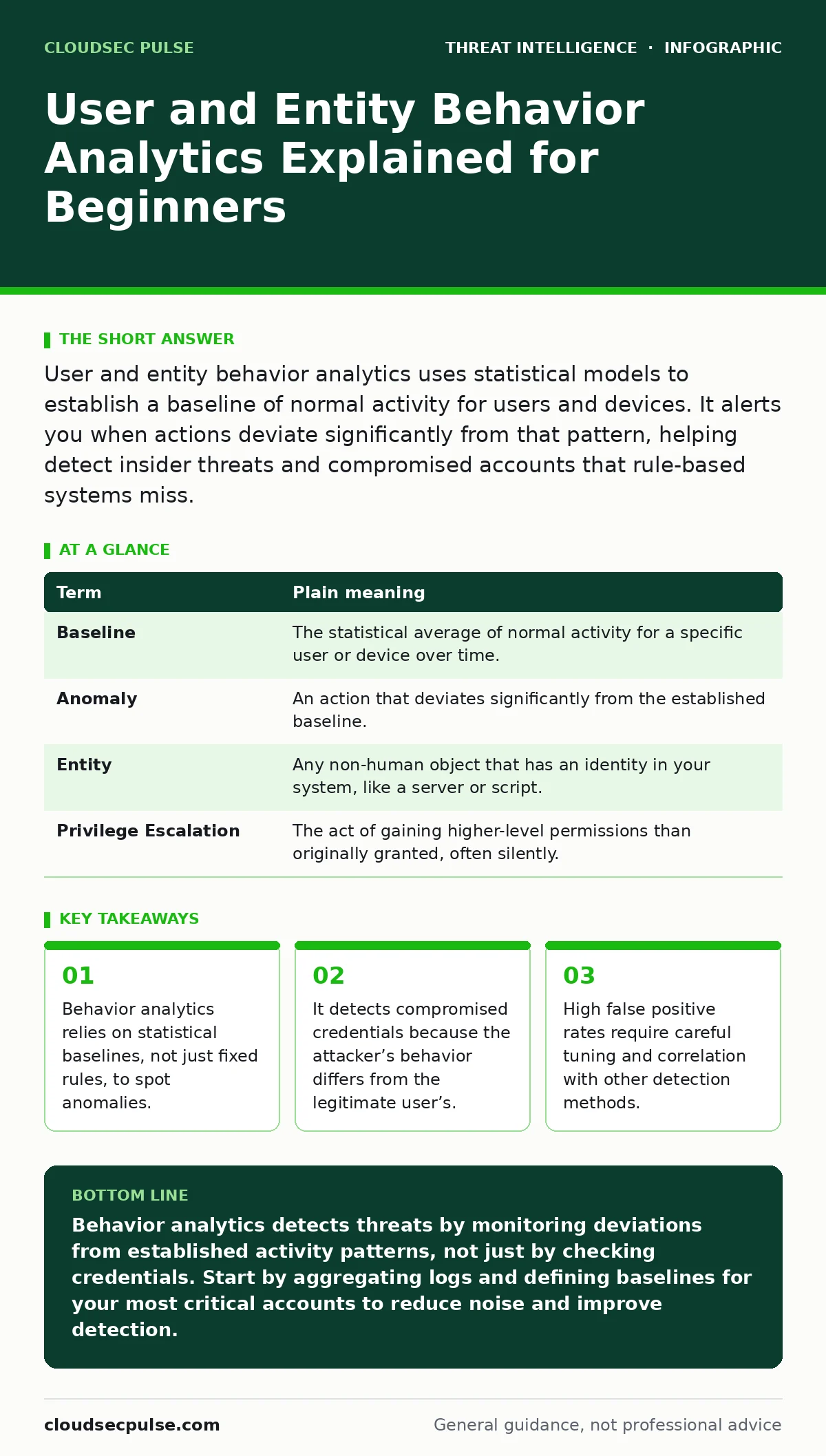
User and entity behavior analytics uses statistical models to establish a baseline of normal activity for users and devices. It alerts you when actions deviate significantly from that pattern, helping detect insider threats and compromised accounts that rule-based systems miss.
The Library Security Model
Imagine your network is a large library. Traditional security tools act like guards at the front door. They check IDs and ensure everyone has a valid pass. If the ID is real, the guard lets the person in. This stops strangers, but it fails if a thief steals a staff ID. They walk in legitimately, looking like an authorized employee.
User and entity behavior analytics (UEBA) changes this approach. Instead of just checking the ID at the door, UEBA watches how the person moves inside. It notes that librarians usually check out books during business hours from the front desk. If someone with a librarian ID tries to check out fifty rare manuscripts at 3 a.m. from a remote terminal, the system flags this. The ID is valid, but the behavior is not.
This shift from identity verification to behavioral monitoring is how modern security catches sophisticated attacks. It assumes that even if an attacker has the right keys, they will not know how to use them like the owner does.
Defining the Core Concepts
To understand how this works, you must separate the two main components of the name. "User" refers to human accounts, such as employees or contractors. "Entity" refers to non-human accounts, including servers, database connections, and automated scripts. Both perform actions that generate data.
The "behavior" part is the pattern of those actions over time. This includes login times, file access frequency, data transfer volumes, and command usage. The "analytics" part is the statistical engine that processes this data. It does not just look for known bad signatures. It looks for statistical outliers that suggest something unusual is happening.
| Term | Plain meaning |
|---|---|
| Baseline | The statistical average of normal activity for a specific user or device over time. |
| Anomaly | An action that deviates significantly from the established baseline. |
| Entity | Any non-human object that has an identity in your system, like a server or script. |
| Privilege Escalation | The act of gaining higher-level permissions than originally granted, often silently. |
Why Rules Alone Fail
Traditional intrusion detection systems rely on signatures or static rules. A rule might say "block any login from a foreign country." This is easy to configure but brittle. If a legitimate employee travels for work, the rule blocks them. If an attacker uses a proxy server in a trusted country, the rule lets them in.
Behavior analytics does not care about geography as much as it cares about consistency. If an employee never logs in from overseas, and suddenly they do, the system flags it. If they log in from overseas but access only their usual files, the risk is lower. This contextual understanding reduces blind spots.
However, this method has a hidden cost. It requires a period of observation to build accurate baselines. You cannot deploy it and expect immediate perfection. The system must learn what "normal" looks like for your specific environment before it can reliably identify "abnormal."
The Insider Threat Advantage
The strongest use case for this technology is insider threats. Malicious insiders already have valid credentials and network access. They bypass perimeter defenses entirely. A disgruntled employee copying customer data to a personal USB drive may not trigger an antivirus alert if the files are not malicious.
Behavior analytics sees the volume and destination. If an employee typically transfers small text files but suddenly moves large database exports to an external storage device, the pattern breaks. The system highlights this for review. It does not automatically block the action, which might disrupt business, but it elevates the alert for human review.
This aligns with the principles of incident triage, where security teams prioritize alerts based on risk and context. Not every anomaly is a breach, but every significant deviation warrants a closer look.
Managing the Noise
The biggest challenge with behavior analytics is noise. Computers and humans are unpredictable. A user might stay late to finish a project, generating unusual activity. A backup job might run at a different time due to maintenance. These are false positives.
If you set the sensitivity too high, your team will be flooded with alerts for every minor deviation. They will become desensitized and miss real threats. This problem of false positives in threat detection is common in all advanced security tools. You must tune the system to ignore known variations, like scheduled maintenance or approved travel.
See also: False Positives in Threat Detection Explained for Beginners · Open-Source Intelligence Investigations: A Beginner’s Framework
Integration with Other Tools
Behavior analytics works best when combined with other data sources. For instance, network traffic analysis can show that the anomalous file transfer is going to an unknown external IP address. This adds a layer of confirmation.
You might also use Sysmon to gather detailed process creation and network connection logs on endpoints. These logs feed into the behavior analytics engine, providing the raw data needed to build accurate baselines. Without detailed logging, the analytics engine is blind to granular actions.
First Practical Steps
Implementing this does not require a massive overhaul. You can start by identifying what data you already collect. Most modern identity providers and endpoint agents log basic activity. Ensure these logs are being aggregated in a central place.
- Audit your current logging capabilities to ensure you capture login events, file access, and process execution.
- Define what "normal" looks like for your most critical accounts, such as administrators and database service accounts.
- Configure alerts for extreme outliers only, such as logins at unusual hours or mass data downloads, to avoid alert fatigue.
By focusing on behavior, you move beyond checking boxes and start understanding the actual risk in your environment. This depth allows you to catch threats that hide in plain sight.
Key takeaways
- Behavior analytics relies on statistical baselines, not just fixed rules, to spot anomalies.
- It detects compromised credentials because the attacker’s behavior differs from the legitimate user’s.
- High false positive rates require careful tuning and correlation with other detection methods.
Behavior analytics detects threats by monitoring deviations from established activity patterns, not just by checking credentials. Start by aggregating logs and defining baselines for your most critical accounts to reduce noise and improve detection.
Frequently asked questions
Does behavior analytics replace antivirus software?
No, it complements it. Antivirus catches known malware, while behavior analytics detects suspicious actions that may or may not involve malware.
How long does it take to establish a baseline?
It typically takes several weeks of data collection to accurately model normal behavior for most users and entities.
Can it detect a compromised account?
Yes, if the attacker’s behavior differs from the legitimate user’s, such as accessing different files or logging in at unusual times.
Is this technology only for large enterprises?
No, smaller organizations can benefit by focusing on critical accounts and using cloud-based security information and event management platforms.
How this guide was produced: written by the CloudSec Pulse editorial team with AI assistance, checked against the public references listed below, and reviewed when the facts change. See our editorial policy or report an error.