Open-Source Intelligence Investigations: A Beginner’s Framework
Public data reveals hidden infrastructure connections that technical scans miss, allowing defenders to map adversary reach without triggering detection alarms.

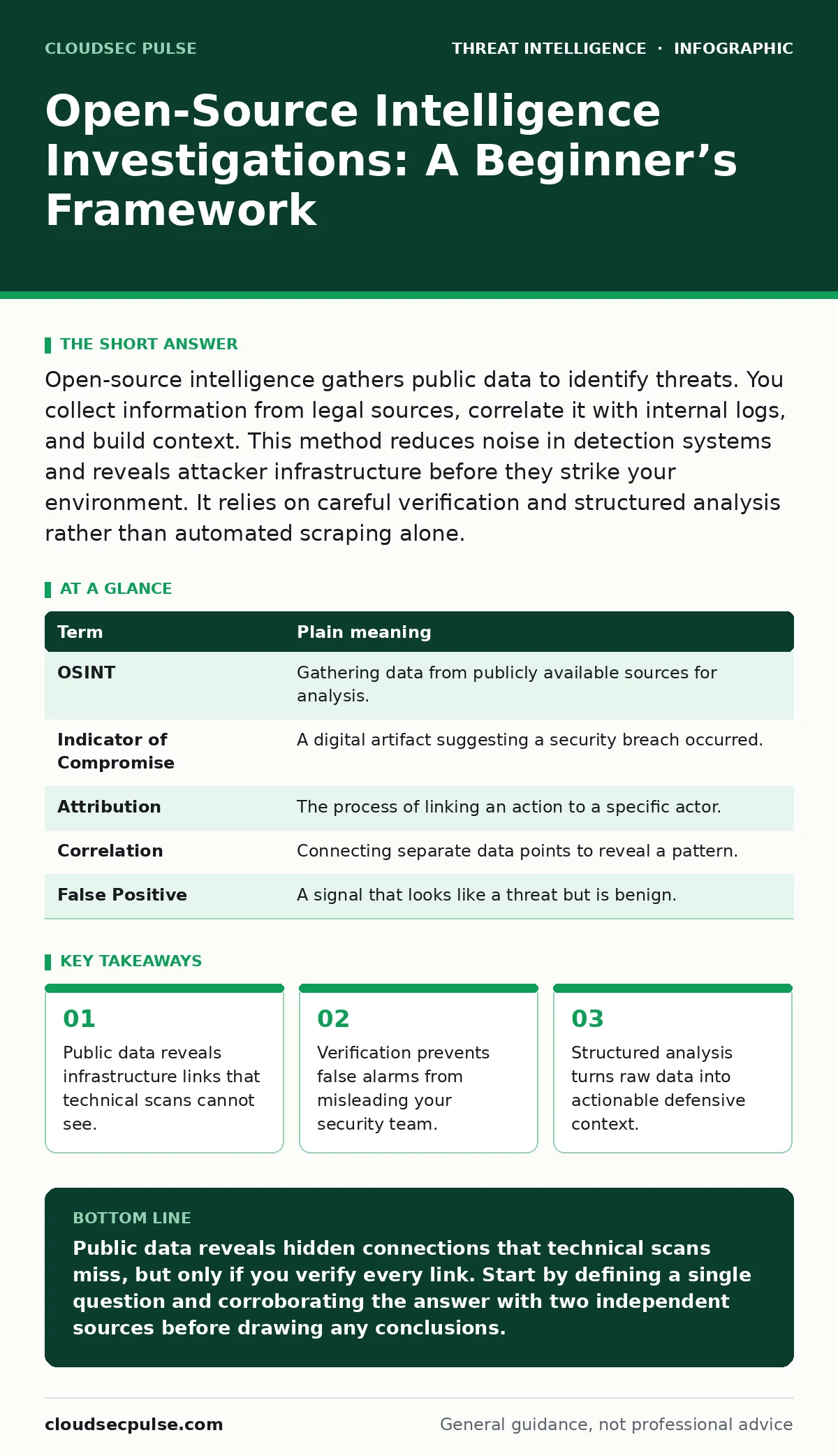
Open-source intelligence gathers public data to identify threats. You collect information from legal sources, correlate it with internal logs, and build context. This method reduces noise in detection systems and reveals attacker infrastructure before they strike your environment. It relies on careful verification and structured analysis rather than automated scraping alone.
The Library Investigation Analogy
Imagine you are a detective trying to find a suspect. You cannot enter their home, but you can read public records. You check property deeds to see who owns the house. You review court filings to find associates. You scan social media for photos that reveal habits. Each document is a clue. Alone, it means nothing. Together, they build a picture. You do not break laws to gather this. You use what is already open. This is the core of open-source intelligence.
Defining the Core Terms
Open-source intelligence relies on specific concepts. Understanding these terms prevents confusion during investigations. The table below defines the essential vocabulary for beginners.
| Term | Plain meaning |
|---|---|
| OSINT | Gathering data from publicly available sources for analysis. |
| Indicator of Compromise | A digital artifact suggesting a security breach occurred. |
| Attribution | The process of linking an action to a specific actor. |
| Correlation | Connecting separate data points to reveal a pattern. |
| False Positive | A signal that looks like a threat but is benign. |
The Hidden Cost of Verification
Most beginners assume public data is trustworthy. It is not. Anyone can register a domain name or create a social profile. Adversaries know this. They create fake identities to pollute the data stream. You must spend time verifying each connection. This verification is the hidden cost of OSINT. It takes more time than technical scanning. If you skip it, you waste resources chasing ghosts. This connects to the broader issue of false positives in threat detection, where noise drowns out real signals.
Connecting Dots Across Platforms
Single sources are rarely sufficient. A domain registration shows one owner. A social profile shows another. A job posting shows a third. You must correlate these. If the same phone number appears in all three, the confidence level rises. This cross-referencing reveals the true scope of an entity. It helps you understand the relationship between seemingly unrelated assets. This manual correlation is often more effective than automated tools for small teams.
Infrastructure Mapping Without Noise
Technical scans like port scanning can alert defenders. They generate noise. OSINT allows you to map infrastructure silently. You can find subdomains by reading certificate transparency logs. You can find cloud storage buckets by searching search engines. This reveals the attack surface without touching it. This silent mapping is a key advantage. It lets you understand the target before any interaction occurs. This approach complements tactical threat intelligence, which focuses on immediate adversary behavior.
See also: What Is the Difference Between STIX and TAXII? A Structural Breakdown · Hacktivism Explained: Defining Motives, Methods, and Mitigation
The Risk of Over-Collection
Collecting everything is a mistake. Too much data creates analysis paralysis. You cannot read every public post. You must define a hypothesis first. What are you trying to prove? Then collect only data that tests that hypothesis. This focus saves time. It prevents you from drowning in irrelevant information. Imagine trying to find a specific book in a library by reading every spine. It fails. You need a catalog. Your hypothesis is the catalog.
Practical Steps for Beginners
Start small. Do not try to map the whole internet. Pick one asset. Follow these steps to begin your first investigation.
- Define your specific question. What do you need to know?
- Search one public source for that answer.
- Verify the finding with a second independent source.
This process builds discipline. It prevents jumping to conclusions. It ensures your intelligence is solid. You can expand to more sources later. For now, master the verification loop. This method applies to understanding complex systems like fast flux DNS, where rapid changes require constant verification.
Integrating with Technical Defenses
OSINT does not replace technical tools. It enhances them. You use OSINT to generate hypotheses. You use technical tools to test them. For example, you find a suspicious domain via OSINT. You then check your firewall logs for connections to it. This integration reduces alert fatigue. It makes your detection systems smarter. You are no longer guessing. You are looking for specific things. This synergy is powerful. It turns passive data into active defense.
The Long-Term Value
Consistency matters more than speed. Regular OSINT builds a baseline. You learn what is normal for your industry. You spot deviations faster. This baseline helps you distinguish between routine noise and real threats. It takes months to build. It saves weeks during an incident. This long-term view is often ignored. Beginners want quick answers. They miss the value of patience. Invest in the baseline. It pays dividends. This foundational work supports advanced frameworks like STIX and TAXII, which standardize how threat data is shared and consumed.
Key takeaways
- Public data reveals infrastructure links that technical scans cannot see.
- Verification prevents false alarms from misleading your security team.
- Structured analysis turns raw data into actionable defensive context.
Public data reveals hidden connections that technical scans miss, but only if you verify every link. Start by defining a single question and corroborating the answer with two independent sources before drawing any conclusions.
Frequently asked questions
Is open-source intelligence legal?
Yes, if you only access publicly available information. Do not bypass paywalls, use stolen credentials, or scrape data against website terms of service.
How do I avoid false positives?
Always cross-reference findings with at least one independent source. Correlation between unrelated data points increases confidence and reduces error rates.
Can OSINT replace technical monitoring?
No. OSINT provides context and hypotheses. Technical tools like Snort and Suricata rules provide real-time detection. You need both for a complete defense.
How much time should I spend on OSINT?
Start with small, focused tasks. Consistent, short sessions are more effective than rare, long marathons. Integration into daily workflows yields the best results.
How this guide was produced: written by the CloudSec Pulse editorial team with AI assistance, checked against the public references listed below, and reviewed when the facts change. See our editorial policy or report an error.