Deploy YARA Rules for Small Business Threat Detection
Pattern matching identifies malware variants before signatures exist, turning static files into active threat indicators without heavy infrastructure.

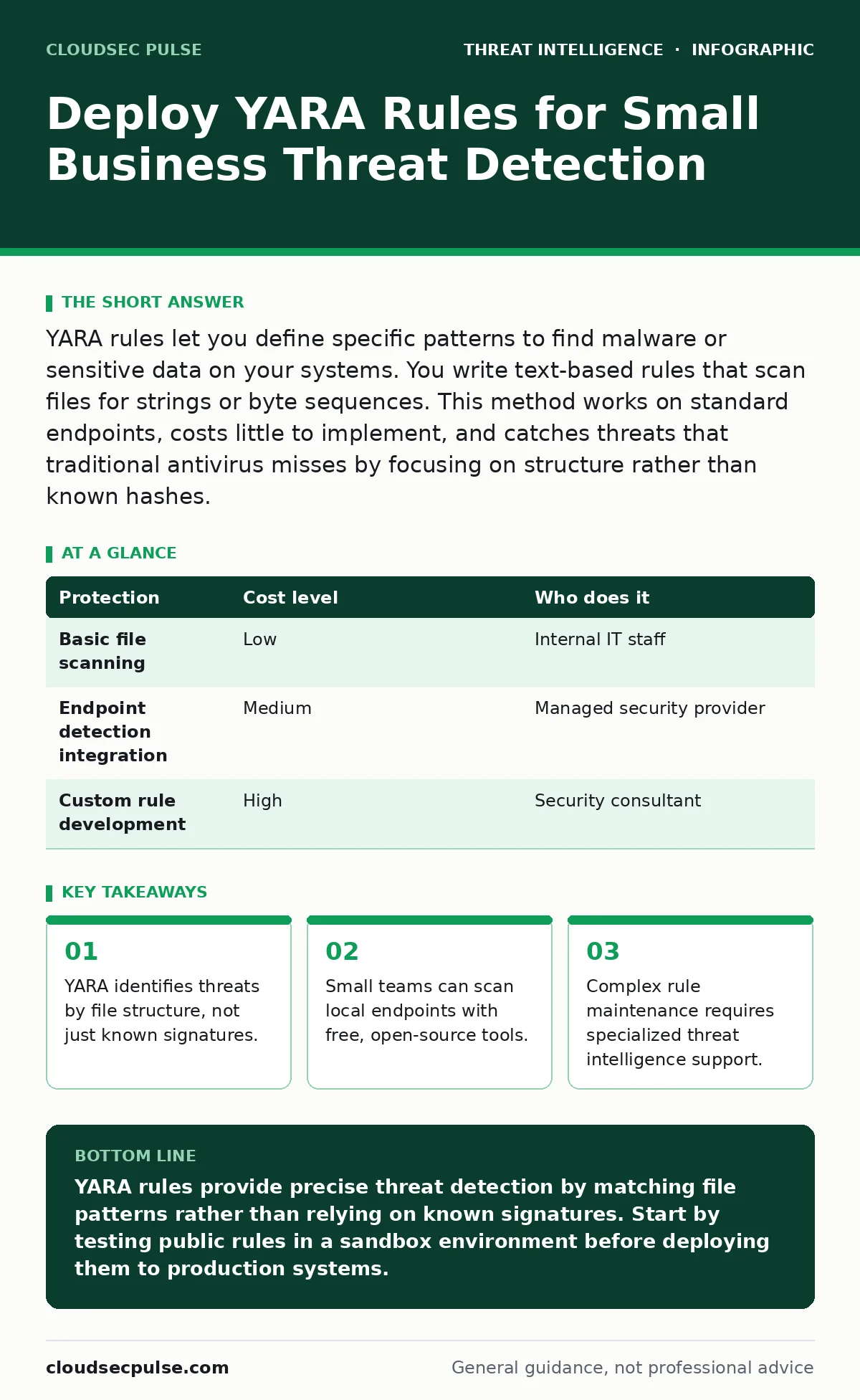
YARA rules let you define specific patterns to find malware or sensitive data on your systems. You write text-based rules that scan files for strings or byte sequences. This method works on standard endpoints, costs little to implement, and catches threats that traditional antivirus misses by focusing on structure rather than known hashes.
Why Pattern Matching Matters for Small Teams
Traditional antivirus relies on databases of known bad files. Attackers modify these files slightly to bypass detection. YARA rules look at the internal structure of a file. You define what a malicious file looks like. This approach catches new variants of known malware. It also finds hidden data exfiltration attempts. Small businesses often assume they are too small for targeted attacks. This assumption fails when attackers use automated tools. These tools do not care about company size. They scan for any vulnerable system. YARA provides a layer of defense that does not depend on vendor updates. It depends on your ability to describe the threat.
The Mechanics of YARA Rule Construction
A YARA rule consists of a header, a string section, and a condition. The header gives the rule a name and optional metadata. The string section defines what to look for. You can specify text strings, hexadecimal bytes, or regular expressions. The condition section defines logic. It states how many strings must be present to trigger a match. For example, a rule might require two specific strings to appear within 500 bytes of each other. This precision reduces false positives. False positives occur when benign files match the pattern. High false positive rates cause alert fatigue. Teams stop trusting the alerts. Precise conditions keep the signal clear.
| Protection | Cost level | Who does it |
|---|---|---|
| Basic file scanning | Low | Internal IT staff |
| Endpoint detection integration | Medium | Managed security provider |
| Custom rule development | High | Security consultant |
Affordable Implementation Strategies
You do not need expensive software to start using YARA. The YARA engine is open source. It runs on Windows, Linux, and macOS. You can install it on a single server or workstation. Schedule it to scan critical directories. This method works for static analysis. It examines files at rest. It does not inspect live network traffic. For live traffic, you need additional tools. Combine YARA with network traffic analysis to see what files are being transferred. This combination gives you visibility into both stored and moving data. The cost is primarily your time. You must learn the syntax. You must write and test rules.
Integrating YARA with Existing Tools
Many endpoint detection and response platforms support YARA. Check your current security stack. If your endpoint agent supports YARA, you can push rules to all devices. This centralizes management. You write the rule once. It applies everywhere. This approach scales better than manual scanning. It also provides consistent logging. You can correlate YARA alerts with other security events. For instance, if a YARA rule flags a file, check if that file attempted LSASS credential theft. This correlation helps you understand the attack chain. It moves you from simple detection to tactical threat intelligence. You begin to understand the attacker's goals.
What to Delegate to Experts
Writing effective YARA rules requires deep knowledge of malware behavior. You must understand binary formats. You must know how packers and obfuscators work. If your team lacks this expertise, delegate rule creation. Hire a consultant to write initial rules. They can identify patterns specific to your industry. They can also train your staff. Training reduces long-term costs. Your team can maintain simple rules. Experts handle complex threats. This hybrid model balances cost and capability. Do not try to write rules for every threat. Focus on the threats most likely to target you.
See also: User and Entity Behavior Analytics Explained for Beginners · Open-Source Intelligence Investigations: A Beginner’s Framework
Maintaining Rule Accuracy Over Time
YARA rules degrade over time. Attackers evolve their techniques. A rule that worked last month may fail today. You must update rules regularly. Review false positives weekly. Adjust conditions to exclude benign files. Review missed detections monthly. Update strings to reflect new variants. This maintenance is ongoing. It is not a one-time setup. Consider using STIX and TAXII standards for sharing threat intelligence. These standards allow you to import rules from trusted sources. They automate part of the update process. This reduces the manual workload. It keeps your defenses current.
Balancing Detection with Performance
Scanning large volumes of data consumes resources. YARA scanning uses CPU and memory. If you scan too frequently, it impacts user experience. Schedule scans during off-hours. Limit the scope of scans. Focus on high-risk directories. Exclude large log files or archives. Use incremental scanning where possible. This approach minimizes performance impact. It also reduces storage requirements for logs. You only store alerts, not full scan results. This efficiency matters for small businesses. You have limited hardware resources. You must optimize for speed and accuracy.
Advanced Use Cases for Small Teams
YARA can identify more than just malware. It can find sensitive data. Write rules to detect credit card numbers or social security numbers. This helps with compliance. It also prevents data leaks. You can use YARA to enforce software policies. Detect unauthorized applications. This gives you control over your environment. It complements other security measures. For example, use YARA to detect indicators of pass-the-ticket attacks. These attacks reuse authentication tokens. YARA can find the tools used to extract these tokens. This early detection stops lateral movement. It limits the damage of a breach.
Key takeaways
- YARA identifies threats by file structure, not just known signatures.
- Small teams can scan local endpoints with free, open-source tools.
- Complex rule maintenance requires specialized threat intelligence support.
YARA rules provide precise threat detection by matching file patterns rather than relying on known signatures. Start by testing public rules in a sandbox environment before deploying them to production systems.
Frequently asked questions
Can YARA detect ransomware before it encrypts files?
YARA can detect ransomware executables if you have a rule for their structure. It works best on static files. It does not stop active encryption processes once they start.
How often should I update my YARA rules?
Update rules whenever new threat intelligence becomes available. Review false positives weekly. Adjust conditions to maintain accuracy and reduce noise.
Is YARA difficult for non-technical staff to use?
Writing rules requires technical knowledge. Using pre-written rules is easier. Many tools provide a graphical interface. This makes management accessible to general IT staff.
Can YARA scan email attachments?
Yes, if your email gateway supports YARA integration. This allows you to scan attachments before they reach users. It blocks malicious files at the perimeter.
How this guide was produced: written by the CloudSec Pulse editorial team with AI assistance, checked against the public references listed below, and reviewed when the facts change. See our editorial policy or report an error.