Honeypots Checklist: Deploy Decoys to Catch Intruders Early
A properly isolated decoy system generates clean alert data by design, eliminating the noise that overwhelms traditional detection tools and revealing attacker tactics in real time.

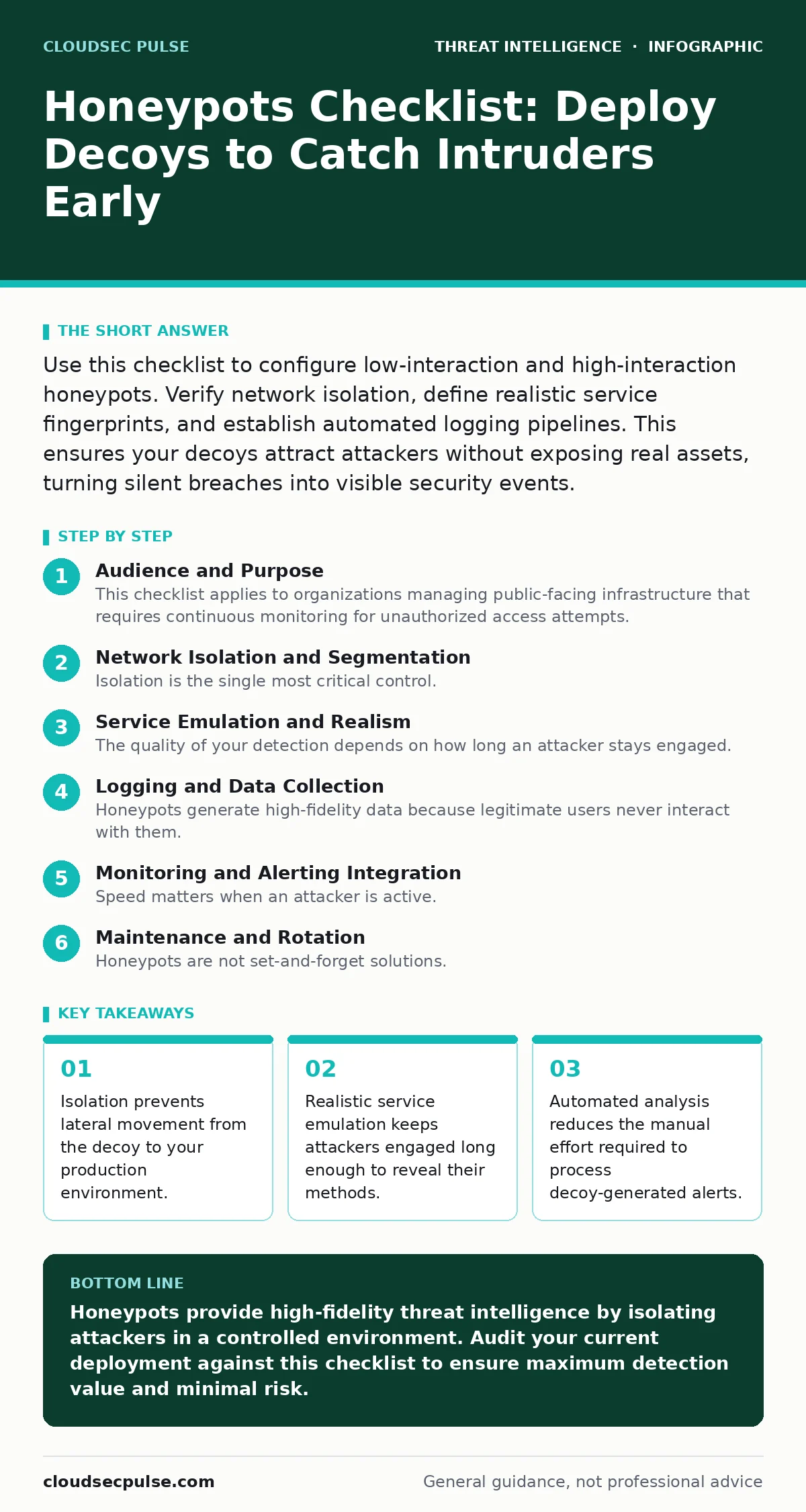
Use this checklist to configure low-interaction and high-interaction honeypots. Verify network isolation, define realistic service fingerprints, and establish automated logging pipelines. This ensures your decoys attract attackers without exposing real assets, turning silent breaches into visible security events.
Audience and Purpose
This checklist applies to organizations managing public-facing infrastructure that requires continuous monitoring for unauthorized access attempts. You use this list to verify that your decoy systems are configured to attract attention while remaining harmless to your actual operations. The goal is to shift detection earlier in the attack chain by creating attractive targets that trigger alerts when touched.
Network Isolation and Segmentation
- Place the honeypot on a dedicated VLAN: This prevents an attacker who compromises the decoy from pivoting to your internal network segments.
- Configure firewall rules to block outbound traffic from the decoy: This stops the compromised system from communicating with command-and-control servers or exfiltrating data from your real systems.
- Disable any bridge connections between the decoy and production hosts: This ensures that network promiscuous mode or ARP spoofing attempts cannot leak into your legitimate traffic lanes.
Isolation is the single most critical control. If an attacker realizes the decoy is connected to your core network, they may treat it as a beachhead. Proper segmentation ensures that even a full compromise of the decoy yields zero access to your actual data. This separation also simplifies the analysis phase, as you know any traffic originating from the decoy is malicious by definition.
Service Emulation and Realism
- Replicate common service banners and version strings: This prevents experienced attackers from immediately identifying the system as a fake based on minor textual discrepancies.
- Implement realistic delay times in responses: Instant responses can signal an automated script rather than a genuine server load, causing sophisticated adversaries to disengage.
- Include plausible but fake directory structures: This encourages attackers to browse and execute commands that reveal their toolset and intent.
The quality of your detection depends on how long an attacker stays engaged. If the decoy feels artificial, skilled operators will exit quickly, leaving you with little useful data. By mimicking the subtle imperfections of real systems, you encourage deeper interaction. This interaction provides the raw material for understanding their methods, which complements broader strategies discussed in guides on living-off-the-land attacks.
Logging and Data Collection
- Enable full packet capture for all inbound connections: This preserves the exact bytes sent by the attacker, allowing for precise malware analysis later.
- Record command-line inputs and outputs for interactive shells: This documents the specific commands used, revealing the attacker’s preferred tools and techniques.
- Store logs in an immutable, external repository: This ensures that if the attacker gains root access to the decoy, they cannot delete or alter the evidence.
Honeypots generate high-fidelity data because legitimate users never interact with them. This eliminates the problem of false positives that plagues traditional intrusion detection systems. However, this data volume can be overwhelming if not managed correctly. Structured logging allows you to correlate events across multiple decoys, providing a clearer picture of distributed scanning activities. This approach supports the principles outlined in frameworks like MITRE D3FEND by mapping specific attacker behaviors to defensive countermeasures.
Monitoring and Alerting Integration
- Configure immediate alerts for any successful authentication attempt: This signals a potential breach of the decoy’s simulated credentials, requiring immediate investigation.
- Integrate honeypot logs with your SIEM platform: This centralizes visibility and allows for correlation with alerts from your production environment.
- Set up automatic snapshotting of the decoy state: This preserves the filesystem state at the moment of compromise, aiding in post-incident analysis.
Speed matters when an attacker is active. Manual review of logs is too slow for real-time defense. Automated alerting ensures your team is notified the moment an anomaly occurs. This immediacy is vital for effective incident triage, allowing you to prioritize responses based on the severity of the interaction. The integration also helps distinguish between automated scanning bots and targeted human adversaries.
See also: User and Entity Behavior Analytics Explained for Beginners · Wormable Vulnerabilities: 10 FAQs on Self-Propagating Threats
Maintenance and Rotation
- Update decoy service signatures regularly: This keeps the emulation current with the latest software versions, preventing detection based on outdated fingerprints.
- Rotate IP addresses or ports periodically: This prevents attackers from marking your decoys as known safe zones in their scanning tools.
- Review and prune old logs to manage storage costs: This ensures that your logging infrastructure remains performant and cost-effective over time.
Honeypots are not set-and-forget solutions. Attackers adapt their scanning patterns to ignore known decoy signatures. Regular maintenance keeps your traps effective. Neglecting updates can lead to the honeypot being bypassed entirely, reducing its value to zero. This lifecycle management mirrors the continuous improvement needed in digital forensics and incident response capabilities.
Ethical and Legal Considerations
- Ensure compliance with local laws regarding data interception: This prevents legal issues related to recording traffic from users who may not be aware they are interacting with a decoy.
- Avoid deploying honeypots that could mislead emergency services: This ensures that critical infrastructure remains clearly identifiable for legitimate operational purposes.
- Document the purpose and scope of the honeypot deployment: This provides a clear audit trail and justifies the resource allocation for security leadership.
Deploying deceptive systems carries legal risks if not handled carefully. You must ensure that your honeypots do not inadvertently capture data from legitimate users or violate privacy regulations. Clear documentation protects your organization and clarifies the security strategy. This transparency supports a mature security culture that values both defense and compliance.
Key takeaways
- Isolation prevents lateral movement from the decoy to your production environment.
- Realistic service emulation keeps attackers engaged long enough to reveal their methods.
- Automated analysis reduces the manual effort required to process decoy-generated alerts.
Honeypots provide high-fidelity threat intelligence by isolating attackers in a controlled environment. Audit your current deployment against this checklist to ensure maximum detection value and minimal risk.
Frequently asked questions
Can a honeypot slow down my network?
No, because it is isolated on a separate segment. However, excessive logging can consume storage resources if not managed properly.
Do honeypots replace firewalls?
No, they complement firewalls by detecting traffic that bypasses perimeter defenses. Firewalls block known bad traffic; honeypots catch unknown or stealthy threats.
How do I know if an attacker found my honeypot?
You will see alerts in your monitoring dashboard. Since legitimate users never access decoys, any interaction is considered suspicious by design.
Are low-interaction honeypots better than high-interaction ones?
Low-interaction honeypots are easier to maintain and safer, while high-interaction ones provide deeper data but carry higher risk and complexity.
How this guide was produced: written by the CloudSec Pulse editorial team with AI assistance, checked against the public references listed below, and reviewed when the facts change. See our editorial policy or report an error.