IoT Device Vulnerabilities: Questions Answered for Secure Networks
Internet of Things devices often bypass standard security checks because they operate on distinct protocols that enterprise firewalls frequently ignore or mishandle.

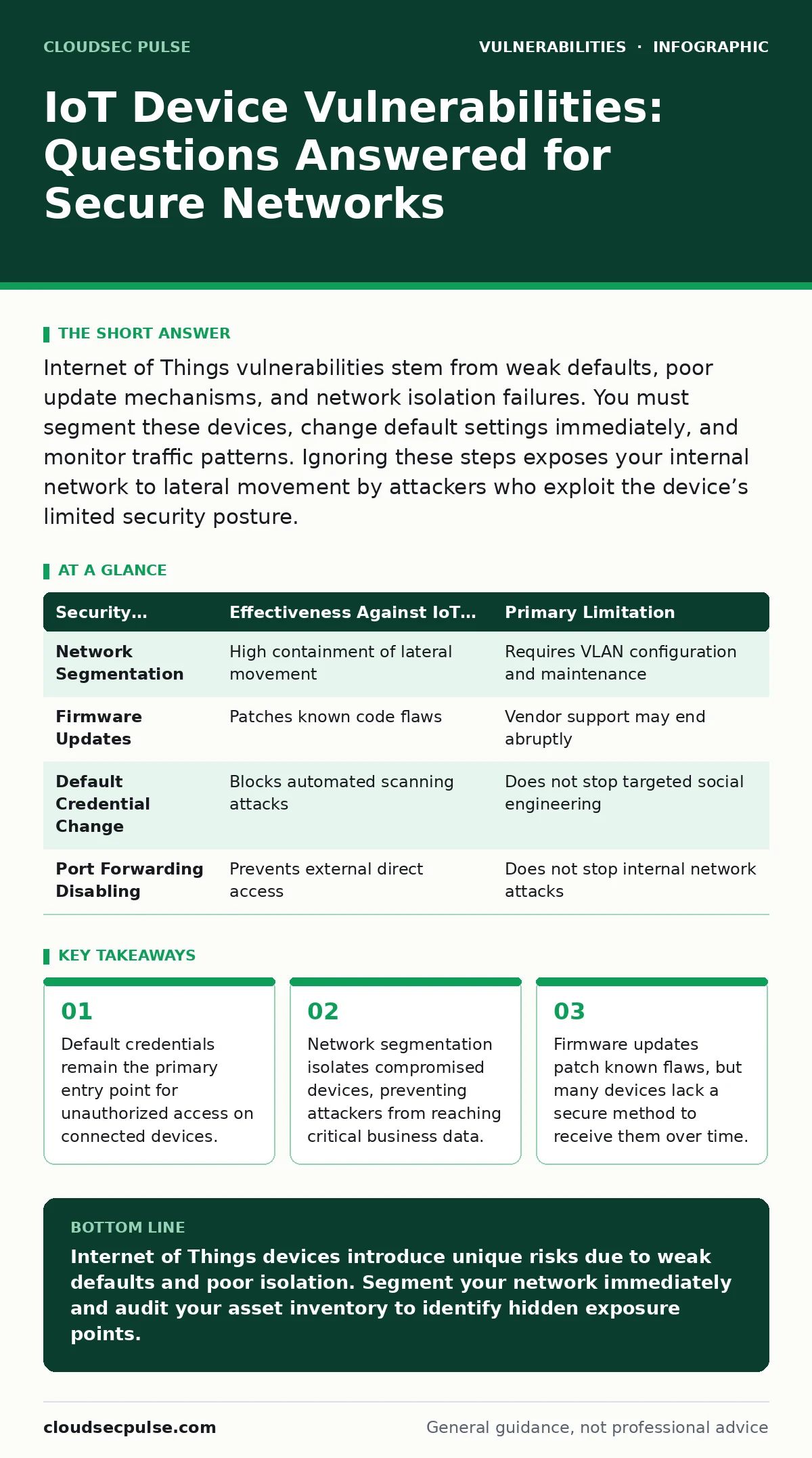
Internet of Things vulnerabilities stem from weak defaults, poor update mechanisms, and network isolation failures. You must segment these devices, change default settings immediately, and monitor traffic patterns. Ignoring these steps exposes your internal network to lateral movement by attackers who exploit the device’s limited security posture.
Why do IoT devices fail basic security checks?
Internet of Things devices often fail basic security checks because manufacturers prioritize speed to market and low production costs over rigorous security engineering. These devices frequently ship with open debugging ports, unused services, or weak cryptographic implementations. You cannot assume a device is secure simply because it connects to your network. The hardware constraints that make these devices cheap also limit their ability to run heavy security agents.
How do default credentials expose my network?
Default credentials allow anyone to log in to the device without knowing the specific password set by the owner. Attackers use automated tools to scan for devices still using factory-set usernames and passwords. This is a form of hard-coded credentials, where the login details are embedded in the software and cannot be changed by the user. Even if you change the password, some devices retain the old one for administrative backdoors.
Can IoT devices bypass my firewall?
Yes, IoT devices can bypass your firewall if they use proprietary protocols or communicate on non-standard ports. Firewalls are designed to filter common traffic like web browsing or email. They often allow UDP traffic or specific IoT protocols because blocking them would break device functionality. This creates a blind spot where malicious traffic hides inside legitimate device communications.
What is the risk of unpatched firmware?
Unpatched firmware leaves known security flaws open to exploitation indefinitely. Unlike computers, many IoT devices cannot install updates easily or at all. Manufacturers may stop providing updates after a short period, leaving the device vulnerable to newly discovered attacks. You must check whether the vendor has a history of releasing security patches. Without updates, the device becomes a permanent liability.
How does network segmentation protect me?
Network segmentation places IoT devices on a separate logical network that cannot access your main business systems. If an attacker compromises a smart thermostat, segmentation prevents them from moving laterally to your email server or database. This limits the blast radius of a breach. You should treat the IoT network as untrusted, regardless of the device’s reputation.
| Security Measure | Effectiveness Against IoT Threats | Primary Limitation |
|---|---|---|
| Network Segmentation | High containment of lateral movement | Requires VLAN configuration and maintenance |
| Firmware Updates | Patches known code flaws | Vendor support may end abruptly |
| Default Credential Change | Blocks automated scanning attacks | Does not stop targeted social engineering |
| Port Forwarding Disabling | Prevents external direct access | Does not stop internal network attacks |
Why is exposure management necessary for IoT?
Exposure management provides a continuous view of all connected assets and their vulnerabilities. Traditional IT asset inventory methods often miss IoT devices because they do not register with standard directory services. You need to know every device on your network to secure it. Automated discovery tools help identify rogue or forgotten devices that still have network access.
How do I prioritize which devices to fix first?
You should prioritize devices based on their network position and the sensitivity of the data they handle. A smart door lock poses a different risk than a decorative light bulb. Use an EPSS score to understand the likelihood of exploitation for known vulnerabilities. This helps you focus resources on the devices that pose the highest immediate risk to your operations. Proper vulnerability prioritization ensures you do not waste time on low-risk issues.
What is broken access control in IoT?
Broken access control occurs when a device fails to properly verify who is accessing its functions or data. An attacker might manipulate network packets to issue commands as if they were the administrator. This happens when the device trusts all incoming requests on a specific port. You must ensure that only authorized applications can communicate with your devices.
How does output encoding help IoT security?
Output encoding prevents attackers from injecting malicious code into the device’s interface or connected services. When a device sends data to a web dashboard, improper encoding can allow script injection. This turns the dashboard into a vector for stealing session cookies. Ensuring that data is properly encoded before display or processing closes this attack path.
Why should I care about prototype pollution?
Prototype pollution is a JavaScript vulnerability that can affect IoT devices with web-based configuration interfaces. If the device’s web server uses vulnerable libraries, attackers can modify core object properties. This can lead to privilege escalation or remote code execution. You must ensure that the web interface is isolated from critical device functions.
Key takeaways
- Default credentials remain the primary entry point for unauthorized access on connected devices.
- Network segmentation isolates compromised devices, preventing attackers from reaching critical business data.
- Firmware updates patch known flaws, but many devices lack a secure method to receive them over time.
Internet of Things devices introduce unique risks due to weak defaults and poor isolation. Segment your network immediately and audit your asset inventory to identify hidden exposure points.
Frequently asked questions
Can a smart speaker be hacked to listen to my conversations?
Yes, if the device’s firmware is compromised or the cloud account is breached, attackers can access audio streams. Microphone indicators are not always reliable security controls.
Do I need a separate network for every IoT device?
No, you can group low-risk devices on a single guest VLAN. However, high-risk devices like cameras or medical equipment should have their own isolated segments.
How do I know if my IoT device has been hacked?
Look for unusual network traffic, unexpected reboots, or changes in device settings. Monitoring baseline traffic patterns helps identify anomalies early.
Are mesh networks more secure than Wi-Fi for IoT?
Not necessarily. Mesh networks simplify connectivity but can complicate security monitoring. The security depends on the encryption and configuration of the individual nodes.
How this guide was produced: written by the CloudSec Pulse editorial team with AI assistance, checked against the public references listed below, and reviewed when the facts change. See our editorial policy or report an error.