Vulnerability Prioritization: Fix What Actually Breaks Your Business
Most security teams waste hours patching low-risk flaws while ignoring critical exposure paths that attackers exploit first.

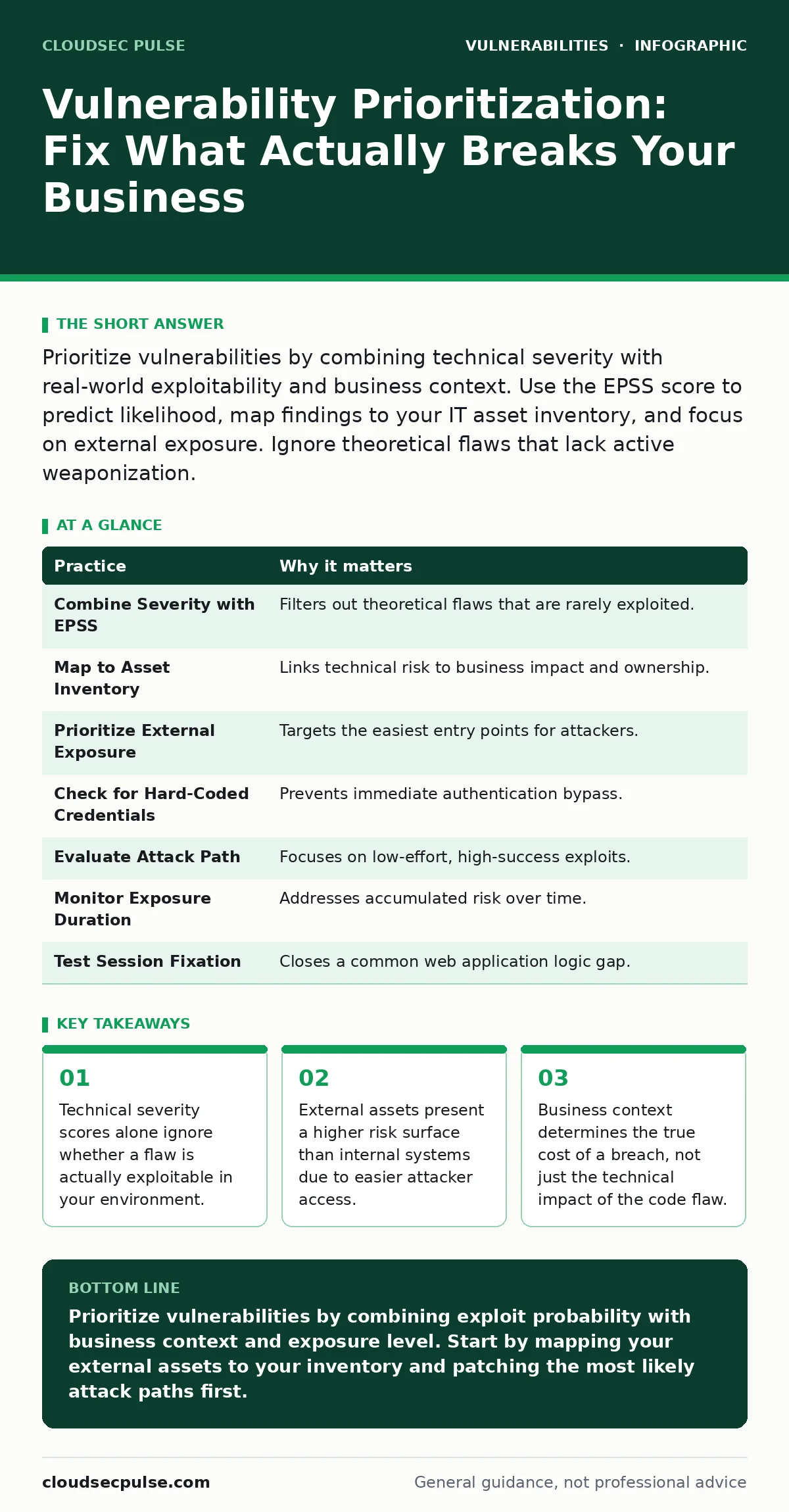
Prioritize vulnerabilities by combining technical severity with real-world exploitability and business context. Use the EPSS score to predict likelihood, map findings to your IT asset inventory, and focus on external exposure. Ignore theoretical flaws that lack active weaponization.
1. Combine Technical Severity with Exploit Probability
Traditional vulnerability management relies heavily on the Common Vulnerability Scoring System (CVSS). This system assigns a numerical value to the severity of a flaw based on technical factors like complexity and required privileges. However, a high CVSS score does not mean an attacker will target it. Many high-severity flaws require specific conditions that rarely occur in production. You need to layer an exploitability metric over the base severity. The EPSS score provides a probability that a vulnerability will be exploited in the wild. By multiplying technical severity by exploit probability, you filter out theoretical risks.
Tip: Set a threshold for the EPSS score. Only patch vulnerabilities with a high probability of exploitation unless they affect critical business functions.
2. Map Findings to Your IT Asset Inventory
A vulnerability scan produces a list of flaws, but it often fails to identify which specific business process runs on the affected server. Without this context, you cannot determine the impact of a breach. If a flaw exists on a decommissioned test server, it poses no risk to your operations. If it exists on your primary customer database, it is an emergency. You must maintain a current IT asset inventory that links every IP address and hostname to a business owner and function. This mapping allows you to triage based on value rather than just technical detail.
Tip: Tag assets in your inventory with business criticality levels. Automate the enrichment of scan results with these tags to sort remediation queues.
3. Prioritize External Exposure Over Internal Flaws
Attackers prefer easy targets. Systems exposed to the internet are reachable without any prior network intrusion. Internal systems are protected by firewalls, network segmentation, and authentication layers. A vulnerability on an internal server is significantly harder to exploit than the same flaw on a public-facing web server. You should treat external exposure as a primary sorting factor. Even a moderate-severity flaw on an external asset often warrants faster remediation than a critical flaw on an isolated internal machine. This approach aligns your efforts with attacker behavior patterns.
Tip: Use exposure management tools to continuously monitor your external attack surface. Cross-reference these findings with your internal vulnerability scan results.
4. Assess the Presence of Hard-Coded Credentials
Some vulnerabilities are not about broken code logic but about poor configuration or development habits. Hard-coded credentials allow attackers to bypass authentication entirely. If a scan identifies a system with embedded passwords, this is a critical failure regardless of other technical metrics. These credentials often persist across code updates and backups. They provide immediate access to attackers who discover the code repository or binary. This risk category requires immediate attention because it eliminates the need for complex exploit chains.
Tip: Integrate static application security testing into your development pipeline. Flag any commit that contains string patterns resembling passwords or keys.
5. Evaluate the Attack Path Complexity
Not all vulnerabilities require the same effort to exploit. Some flaws can be triggered with a single HTTP request from any browser. Others require a multi-stage attack where the attacker must first compromise a different system. You should prioritize flaws that have a low attack path complexity. These are the "front door" vulnerabilities. By fixing the easy entry points, you force attackers to work harder. This increases the likelihood of detection and reduces the chance of successful intrusion. Understanding the steps required to exploit a flaw helps you gauge the real-world threat.
Tip: Review the proof-of-concept exploits available for each vulnerability. If the exploit is simple and automated, prioritize the patch.
See also: Use EPSS Scores to Prioritize Vulnerability Patching · National Vulnerability Database Explained: How NVD Works for You
6. Consider the Duration of Exposure
The longer a vulnerability remains unpatched, the higher the chance it will be discovered and weaponized. Time is a critical factor in risk calculation. A newly disclosed flaw might have low exploit probability initially. However, that probability increases as attackers write scripts and tools to target it. You should prioritize vulnerabilities that have been known for a longer period. These flaws have had more time to be integrated into automated attack frameworks. Addressing older vulnerabilities reduces the accumulated risk in your environment.
Tip: Create a aging report for open vulnerabilities. Escalate any item that exceeds your defined maximum time-to-patch threshold.
7. Integrate Session Fixation Risks
Web applications often manage user state through sessions. Session fixation occurs when an attacker sets a known session ID for a victim. If the application does not invalidate the session ID upon login, the attacker gains access. This flaw is often overlooked in standard vulnerability scans because it requires dynamic interaction. It is distinct from simple cross-site scripting or output encoding errors. You must assess whether your application regenerates session tokens after authentication. Failure to do so creates a persistent backdoor for attackers.
Tip: Test your login flow manually. Verify that the session ID changes after a successful password entry.
8. Account for IoT Device Vulnerabilities
Internet of Things devices often lack standard patching mechanisms. Many run embedded operating systems that cannot be updated remotely. This creates a permanent risk surface. If an IoT device is connected to your network, it can serve as a pivot point for attackers. You cannot always patch these devices. Instead, you must isolate them. Network segmentation is the primary control for IoT vulnerabilities. Place these devices on a separate network segment with strict firewall rules. This limits the damage even if the device is compromised.
Tip: Disable unnecessary services on IoT devices. Turn off remote management ports if you do not need them.
| Practice | Why it matters |
|---|---|
| Combine Severity with EPSS | Filters out theoretical flaws that are rarely exploited. |
| Map to Asset Inventory | Links technical risk to business impact and ownership. |
| Prioritize External Exposure | Targets the easiest entry points for attackers. |
| Check for Hard-Coded Credentials | Prevents immediate authentication bypass. |
| Evaluate Attack Path | Focuses on low-effort, high-success exploits. |
| Monitor Exposure Duration | Addresses accumulated risk over time. |
| Test Session Fixation | Closes a common web application logic gap. |
| Isolate IoT Devices | Limits lateral movement from unpatchable hardware. |
9. Review Prototype Pollution Risks
If you use JavaScript in your applications, you must consider prototype pollution. This vulnerability allows attackers to inject properties into the base object prototype. It can lead to remote code execution or privilege escalation. This flaw is specific to JavaScript environments and is often missed by generic scanners. It requires specialized testing. If your application processes untrusted JSON data, you are at risk. You must validate and sanitize all incoming data structures. This practice protects your application logic from manipulation.
Tip: Use libraries that prevent prototype pollution by default. Ensure your team understands how JavaScript object inheritance works.
Key takeaways
- Technical severity scores alone ignore whether a flaw is actually exploitable in your environment.
- External assets present a higher risk surface than internal systems due to easier attacker access.
- Business context determines the true cost of a breach, not just the technical impact of the code flaw.
Prioritize vulnerabilities by combining exploit probability with business context and exposure level. Start by mapping your external assets to your inventory and patching the most likely attack paths first.
Frequently asked questions
How do I handle zero-day vulnerabilities?
Zero-days have no known patch. Focus on mitigation by restricting access, enabling logging, and isolating critical assets.
Should I patch development environments?
Yes, but with lower urgency. Development environments can be used as pivot points if connected to production networks.
What if a vendor refuses to patch a flaw?
Isolate the affected system. Use virtual patching via a web application firewall or network firewall to block the exploit.
How often should I review my prioritization strategy?
Review it quarterly. Changes in your technology stack or business goals may shift the risk landscape.
How this guide was produced: written by the CloudSec Pulse editorial team with AI assistance, checked against the public references listed below, and reviewed when the facts change. See our editorial policy or report an error.