Cloud Compliance Best Practices: 8 Steps to Secure Your Data
Compliance is not a static checklist but a continuous process of aligning technical controls with regulatory requirements to prevent data loss.

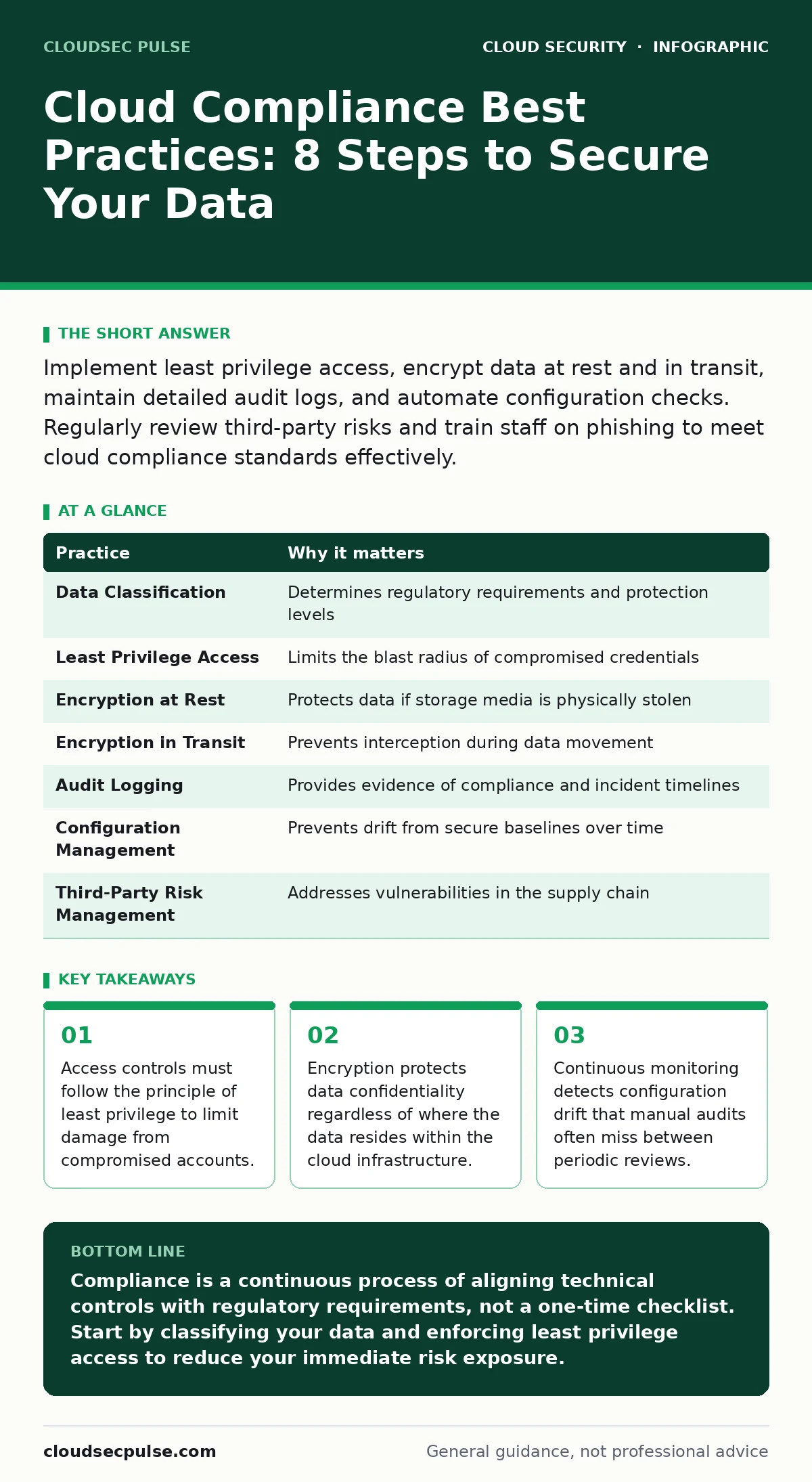
Implement least privilege access, encrypt data at rest and in transit, maintain detailed audit logs, and automate configuration checks. Regularly review third-party risks and train staff on phishing to meet cloud compliance standards effectively.
Define Scope and Data Classification
You cannot protect what you do not understand. Before applying controls, you must map your data flow and classify information based on sensitivity. This classification determines which regulations apply and what level of protection is required. Treating all data as equally sensitive wastes resources, while treating all data as public invites breach.
Imagine you store customer payment details alongside internal design notes. The payment data requires strict encryption and access logging, while the design notes may need only basic access controls. This distinction drives your entire security strategy.
| Practice | Why it matters |
|---|---|
| Data Classification | Determines regulatory requirements and protection levels |
| Least Privilege Access | Limits the blast radius of compromised credentials |
| Encryption at Rest | Protects data if storage media is physically stolen |
| Encryption in Transit | Prevents interception during data movement |
| Audit Logging | Provides evidence of compliance and incident timelines |
| Configuration Management | Prevents drift from secure baselines over time |
| Third-Party Risk Management | Addresses vulnerabilities in the supply chain |
| Employee Training | Reduces human error and social engineering success |
Enforce Least Privilege Access
The principle of least privilege means granting users only the permissions they need to perform their specific job functions. In cloud environments, default permissions are often overly broad to facilitate rapid development. This convenience creates a massive attack surface. If an attacker compromises a developer account with admin rights, they control your entire infrastructure.
You must review permissions regularly. Access that was necessary for a project six months ago may no longer be required today. Stale permissions are a common entry point for lateral movement.
Encrypt Data at Rest and in Transit
Encryption transforms readable data into ciphertext using mathematical algorithms. Data at rest refers to information stored on disks, databases, or backups. Data in transit refers to information moving between servers, users, and services. You must encrypt both states to meet most compliance frameworks.
Key management is the hidden cost of encryption. If you lose your encryption keys, you lose your data forever. If an attacker steals your keys, encryption provides no protection. Use a dedicated key management service that separates key storage from data storage. This ensures that even if the data store is breached, the keys remain secure.
Maintain Immutable Audit Logs
Audit logs record who did what, when, and where in your cloud environment. These logs are your primary evidence during a compliance audit or incident investigation. Without them, you cannot prove that your controls are working or identify the root cause of a breach.
You must make these logs immutable. Immutable logs cannot be altered or deleted after creation. This prevents attackers from covering their tracks after a breach. Store logs in a separate, locked-down account or service that even administrators cannot modify. This separation of duties is a core requirement for many standards.
Automate Configuration Checks
Manual configuration reviews are slow and prone to human error. Cloud environments change constantly as new resources are spun up and torn down. A configuration that is secure today may be misconfigured tomorrow due to a routine update or a new developer’s mistake.
You need automated tools that continuously compare your actual configuration against a secure baseline. This practice, known as configuration drift detection, alerts you the moment a setting changes. For example, if a storage bucket becomes public, the system flags it immediately. This approach is far more effective than quarterly manual audits.
See also: Data Sovereignty FAQ: How Location Laws Control Your Cloud Data · Implement CASB Step-by-Step: Configuration, Validation, and Maintenance
Manage Third-Party Risks
Your cloud provider is a third party, but so are the software vendors and SaaS applications you integrate with. You are responsible for the security of your data, even when it resides outside your direct control. A breach in a smaller vendor can expose your customer data and violate compliance obligations.
You must assess the security posture of every vendor that touches your data. Do not rely on their marketing claims. Review their security certifications and incident response plans. Understand how they handle data breaches and whether they notify you promptly. This due diligence protects your reputation and legal standing.
Implement Continuous Monitoring
Static point-in-time checks are insufficient for dynamic cloud environments. Threats evolve rapidly, and attackers exploit misconfigurations within minutes of discovery. Continuous monitoring provides real-time visibility into your security posture.
You should deploy tools that analyze traffic patterns and system behavior for anomalies. For instance, a sudden spike in data exfiltration to an unknown region indicates a potential breach. These tools allow you to respond before significant damage occurs. This proactive stance is required by many modern compliance frameworks.
Train Staff on Security Hygiene
Technology controls fail if users bypass them through error or malice. Phishing remains a primary method for attackers to gain initial access. Employees who cannot identify suspicious emails are a liability, regardless of your technical defenses.
Training must be ongoing and realistic. Generic annual videos are ineffective. Use simulated phishing campaigns to test awareness and provide immediate feedback. This reinforces good habits and highlights vulnerabilities in human behavior. Security is a cultural issue, not just a technical one.
Review Access Regularly
Access reviews are formal processes where managers verify that their team members still need their current permissions. This process catches orphaned accounts and excessive privileges. It is a mandatory requirement for most compliance standards.
You must automate this process as much as possible. Sending email reminders to managers often results in ignored requests or rubber-stamped approvals. Integrate access reviews into your identity management workflow. This ensures that permissions are validated consistently and documented for auditors.
Key takeaways
- Access controls must follow the principle of least privilege to limit damage from compromised accounts.
- Encryption protects data confidentiality regardless of where the data resides within the cloud infrastructure.
- Continuous monitoring detects configuration drift that manual audits often miss between periodic reviews.
Compliance is a continuous process of aligning technical controls with regulatory requirements, not a one-time checklist. Start by classifying your data and enforcing least privilege access to reduce your immediate risk exposure.
Frequently asked questions
How often should I perform access reviews?
You should perform access reviews at least quarterly for high-privilege accounts and annually for standard user accounts, depending on your regulatory requirements.
Does encryption alone ensure compliance?
No, encryption is only one control. You must also manage keys securely, monitor access, and maintain audit logs to meet full compliance standards.
Who is responsible for cloud security?
You share responsibility with your cloud provider. They secure the infrastructure, while you secure your data, applications, and access controls.
What is the first step in cloud compliance?
The first step is data classification. You must identify what data you have, where it is, and how sensitive it is to determine the necessary controls.
How this guide was produced: written by the CloudSec Pulse editorial team with AI assistance, checked against the public references listed below, and reviewed when the facts change. See our editorial policy or report an error.