Data Sovereignty FAQ: How Location Laws Control Your Cloud Data
Your data’s physical location determines which government can demand access, regardless of your company’s privacy policies or contractual agreements.

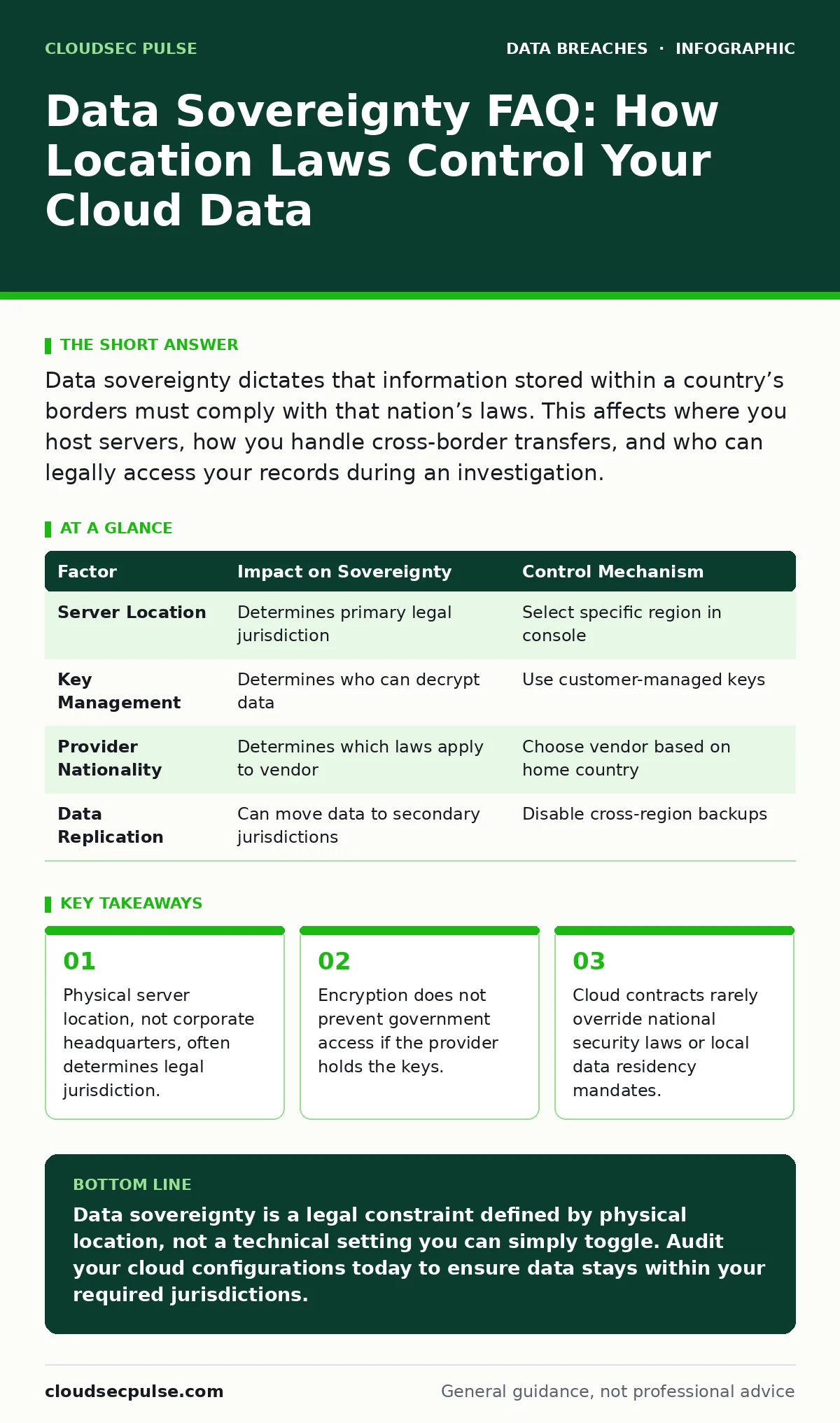
Data sovereignty dictates that information stored within a country’s borders must comply with that nation’s laws. This affects where you host servers, how you handle cross-border transfers, and who can legally access your records during an investigation.
What is data sovereignty?
Data sovereignty is the concept that digital data is subject to the laws and governance structures of the nation in which it is physically located. It differs from data privacy, which focuses on consent and usage rights. Sovereignty determines which government has the legal authority to inspect, seize, or regulate that information.
Where does my data actually live?
Your data resides on physical hardware in a specific geographic region, often far from your office. Cloud providers operate massive data centers distributed across multiple countries to ensure redundancy and speed. Even if you select a region like "US East," your data might replicate to secondary sites in other jurisdictions for backup purposes.
How does sovereignty differ from residency?
Data residency is a contractual choice to store data in a specific location. Data sovereignty is the legal reality that imposes local laws on that stored data. You can choose residency, but you cannot contract away sovereignty. If you store data in Germany, German law applies, even if your contract says otherwise.
Can encryption prevent foreign access?
Encryption scrambles data so only authorized parties can read it, but it does not hide the data’s location. If a foreign government seizes the server, they also seize the encrypted file. If your cloud provider holds the decryption keys, they can be compelled to decrypt the data. End-to-end encryption helps only if you hold the keys and the provider cannot access the plaintext.
Which countries have strict sovereignty laws?
Many nations enforce strict data localization requirements for specific types of information. These laws often target health records, financial data, or government-related information. The goal is usually national security or economic protectionism. Ignoring these laws can result in service termination or legal penalties.
See also: Cloud Compliance Best Practices: 8 Steps to Secure Your Data · What Does Data Residency Mean: Control Where Your Cloud Data Lives
How does the CLOUD Act change things?
The CLOUD Act allows US authorities to request data held by US companies, even if that data is stored on servers outside the United States. This creates a conflict with countries that require data to stay within their borders. It means your data is not safe from US reach just because it sits in a European data center.
What risks do cross-border transfers create?
Moving data between countries exposes it to interception and varying legal standards during transit. Each handoff increases the attack surface and complicates compliance audits. You must ensure the destination country offers an adequate level of protection. Otherwise, you risk violating local regulations and exposing sensitive information to lower-security environments.
How do I verify my provider’s location?
You must review your service agreement and technical documentation to confirm where primary and backup copies are stored. Ask for a data flow diagram that shows every point of storage and transit. Do not rely on marketing claims about "global infrastructure." Verify the specific data center locations listed in the provider’s compliance reports.
| Factor | Impact on Sovereignty | Control Mechanism |
|---|---|---|
| Server Location | Determines primary legal jurisdiction | Select specific region in console |
| Key Management | Determines who can decrypt data | Use customer-managed keys |
| Provider Nationality | Determines which laws apply to vendor | Choose vendor based on home country |
| Data Replication | Can move data to secondary jurisdictions | Disable cross-region backups |
Who owns the decryption keys?
If your cloud provider manages the keys, they can access your data at any time. This is convenient for recovery but risky for sovereignty. If you manage the keys, you retain control, but you also bear the responsibility for key rotation and backup. Losing your keys means losing your data forever. For deep technical details, see our guide on encryption key management.
How does this affect breach notifications?
A data breach in one country may trigger notification requirements in multiple jurisdictions. You must comply with the laws of every country where the data resided. This can lead to conflicting deadlines and reporting formats. Understanding these obligations is critical for managing customer breach notification letters effectively.
What is the cost of compliance?
Enforcing sovereignty requires additional infrastructure, legal review, and monitoring. You may need to spin up separate environments for different regions. This increases operational complexity and reduces the economies of scale that cloud computing offers. The trade-off is between legal safety and operational efficiency.
How do I handle international employees?
Employees in different countries may generate data that falls under local sovereignty laws. Accessing that data from another country can violate local regulations. You must implement strict access controls and data classification policies. See our guide on data minimization to learn how to reduce the volume of sensitive data you collect.
What about third-party processors?
Third-party vendors often process data in their own infrastructure, which may be in a different country. You are responsible for their compliance as well. Ensure your contracts include strict data location clauses. Regular audits are necessary to verify they are not moving data unexpectedly. This relates closely to database security practices and vendor risk management.
How do I prove compliance?
You need documented evidence of where your data is stored and who can access it. Maintain logs of data transfers and access requests. Regular third-party audits provide independent verification. These records are essential if you face a legal challenge or regulatory inquiry. They also support your cyber insurance claims by demonstrating due diligence.
What happens if I violate sovereignty laws?
Violations can result in fines, service suspension, or criminal charges. The severity depends on the type of data and the country involved. Some nations block access to non-compliant services entirely. This can disrupt your business operations and damage your reputation.
How does this relate to credential exposure?
If attackers compromise your credentials, they can move data to jurisdictions of their choice. This bypasses your sovereignty controls entirely. Strong authentication and monitoring are vital to prevent unauthorized data movement. See our guide on credential exposure for strategies to protect access points.
What is the future of data sovereignty?
Governments are increasingly asserting control over digital data. Expect more localization laws and stricter enforcement. Cloud providers will need to offer more granular control over data location. You will need to adapt your architecture to accommodate these changes. This trend intersects with broader data breaches prevention strategies and international trade policies.
Key takeaways
- Physical server location, not corporate headquarters, often determines legal jurisdiction.
- Encryption does not prevent government access if the provider holds the keys.
- Cloud contracts rarely override national security laws or local data residency mandates.
Data sovereignty is a legal constraint defined by physical location, not a technical setting you can simply toggle. Audit your cloud configurations today to ensure data stays within your required jurisdictions.
Frequently asked questions
Does deleting data remove sovereignty obligations?
No, you must ensure complete erasure from all backups and caches. Residual copies may still be subject to local laws until fully destroyed.
Can I use a VPN to bypass sovereignty laws?
No, a VPN masks network traffic but does not change the physical location of stored data. Government requests target the storage provider, not the network path.
Is public data subject to sovereignty laws?
Yes, if the data is stored on servers within a country’s borders, it is subject to that country’s laws regardless of its public status.
How do I handle data backups in the cloud?
Treat backups with the same sovereignty requirements as primary data. Ensure backup locations comply with the same legal jurisdictions as your production environment.
How this guide was produced: written by the CloudSec Pulse editorial team with AI assistance, checked against the public references listed below, and reviewed when the facts change. See our editorial policy or report an error.