Data Center Resilience Myths That Undermine Your Cloud Strategy
Most organizations confuse resilience with redundancy, ignoring that shared infrastructure risks and silent configuration drift can bypass even the most expensive disaster recovery plans.

Data center resilience planning is not just about buying extra servers or trusting cloud providers implicitly. It requires active testing of failover mechanisms, strict isolation of critical workloads, and continuous verification of configuration states. Misunderstanding these concepts leaves systems vulnerable to cascading failures that simple redundancy cannot prevent.
Misreading: Redundancy Equals Resilience
Correct reading: Redundancy provides duplicate components, but resilience requires the system to survive failure modes that redundancy cannot predict. You might have 2 identical servers, but if they share a power distribution unit or a network switch, a single hardware fault takes both offline. Resilience planning must map physical dependencies, not just logical connections.
Imagine a setup where 2 virtual machines run on different hosts, but those hosts draw power from the same rack. A cooling failure in that rack shuts down both hosts simultaneously. The redundancy was logical, not physical. You must separate failure domains by ensuring independent power, cooling, and network paths for critical services.
This distinction matters because cloud providers often abstract these physical details. You must verify that your high-availability setup spans multiple availability zones or data centers. If your architecture relies on a single region, a regional outage affects all your redundant instances. True resilience requires geographic distribution, not just local duplication.
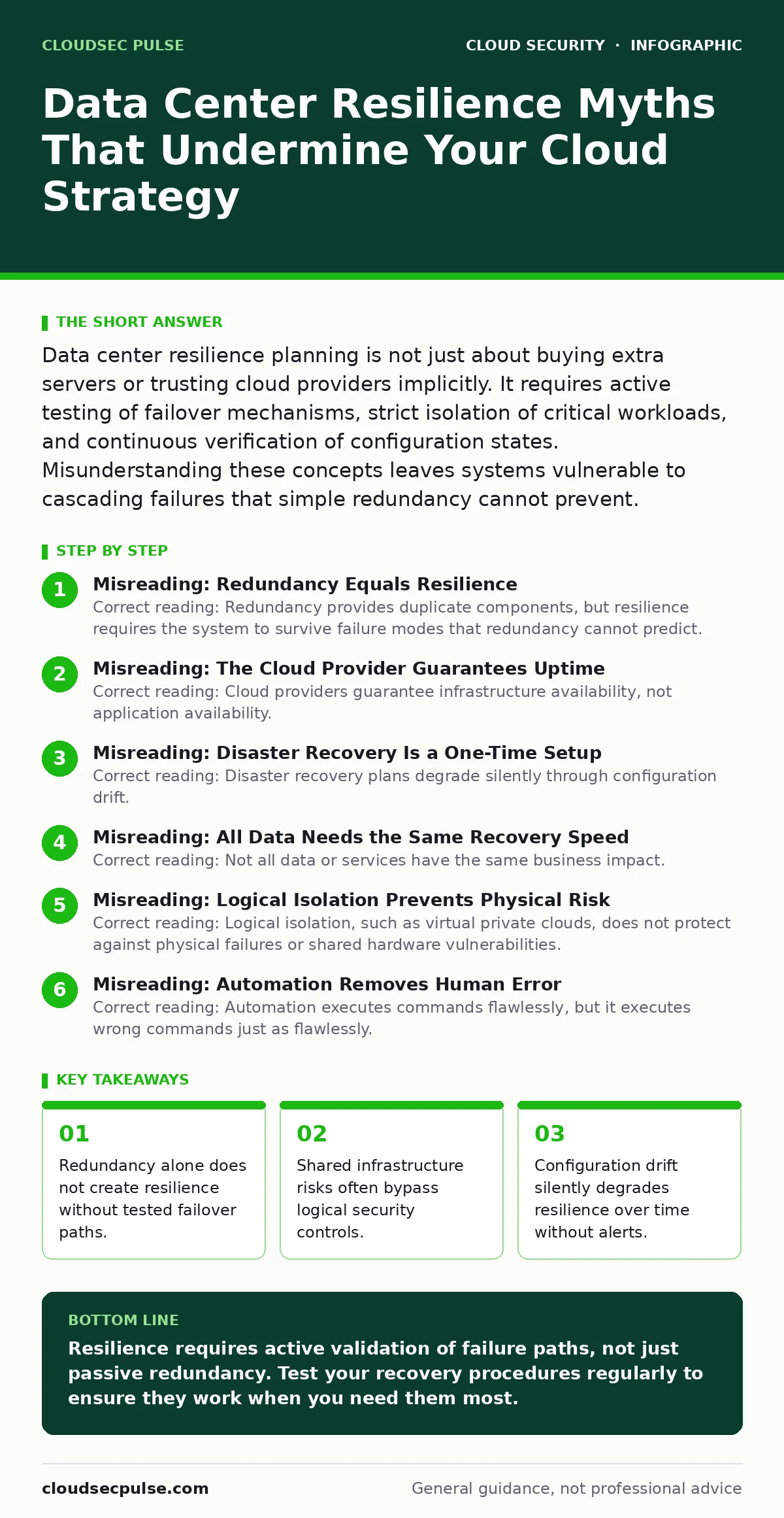
Misreading: The Cloud Provider Guarantees Uptime
Correct reading: Cloud providers guarantee infrastructure availability, not application availability. Your responsibility begins where their infrastructure ends. If your application code contains a memory leak or a deadlock, the underlying servers may run perfectly, but your service will fail. The provider’s uptime commitment does not cover your configuration errors or software bugs.
Your application still crashes if a database connection pool exhausts its resources during a traffic spike. The provider’s metrics show green status, but your customers see errors. This gap is where most resilience plans fail. You must monitor your application health independently of infrastructure health.
See also: cloud security architecture
You need to implement health checks that verify end-to-end functionality, not just server ping responses. These checks should trigger automatic remediation or failover when application metrics degrade. Relying solely on provider status pages leaves you blind to application-level failures that occur within a healthy infrastructure.
Misreading: Disaster Recovery Is a One-Time Setup
Correct reading: Disaster recovery plans degrade silently through configuration drift. Servers change, dependencies shift, and documentation becomes obsolete. A plan tested once a year may fail because the current environment differs significantly from the tested environment. Resilience requires continuous validation, not periodic checkbox exercises.
Imagine a team updates a firewall rule to allow new traffic but forgets to update the disaster recovery site’s firewall. When the primary site fails, traffic cannot reach the backup site. The recovery plan exists, but it is broken. This happens because resilience is a state, not an artifact. The environment must be kept in sync with the plan.
See also: cloud compliance
Automate your disaster recovery testing. Use infrastructure as code to define your recovery environment and test failovers regularly. This ensures that the backup environment matches the production environment. Manual updates introduce errors that accumulate over time, creating a false sense of security. Regular testing exposes these gaps before a real incident occurs.
Misreading: All Data Needs the Same Recovery Speed
Correct reading: Not all data or services have the same business impact. Applying the same Recovery Time Objective to a database and a static website wastes resources and complicates recovery. You must classify data by criticality and assign different recovery strategies. This prioritization ensures that critical services recover first during an incident.
Suppose your email server and your customer-facing payment gateway are on the same recovery timeline. Restoring the email server first delays the payment gateway, causing revenue loss. By classifying the payment gateway as critical, you allocate more resources to its recovery. This approach optimizes both cost and business continuity.
See also: cloud encryption
Define Recovery Point Objectives for each data tier. Critical transactional data may require near-zero data loss, while archived logs can tolerate hours of loss. This differentiation allows you to use faster, more expensive storage for critical data and slower, cheaper storage for non-critical data. It balances resilience with economic reality.
Misreading: Logical Isolation Prevents Physical Risk
Correct reading: Logical isolation, such as virtual private clouds, does not protect against physical failures or shared hardware vulnerabilities. If multiple tenants share the same hypervisor, a bug in that hypervisor could compromise all tenants. You must assume that physical boundaries are porous and design for worst-case scenarios.
Imagine a scenario where a firmware update fails on a shared storage array. Even if your data is logically separated, the physical failure affects all data on that array. Logical controls cannot prevent this. You must distribute data across physically independent storage systems. This reduces the blast radius of a single hardware failure.
See also: identity as the new perimeter
Use encryption at rest to protect data even if physical media is compromised. This adds a layer of security that survives infrastructure failures. However, encryption keys must be managed separately from the encrypted data. If the key management system fails, you cannot decrypt your data, creating a new single point of failure.
Misreading: Automation Removes Human Error
Correct reading: Automation executes commands flawlessly, but it executes wrong commands just as flawlessly. If your automation script contains a logic error, it will apply that error across all systems simultaneously. Resilience planning must include safeguards against automated mistakes, such as approval gates and rollback mechanisms.
Suppose an automated script misinterprets a configuration change and deletes critical files. Without safeguards, this error propagates instantly. You must implement change control processes that verify automation outcomes. This includes testing scripts in isolated environments before applying them to production.
See also: MFA for cloud accounts
Add human-in-the-loop checks for critical operations. Automation should handle routine tasks, but high-impact changes require manual verification. This hybrid approach combines the speed of automation with the judgment of human operators. It prevents catastrophic errors that pure automation might accelerate.
Misreading: Monitoring Alerts Equal Resilience Awareness
Correct reading: Monitoring tools generate noise, not insight. An alert tells you something happened, but it does not tell you if your resilience plan worked. You need observability that correlates events across infrastructure, application, and business layers. This correlation reveals whether a failure was contained or cascaded.
Imagine receiving 50 alerts during a server outage. Without correlation, you cannot tell if the outage is isolated or spreading. You must group alerts by root cause and impact. This reduces noise and highlights true resilience failures. It allows your team to focus on fixing the underlying issue, not reacting to symptoms.
See also: cloud penetration testing
Define clear metrics for resilience, such as mean time to recovery and failure rate. Track these metrics over time to identify trends. If your mean time to recovery increases, your resilience is degrading. Use this data to adjust your plans and resources. Monitoring should drive improvement, not just alerting.
Misreading: Resilience Is Only for Large Enterprises
Correct reading: Small organizations face the same technical risks as large ones, often with fewer resources to absorb impact. A single data center failure can be existential for a small business. Resilience planning is not about budget size; it is about risk tolerance and business continuity needs. Every organization must define what failure means to them.
Suppose a small e-commerce store relies on a single cloud region. A regional outage stops all sales. The financial impact is immediate and severe. By implementing basic failover to a secondary region, even with limited resources, the business can survive. Resilience is proportional to risk, not company size.
See also: cloud workload protection
Start with critical services. Identify the 3 most important applications and ensure they have a recovery path. You do not need to protect every system equally. Focus on the services that generate revenue or maintain customer trust. This targeted approach maximizes resilience within budget constraints.
Key takeaways
- Redundancy alone does not create resilience without tested failover paths.
- Shared infrastructure risks often bypass logical security controls.
- Configuration drift silently degrades resilience over time without alerts.
- Recovery Time Objectives must account for human operational limits.
Resilience requires active validation of failure paths, not just passive redundancy. Test your recovery procedures regularly to ensure they work when you need them most.
Frequently asked questions
How often should I test my disaster recovery plan?
Test critical recovery paths quarterly and non-critical paths annually. Frequent testing exposes configuration drift and ensures your team remains proficient in recovery procedures.
Can I use the same cloud provider for both primary and backup sites?
Yes, but ensure they are in different geographic regions. This protects against regional outages. However, diversifying providers adds another layer of resilience against provider-specific issues.
What is the biggest mistake in resilience planning?
Assuming redundancy equals resilience. Redundancy provides duplicates, but resilience requires tested failover mechanisms and independent failure domains. Without testing, redundancy is just extra cost.
How do I balance cost with resilience needs?
Classify services by business criticality. Allocate more resources to high-impact services and use cost-effective solutions for low-impact ones. This ensures you spend wisely on what matters most.
How this guide was produced: written by the CloudSec Pulse editorial team with AI assistance, checked against the public references listed below, and reviewed when the facts change. See our editorial policy or report an error.