Data Minimization: Cut Breach Risk by Deleting What You Do Not Need
Reducing stored data lowers the value of your organization to attackers, making security controls more effective and breach costs significantly lower.

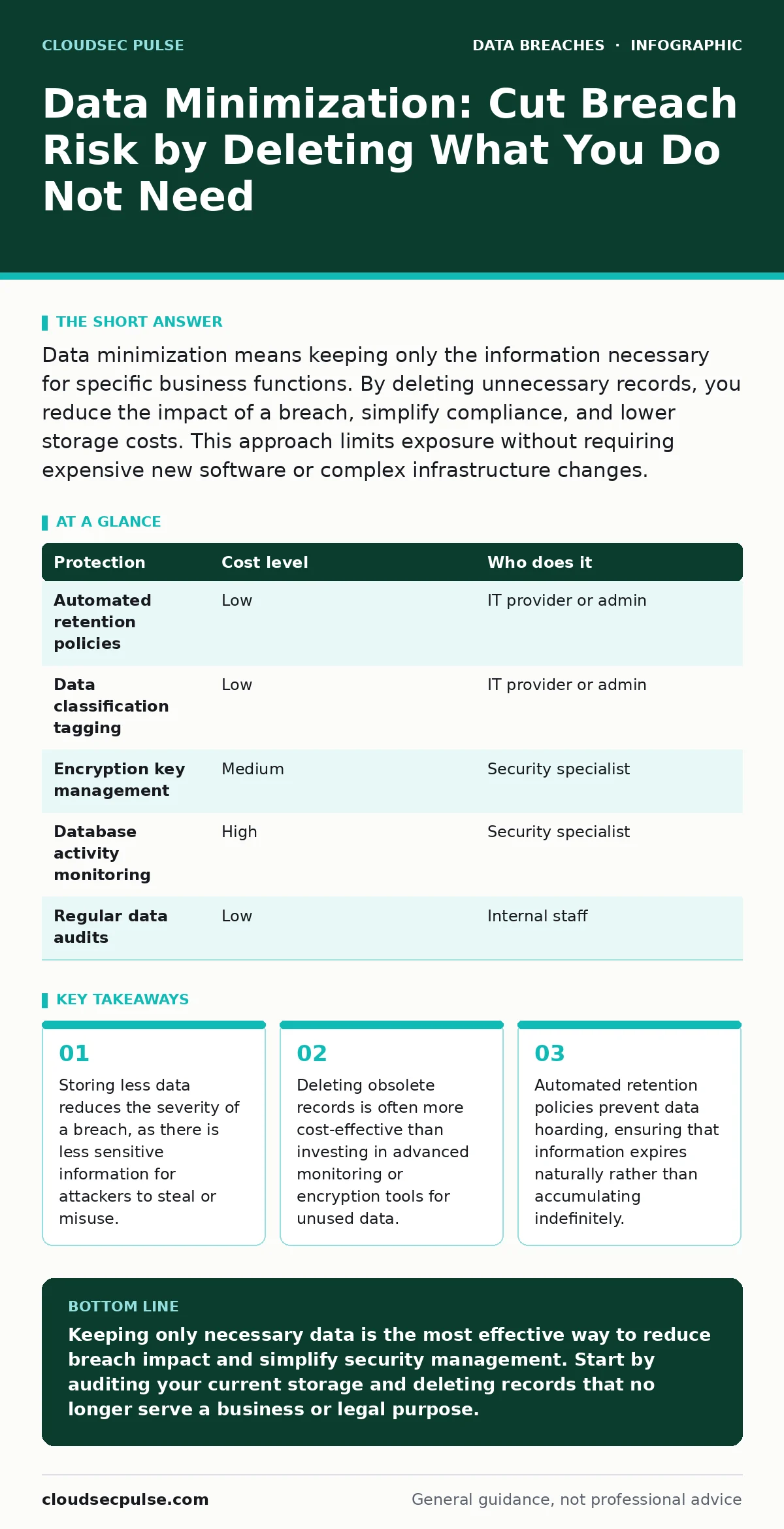
Data minimization means keeping only the information necessary for specific business functions. By deleting unnecessary records, you reduce the impact of a breach, simplify compliance, and lower storage costs. This approach limits exposure without requiring expensive new software or complex infrastructure changes.
The Hidden Cost of Keeping Everything
Most organizations operate under the assumption that data is an asset. In reality, unused data is a liability. Every record you store represents a potential entry point for an attacker. When you keep information longer than necessary, you increase the surface area for a data breach. This is the unauthorized access to, or acquisition of, sensitive information.
For smaller teams, the impact is disproportionate. Large enterprises have dedicated security teams to monitor vast datasets. You likely do not. A breach involving five years of customer records looks the same on the news as one involving five months. The legal and reputational damage does not scale with the size of the company. It scales with the sensitivity of the exposed data.
Keeping data "just in case" creates a hidden tax on your security budget. You must secure, back up, and monitor every byte. This includes data that no employee has accessed in years. By reducing the volume of stored information, you reduce the complexity of your security posture. You are not just saving disk space; you are removing targets.
Defining What Is Necessary
Data minimization requires a clear definition of necessity. You must distinguish between data you need to run your business and data you are hoarding out of habit. Start by mapping your data flows. Identify where information enters your systems, where it is stored, and who can access it.
Ask yourself if each data point serves a current business function. If you collect phone numbers for delivery, do you need to keep them after the service is complete? If the answer is no, that data should be scheduled for deletion. This process is known as data lifecycle management. It involves defining how long data is retained and when it is securely destroyed.
This step often reveals surprising redundancies. You may find multiple copies of the same invoice stored in different cloud folders. You may find customer profiles containing addresses that have not been updated in years. Consolidating these records reduces the number of places an attacker needs to compromise to find valuable information.
Affordable Controls for Small Teams
You do not need expensive software to implement data minimization. The most effective controls are procedural and automated. Start by enforcing strict retention policies. Set automated rules to delete or archive data after a specific period. For example, delete temporary files after thirty days and archive customer records after seven years, depending on your industry requirements.
Use encryption to protect data at rest. Encryption converts readable data into unreadable code using a mathematical algorithm. Even if an attacker steals your hard drives or cloud backups, they cannot read the information without the encryption key. This is the secret code used to decrypt the data. However, encryption does not replace the need to delete data. It only protects it if it is accessed.
Consider implementing data loss prevention tools. These systems monitor for unauthorized attempts to move sensitive data outside your organization. While enterprise-grade DLP can be costly, many cloud service providers offer basic classification and tagging features for free. Use these tags to identify sensitive data and apply stricter deletion rules to it.
| Protection | Cost level | Who does it |
|---|---|---|
| Automated retention policies | Low | IT provider or admin |
| Data classification tagging | Low | IT provider or admin |
| Encryption key management | Medium | Security specialist |
| Database activity monitoring | High | Security specialist |
| Regular data audits | Low | Internal staff |
What to Delegate to Experts
Some aspects of data minimization require specialized knowledge. You should delegate encryption key management to a trusted provider. Losing your keys means losing your data forever. Managing keys securely involves complex rotation and backup procedures that are error-prone for small teams.
Delegate the technical implementation of deletion scripts. Incorrectly deleting data can lead to accidental loss of critical business records. An IT provider can create scripts that verify data age and sensitivity before removal. They can also ensure that deleted data is unrecoverable, a process known as secure erasure.
Do not delegate the decision of what to keep. You must define the retention periods based on your legal and business needs. An IT provider can tell you how to delete data, but they cannot tell you why you need it. This distinction is critical for maintaining control over your data sovereignty, which refers to the laws governing where your data is stored and processed.
Questions for Your IT Provider
When discussing data minimization with your IT provider, ask specific questions to ensure they understand your goals. Do not assume they will proactively reduce your data footprint. You must direct them to prioritize deletion over retention.
- What is the current volume of stored data, and how much is actively used?
- Which systems contain the most sensitive customer or employee information?
- How are old backups handled? Are they deleted after a set period?
- Can you automate the deletion of temporary files and logs?
- What is the process for verifying that deleted data is unrecoverable?
These questions force a conversation about data hygiene. They shift the focus from adding new security layers to removing unnecessary risk. If your provider cannot answer these questions, they may not be equipped to handle data minimization effectively.
See also: Baiting Attacks: Risks and Protection for Small Businesses
The Edge Case of Legal Holds
There is one scenario where you must keep data regardless of minimization principles: legal holds. If you are involved in litigation or a regulatory investigation, you must preserve relevant data. Deleting this data can lead to severe legal penalties, including fines and sanctions.
Communicate any legal holds to your IT provider immediately. They must pause automated deletion scripts for the affected data. This pause is temporary and specific. Once the legal matter is resolved, the data should be reviewed for deletion. Do not let legal holds become an excuse for permanent data hoarding.
Be aware that third-party data breaches can also trigger legal holds. If a vendor you use is breached, you may need to preserve communications related to that incident. Document these holds carefully. Keep a log of what data is preserved, why, and for how long. This documentation protects you if auditors question your data retention practices.
Measuring Success
Success in data minimization is measured by reduction, not addition. Track the total volume of stored data over time. A successful program will show a steady decline in data volume, even as your business grows. This indicates that you are deleting obsolete data faster than you are creating new data.
Monitor the number of access requests to old data. If employees rarely access records older than a year, your retention policy may be too long. Adjust the policy to match actual usage patterns. This iterative approach ensures that your data minimization efforts remain aligned with your business needs.
Remember that data minimization is a continuous process. New data is created every day. New systems are added. New regulations emerge. Regular audits are necessary to maintain a lean data footprint. By consistently applying these principles, you reduce your risk exposure and simplify your security operations.
Key takeaways
- Storing less data reduces the severity of a breach, as there is less sensitive information for attackers to steal or misuse.
- Deleting obsolete records is often more cost-effective than investing in advanced monitoring or encryption tools for unused data.
- Automated retention policies prevent data hoarding, ensuring that information expires naturally rather than accumulating indefinitely.
Keeping only necessary data is the most effective way to reduce breach impact and simplify security management. Start by auditing your current storage and deleting records that no longer serve a business or legal purpose.
Frequently asked questions
Does deleting data make me vulnerable to losing important information?
No, if you implement proper backups and retention policies. Backups preserve data for disaster recovery, while retention policies ensure you keep data only as long as needed. Secure deletion applies to data that is no longer required for business or legal reasons.
How do I know if my IT provider is effectively managing data deletion?
Ask for regular reports on data volume trends. If your data storage is growing exponentially without a corresponding business growth, your provider may not be enforcing deletion policies. Request logs of automated deletions to verify that scripts are running correctly.
Can I use data minimization to reduce cyber insurance premiums?
Yes, many insurers consider data hygiene when calculating premiums. A smaller data footprint means lower potential loss in a breach. Provide your insurer with documentation of your retention policies and deletion procedures to demonstrate reduced risk.
What is the difference between data minimization and data anonymization?
Data minimization involves deleting unnecessary data. Data anonymization involves removing personally identifiable information from data so it cannot be linked back to an individual. Both reduce risk, but minimization is more effective for reducing breach severity.
How this guide was produced: written by the CloudSec Pulse editorial team with AI assistance, checked against the public references listed below, and reviewed when the facts change. See our editorial policy or report an error.