Third-Party Data Breaches: Early Warning Signs You Cannot Ignore
Most compromise indicators originate outside your network perimeter, appearing in vendor communications or partner interfaces long before your own systems show signs of intrusion.
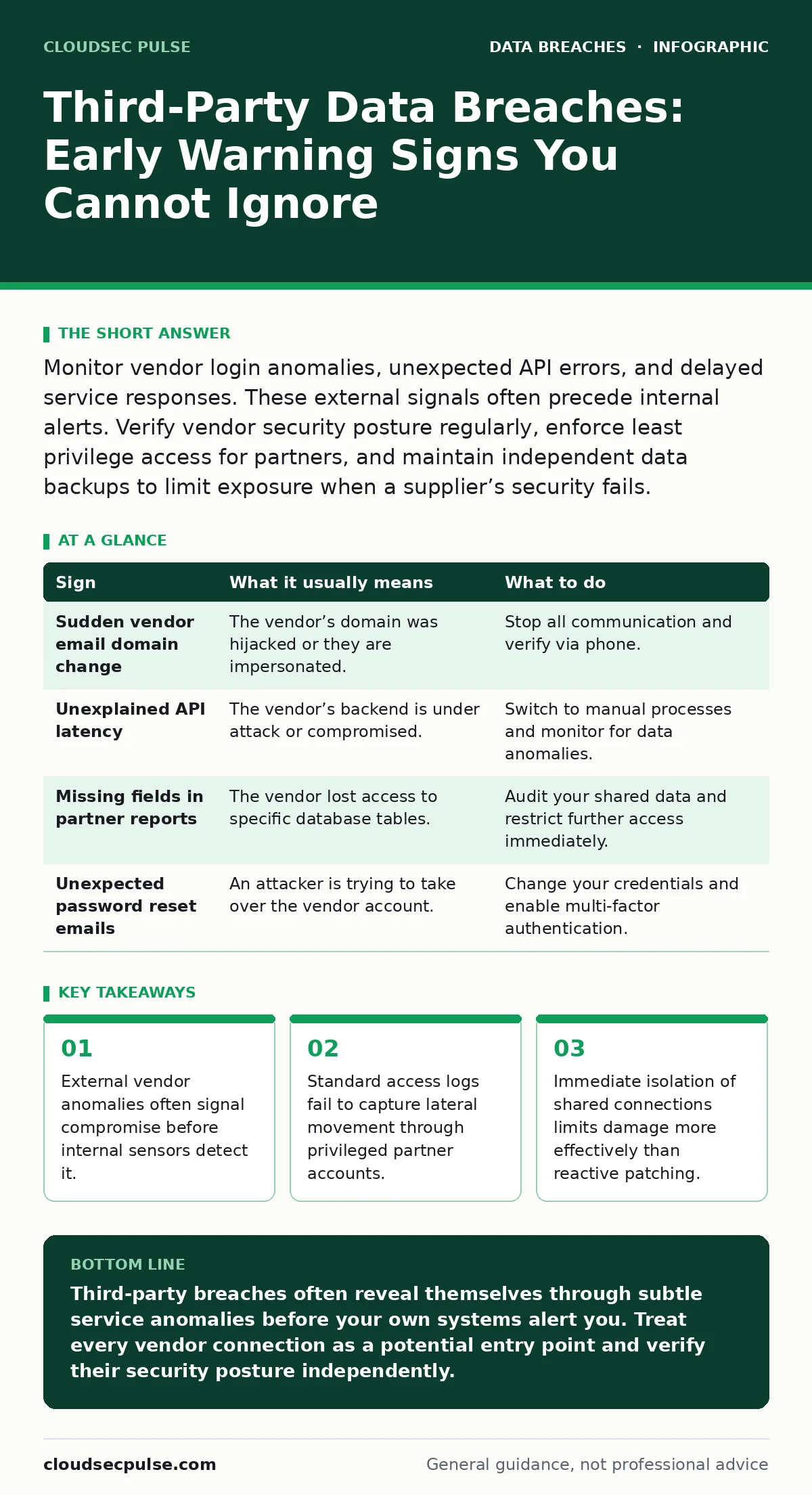
Monitor vendor login anomalies, unexpected API errors, and delayed service responses. These external signals often precede internal alerts. Verify vendor security posture regularly, enforce least privilege access for partners, and maintain independent data backups to limit exposure when a supplier’s security fails.
The Illusion of Internal Safety
You likely monitor your firewall logs and endpoint detection systems diligently. This focus creates a blind spot. Attackers frequently bypass your defenses by compromising a weaker link in your supply chain. A vendor with poor security becomes the entry point for threats targeting your organization. You cannot secure what you do not control, yet you depend on these third parties for critical operations.
Immediate Signs of Compromise
The first signs often appear in routine communications. You might notice a sudden change in a vendor’s email signature or domain. Phishing attempts from compromised partners use legitimate-looking addresses, making them harder to spot. Another early indicator is a sudden drop in service availability. If a provider’s portal becomes slow or returns generic error codes, they may be experiencing a denial-of-service attack or data exfiltration.
Subtle Indicators That Slip By
Some signs are far less obvious than service outages. You might see unusual API response times from a software provider. These delays can indicate that the vendor’s backend is under heavy, unauthorized load. Another hidden signal is a change in data format or structure from a partner. If a reporting tool suddenly stops including certain fields, the vendor may have lost access to their own database. These discrepancies often go unnoticed by staff who assume the issue is a minor bug.
The Hidden Cost of Trust
Relying on a partner’s security claims is a risky strategy. You often lack visibility into their internal controls. A vendor may claim compliance with standards, but their implementation can be flawed. This gap means you are inheriting their vulnerabilities. When a third party is breached, your data is exposed even if your own systems are secure. The failure is not yours, but the liability and remediation burden often fall on you.
| Sign | What it usually means | What to do |
|---|---|---|
| Sudden vendor email domain change | The vendor’s domain was hijacked or they are impersonated. | Stop all communication and verify via phone. |
| Unexplained API latency | The vendor’s backend is under attack or compromised. | Switch to manual processes and monitor for data anomalies. |
| Missing fields in partner reports | The vendor lost access to specific database tables. | Audit your shared data and restrict further access immediately. |
| Unexpected password reset emails | An attacker is trying to take over the vendor account. | Change your credentials and enable multi-factor authentication. |
Immediate Response Steps
When you detect a sign, act quickly to limit exposure. First, isolate the connection. Disable the API keys or service accounts that link your systems to the compromised vendor. This prevents the attacker from moving laterally into your environment. Next, notify your internal team. They need to know not to trust data from that source. Finally, contact the vendor through a verified channel to confirm the incident. Do not rely on their standard support ticket system, which may be compromised.
Long-Term Mitigation Strategies
Reactive measures are insufficient for long-term security. You must integrate third-party risk into your ongoing strategy. Conduct regular reviews of your vendors’ security practices. Ask for evidence of their controls, not just claims. Implement data loss prevention tools to monitor sensitive data leaving your environment, even through trusted partners. Consider cyber insurance to cover the financial impact of a supply chain breach. These steps reduce the likelihood and severity of future incidents.
Verifying Vendor Security
Do not accept a vendor’s word at face value. Request their latest security audit reports. Look for specific details about how they handle encryption key management. If they manage keys poorly, your data is vulnerable even if it is encrypted. Check if they use database activity monitoring to detect unauthorized access. These technical controls provide a clearer picture of their actual security posture than a generic compliance certificate.
Key takeaways
- External vendor anomalies often signal compromise before internal sensors detect it.
- Standard access logs fail to capture lateral movement through privileged partner accounts.
- Immediate isolation of shared connections limits damage more effectively than reactive patching.
Third-party breaches often reveal themselves through subtle service anomalies before your own systems alert you. Treat every vendor connection as a potential entry point and verify their security posture independently.
Frequently asked questions
How do I distinguish between a vendor bug and a security breach?
Bugs typically affect specific features and have clear error logs. Breaches often cause broad, unexplained data inconsistencies or access failures across multiple services.
Should I disconnect all vendor integrations immediately upon suspicion?
Yes. Disconnecting is safer than investigating while connected. You can reconnect once the vendor confirms the issue is resolved and their security is intact.
Does cyber insurance cover third-party data breaches?
Many policies do, but they often have exclusions for known vulnerabilities or lack of due diligence. Review your policy’s specific terms regarding supply chain risks.
What is the most common mistake businesses make after a vendor breach?
Trusting the vendor’s initial assessment without independent verification. This delay allows attackers to maintain access or exfiltrate more data before you react.
How this guide was produced: written by the CloudSec Pulse editorial team with AI assistance, checked against the public references listed below, and reviewed when the facts change. See our editorial policy or report an error.