Wormable Vulnerabilities: 10 FAQs on Self-Propagating Threats
Wormable flaws bypass user interaction entirely, allowing malware to spread across networks at machine speed without any human clicking a malicious link.

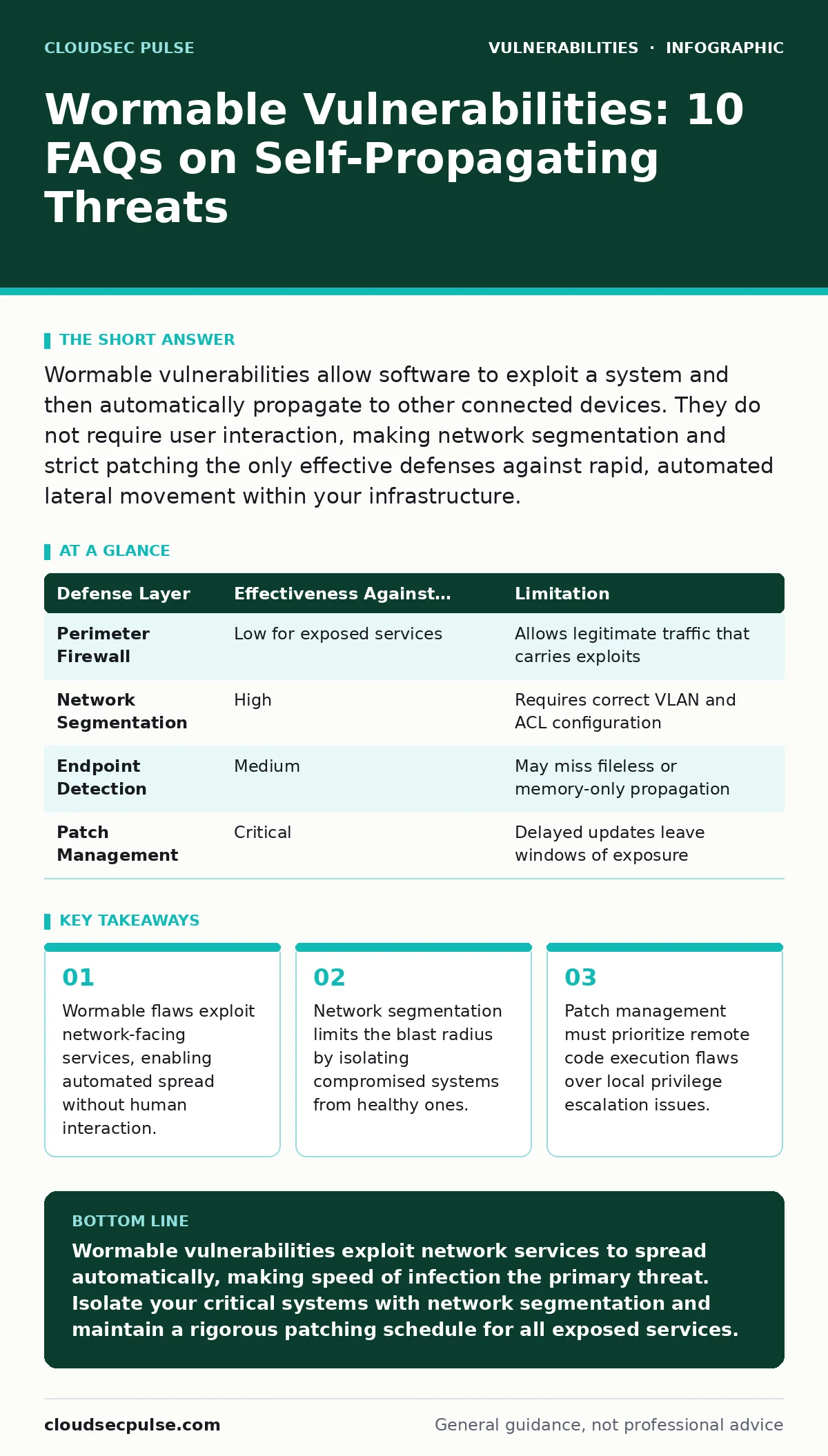
Wormable vulnerabilities allow software to exploit a system and then automatically propagate to other connected devices. They do not require user interaction, making network segmentation and strict patching the only effective defenses against rapid, automated lateral movement within your infrastructure.
What defines a wormable vulnerability?
A wormable vulnerability is a software flaw that allows an attacker to execute arbitrary code remotely and automatically propagate to other systems on the same network. Unlike standard vulnerabilities that require a user to open a file or click a link, these flaws exist in services that listen for network traffic. The malware uses the compromised system as a launchpad to scan for and infect other vulnerable hosts. This self-replicating behavior creates a chain reaction that can saturate a network in minutes.
How does a worm differ from a virus?
A virus requires a host file and human action to spread, while a worm is a standalone program that travels across networks autonomously. Viruses attach themselves to legitimate applications and rely on users to share infected files. Worms exploit network protocols and open ports to move laterally between devices. This distinction matters because viruses are contained by user behavior, whereas worms are contained only by network architecture and patching speed. You cannot stop a worm by telling users not to click suspicious emails.
Why are wormable flaws more dangerous than local exploits?
Wormable flaws pose a higher risk because they enable remote code execution without any physical or logical access credentials. Local exploits require an attacker to already have a foothold on the system, such as a user account or physical presence. Wormable flaws allow entry from the outside world, often through the internet. Once inside, the attacker gains control of the operating system. This bypasses perimeter defenses like firewalls if the service is exposed. The speed of infection is the primary danger, not just the initial access.
How do worms find new victims to infect?
Worms use automated scanning techniques to identify open ports and vulnerable services on adjacent network segments. They generate lists of IP addresses and send exploit payloads to each one. If a system responds with a success signal, the worm installs itself and begins scanning from that new location. This distributed scanning makes the attack harder to trace and block. The worm effectively turns every infected machine into a botnet node that helps accelerate the infection process.
Can firewalls stop a wormable attack?
Firewalls can block known malicious IP addresses but cannot prevent exploitation of a vulnerability in a service that is intentionally exposed. If you allow traffic to a service like a database or web server, a firewall permits the connection. The worm exploits the software logic within that service, not the network protocol itself. Firewalls filter traffic based on rules, not code quality. Relying solely on perimeter filtering leaves you vulnerable to attacks that arrive through legitimate, allowed channels. You must secure the application layer behind the firewall.
| Defense Layer | Effectiveness Against Worms | Limitation |
|---|---|---|
| Perimeter Firewall | Low for exposed services | Allows legitimate traffic that carries exploits |
| Network Segmentation | High | Requires correct VLAN and ACL configuration |
| Endpoint Detection | Medium | May miss fileless or memory-only propagation |
| Patch Management | Critical | Delayed updates leave windows of exposure |
See also: Implement Zero Trust Security: A Step-by-Step Execution Plan · Why Firewalls Are Important: The Hidden Costs of Missing Filters
What is the role of network segmentation?
Network segmentation divides a large network into smaller, isolated zones to limit the spread of lateral movement. If a worm infects one segment, it cannot easily reach other segments without passing through controlled chokepoints. This containment strategy buys time for security teams to detect and remediate the issue. Without segmentation, a single infected workstation can compromise the entire corporate infrastructure. Properly configured virtual local networks and access control lists enforce these boundaries.
How do you prioritize patching for wormable flaws?
You must prioritize patches that fix remote code execution flaws over those that fix local issues or minor bugs. Use risk scoring models like the EPSS score to understand the likelihood of exploitation in the wild. Wormable vulnerabilities often have high severity ratings because they allow immediate, unauthenticated access. Delaying these patches leaves your systems exposed to automated scanning bots. Regular updates to your IT asset inventory ensure you know exactly which systems require immediate attention.
Are zero-day worms still a threat?
Zero-day worms remain a significant threat because they exploit unknown vulnerabilities for which no patches exist. Attackers can develop exploits in secret and release them as worms to maximize damage before vendors respond. These attacks are rare but devastating because traditional signature-based defenses cannot detect them. Behavioral analysis and anomaly detection are your best defenses against unknown threats. Assume that some zero-days will bypass your standard security controls.
How does secure configuration reduce worm risk?
Secure configuration baselines reduce the attack surface by disabling unnecessary services and closing unused ports. A system running only the minimum required services has fewer entry points for a worm to exploit. Disabling default accounts and enforcing complex authentication reduces the chance of successful exploitation. Hardening your systems ensures that even if a vulnerability exists, the service it affects is not running or accessible. This defense-in-depth approach limits the opportunities for automated attacks.
What is the impact of server-side template injection?
Server-side template injection can sometimes lead to wormable conditions if the template engine processes untrusted input without sanitization. Attackers can inject malicious code that executes on the server side. If the application allows file uploads or data processing, this can escalate to remote code execution. Unlike simple data injection, this flaw allows the attacker to control the server's logic. Proper input validation and output encoding are necessary to prevent this type of exploitation.
Can Linux systems be infected by worms?
Linux systems are susceptible to wormable vulnerabilities, particularly in network services and the kernel. While less targeted than Windows in some contexts, Linux servers often run critical infrastructure that is exposed to the internet. Flaws in web servers, databases, or the Linux kernel privilege escalation paths can allow worms to spread. The open-source nature of Linux means vulnerabilities are often discovered and patched quickly, but unpatched systems remain vulnerable. Do not assume Linux is immune to automated propagation.
How do you detect a worm in progress?
Detection relies on identifying abnormal network behavior, such as rapid internal scanning or unusual process creation. Security information and event management systems can correlate logs to find patterns of infection. Look for multiple systems attempting to connect to the same internal port simultaneously. Endpoint detection solutions can flag suspicious memory activities or file changes. Early detection is critical because worms spread exponentially. The longer you wait, the harder it is to contain the outbreak.
What is the relationship between hard-coded credentials and worms?
Hard-coded credentials in software can facilitate worm propagation by providing the authentication needed to move laterally. If a worm exploits a vulnerability and finds stored passwords, it can use them to access other systems that require login. This bypasses the need for further exploitation of network services. Removing hard-coded credentials forces the worm to rely solely on technical exploits, which are harder to chain together. Secure coding practices prevent this shortcut for attackers.
How do medical device vulnerabilities fit in?
Medical device vulnerabilities often include wormable flaws because many devices run outdated operating systems and cannot be easily patched. These devices are connected to hospital networks, creating a bridge between IT and operational technology. A worm spreading through a hospital network can disrupt critical care systems. Specialized protocols used by medical equipment may lack security features, making them easy targets. Isolation and strict network access controls are vital for these sensitive environments.
Key takeaways
- Wormable flaws exploit network-facing services, enabling automated spread without human interaction.
- Network segmentation limits the blast radius by isolating compromised systems from healthy ones.
- Patch management must prioritize remote code execution flaws over local privilege escalation issues.
Wormable vulnerabilities exploit network services to spread automatically, making speed of infection the primary threat. Isolate your critical systems with network segmentation and maintain a rigorous patching schedule for all exposed services.
Frequently asked questions
Can antivirus software stop a worm?
Antivirus software can detect and remove worm components on an endpoint, but it cannot prevent the initial network-based exploitation or stop the worm from scanning other systems before detection occurs.
How long does it take for a worm to spread?
A worm can spread across a flat network in minutes, as it uses infected machines to accelerate its scanning and infection rate exponentially without human intervention.
Do worms steal data?
Some worms are designed to steal data, but their primary function is propagation; they may install additional malware like ransomware or spyware after establishing a foothold.
Is segmentation enough to stop worms?
Segmentation limits the spread but does not prevent initial infection; you must also patch vulnerabilities and monitor for anomalies to fully mitigate the risk of wormable flaws.
How this guide was produced: written by the CloudSec Pulse editorial team with AI assistance, checked against the public references listed below, and reviewed when the facts change. See our editorial policy or report an error.