Dark Web Monitoring Meaning: How It Works and What It Misses
Dark web monitoring scans hidden networks for exposed credentials, but it cannot see what is shared offline or stored in unmonitored private forums.

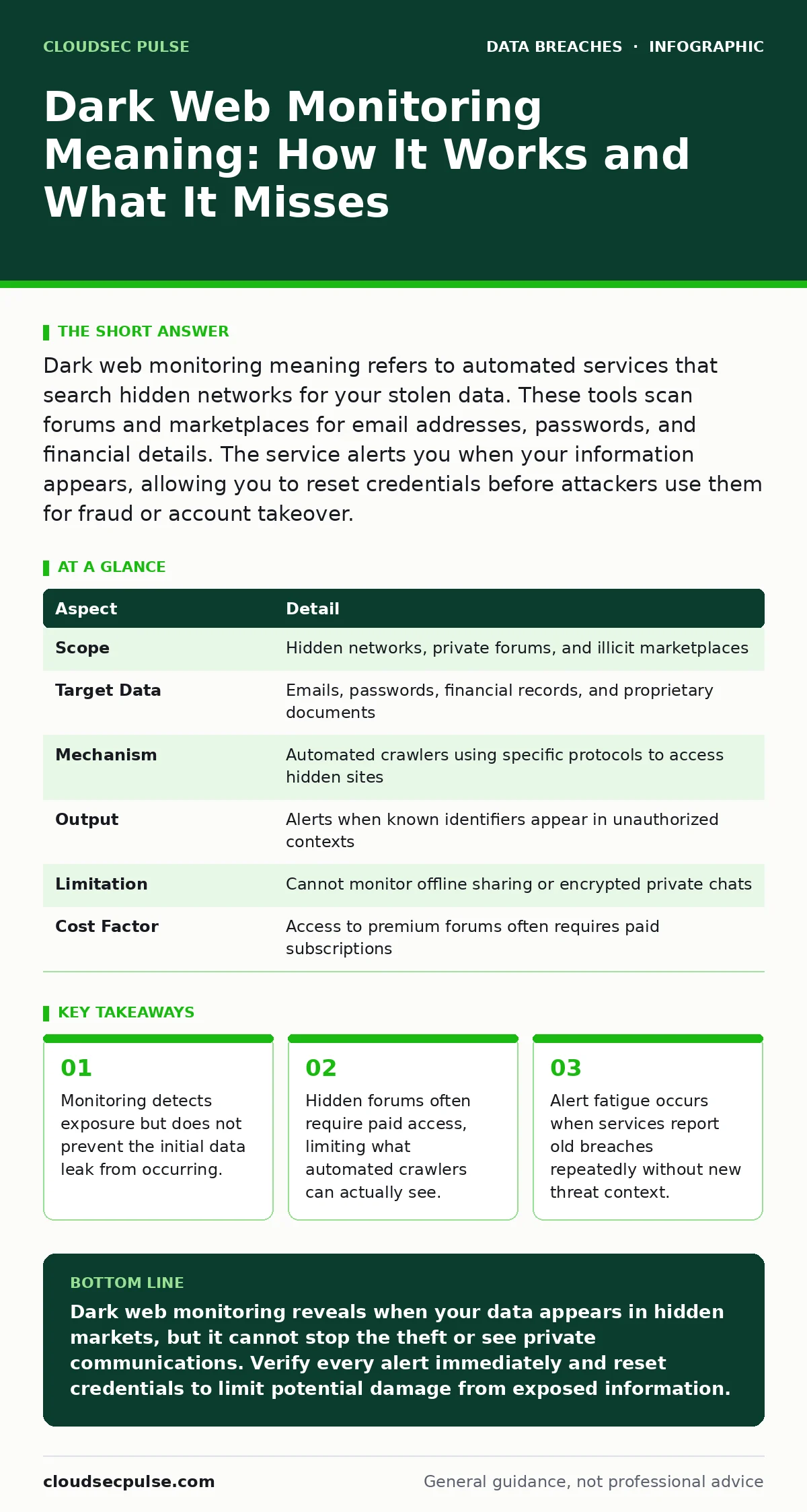
Dark web monitoring meaning refers to automated services that search hidden networks for your stolen data. These tools scan forums and marketplaces for email addresses, passwords, and financial details. The service alerts you when your information appears, allowing you to reset credentials before attackers use them for fraud or account takeover.
An Everyday Analogy for Hidden Threats
Imagine your organization is a house with a public front door and a private back alley. The public internet is the front yard where anyone can walk by. The dark web is the back alley where people meet in shadows to trade items they do not want found by authorities. Dark web monitoring acts like a security guard standing at the entrance to that alley.
The guard watches who enters and what they carry. If someone walks out with your house keys, the guard tells you immediately. This analogy helps clarify that the monitoring tool is an observer, not a barrier. It sees what is being traded, but it cannot stop the thief from entering the alley in the first place. You must still lock your doors and secure your windows.
What Is Dark Web Monitoring Meaning
Dark web monitoring meaning centers on the continuous scanning of non-indexed parts of the internet for sensitive organizational data. These systems use automated crawlers to search hidden services, private forums, and illicit marketplaces. The tools look for specific indicators such as email addresses, domain names, credit card numbers, and social security numbers.
When a match is found, the system generates an alert for the security team. This process is distinct from standard web search, which only indexes public sites. The dark web requires special protocols to access, making manual monitoring impossible for most organizations. The value lies in early detection of credential theft before it leads to a full compromise.
| Aspect | Detail |
|---|---|
| Scope | Hidden networks, private forums, and illicit marketplaces |
| Target Data | Emails, passwords, financial records, and proprietary documents |
| Mechanism | Automated crawlers using specific protocols to access hidden sites |
| Output | Alerts when known identifiers appear in unauthorized contexts |
| Limitation | Cannot monitor offline sharing or encrypted private chats |
| Cost Factor | Access to premium forums often requires paid subscriptions |
How the Technology Actually Works
The technical foundation relies on specialized browsers and crawlers that can navigate onion sites and other hidden networks. Standard search engines cannot index these pages because they lack a public directory. Monitoring services maintain a database of known dark web endpoints. They deploy scripts to scrape content from these locations at regular intervals.
The scraped data is then compared against a library of your organization’s known identifiers. This includes employee email formats, domain names, and previously exposed credentials. If a match occurs, the system flags the incident. The process is largely passive and reactive. It does not interact with the threat actors. It simply observes what has already been posted or sold. This means there is always a lag between the data leak and the alert.
Who Is Affected by Data Exposure
Every organization with an online presence faces this risk. Small businesses are often targeted because they typically have weaker security controls than large enterprises. Attackers scan for exposed credentials to gain initial access. Once inside, they can move laterally to more valuable systems. The impact extends beyond immediate financial loss.
Regulatory compliance requirements often mandate notification when personal data is exposed. This creates legal and reputational risks. Employees are also affected when their personal information is sold. They may need to monitor their credit or change personal passwords. The burden of remediation falls on the IT team, who must verify each alert and reset affected accounts. This process consumes significant time and resources.
Common Misconceptions About Monitoring
Many organizations believe that dark web monitoring provides a complete shield against cyber threats. This is a dangerous assumption. The technology only sees what is posted in monitored locations. Many threat actors communicate in private channels that are not indexed. They may share data via encrypted messaging apps or offline drives. Monitoring tools cannot see these exchanges.
Another misconception is that alerts are always actionable. False positives occur when old breaches are re-posted. Services may alert you on data that is years old and no longer relevant. This creates noise and distracts from fresh threats. You must verify the recency and relevance of each finding. Do not assume an alert means an active breach is in progress.
What To Do About Exposed Data
Detection is only the first step. You need a clear incident response plan for when alerts occur. Start by verifying the source of the data. Determine if the credentials are still active or have been changed. If the data is current, force a password reset immediately. Enable multi-factor authentication on the affected account to block unauthorized access.
Review login logs for suspicious activity leading up to the alert. This helps determine if the attacker has already gained entry. Document the incident for compliance purposes. Communicate with affected employees if personal data was involved. Regularly review your monitoring settings to ensure they cover all critical assets. Ignore alerts at your own risk.
The Hidden Costs of Oversight
One unexpected consequence of dark web monitoring is alert fatigue. Security teams receive dozens of alerts daily. Many are duplicates or outdated. Sorting through these alerts requires skilled personnel. If you lack the staff to investigate, the tool becomes a liability. It creates a false sense of security while hiding real threats in the noise. Another hidden cost is the coverage gap. Premium forums often require invitation or payment to join.
Monitoring services may not have access to the most exclusive channels. This means the most valuable data might remain hidden from your view. You must supplement automated monitoring with other controls. Implement data loss prevention to stop data from leaving your network in the first place. Use database activity monitoring to detect unauthorized access to sensitive records. These proactive measures reduce the amount of data available for sale.
Integrating With Broader Security
Dark web monitoring is one piece of a larger puzzle. It works best when combined with encryption key management and data encryption practices. If your data is encrypted, stolen credentials may not grant access to the actual information. Data minimization reduces the amount of sensitive data you hold. Less data means less to lose if a breach occurs.
Consider backup data exposure as well. Attackers often target backups because they are less protected. Ensure your backups are secured and monitored. Understanding data breaches helps you contextualize the alerts you receive. Not every exposure leads to a full breach. But every exposure is a warning sign. Treat monitoring as an early warning system, not a cure.
Key takeaways
- Monitoring detects exposure but does not prevent the initial data leak from occurring.
- Hidden forums often require paid access, limiting what automated crawlers can actually see.
- Alert fatigue occurs when services report old breaches repeatedly without new threat context.
Dark web monitoring reveals when your data appears in hidden markets, but it cannot stop the theft or see private communications. Verify every alert immediately and reset credentials to limit potential damage from exposed information.
Frequently asked questions
How long does it take for dark web monitoring to detect a leak?
Detection times vary based on how often the service scans its sources and whether the data is posted in open or private forums. It may take days or weeks to appear in monitored areas.
Can dark web monitoring prevent a data breach?
No, monitoring is a reactive measure. It identifies data that has already been stolen or leaked. It does not block attacks or secure systems against intrusion.
Is dark web monitoring legal for businesses?
Yes, monitoring publicly accessible parts of the dark web for your own data is legal. However, accessing private forums without invitation may violate terms of service or local laws.
What is the difference between dark web and deep web?
The deep web includes any content not indexed by search engines, such as private databases. The dark web is a subset of the deep web that requires special software to access and is often used for illicit activities.
How this guide was produced: written by the CloudSec Pulse editorial team with AI assistance, checked against the public references listed below, and reviewed when the facts change. See our editorial policy or report an error.