Snort and Suricata Rules Checklist for Network Defense
Signature-based detection relies on precise rule syntax to filter noise, but misconfigured thresholds create blind spots that attackers exploit during lateral movement phases.

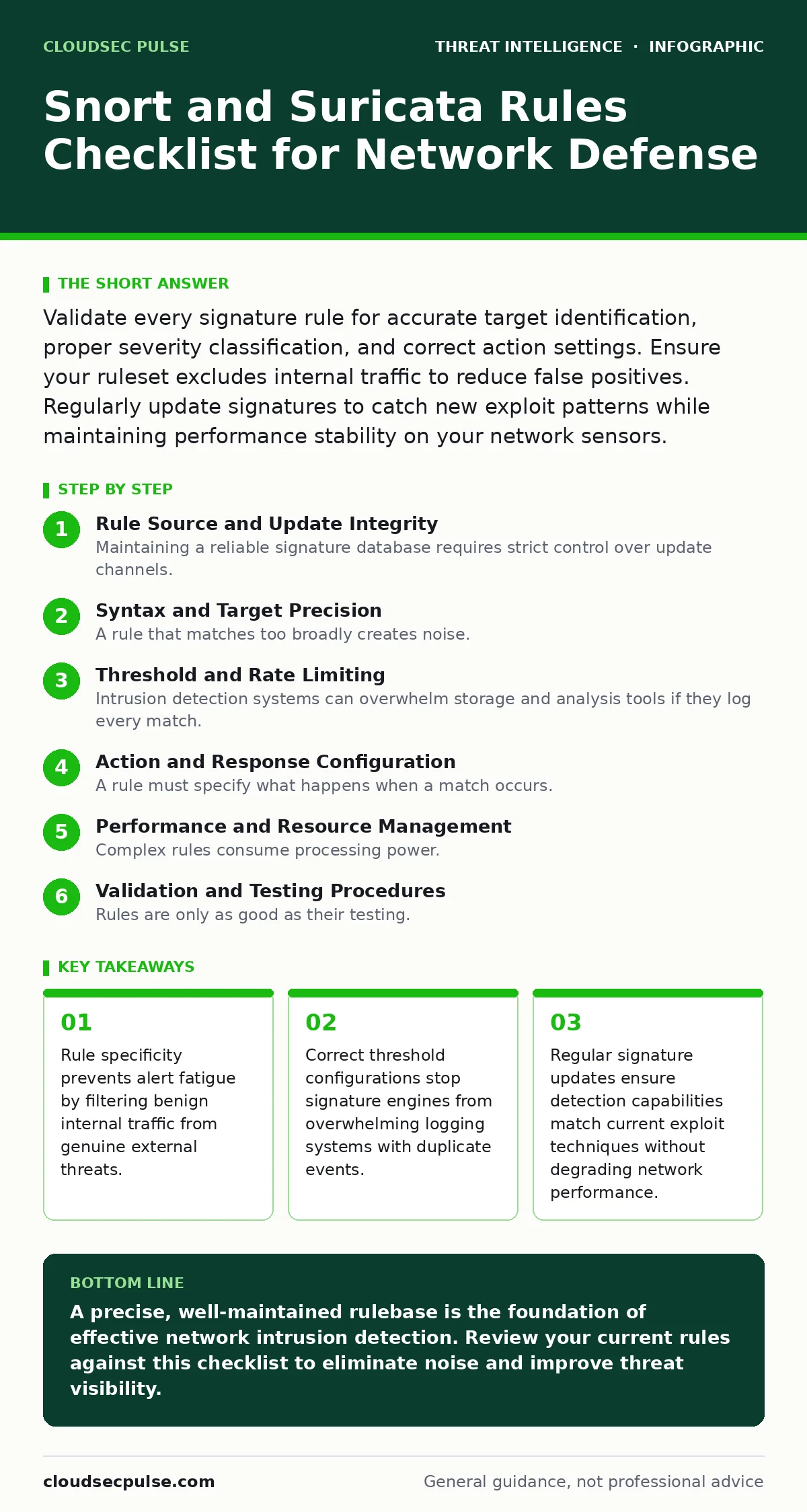
Validate every signature rule for accurate target identification, proper severity classification, and correct action settings. Ensure your ruleset excludes internal traffic to reduce false positives. Regularly update signatures to catch new exploit patterns while maintaining performance stability on your network sensors.
Rule Source and Update Integrity
Maintaining a reliable signature database requires strict control over update channels. You must verify the origin of every rule file before it enters your production environment. Unsigned or modified rules introduce logical errors that bypass detection or trigger false alarms.
- Verify checksums for downloaded rule files: ensures the file has not been tampered with during transit or storage.
- Subscribe to official community or vendor feeds: provides timely updates for newly discovered vulnerabilities and attack patterns.
- Test updates in a staging environment first: prevents syntax errors in new rules from crashing the intrusion detection engine.
Syntax and Target Precision
A rule that matches too broadly creates noise. You must define the source and destination addresses precisely. Generic rules that apply to all traffic generate thousands of irrelevant alerts, burying critical security events under false positives. Specificity is the primary defense against alert fatigue.
- Define specific source IP ranges: limits detection to external threats rather than internal administrative traffic.
- Specify destination ports accurately: ensures the rule only triggers on services that actually exist on the target host.
- Use correct protocol identifiers: prevents misclassification of traffic, such as treating UDP packets as TCP connections.
Imagine a rule that flags all HTTP traffic. It will trigger on every web page load, making it impossible to identify actual web application attacks. Narrowing the rule to specific URL patterns or payload signatures solves this problem.
Threshold and Rate Limiting
Intrusion detection systems can overwhelm storage and analysis tools if they log every match. You need thresholds to aggregate similar events.
- Set threshold counts for repeated events: groups multiple instances of the same attack into a single, manageable alert.
- Define threshold time windows: ensures the system aggregates events within a relevant timeframe for accurate correlation.
- Configure bypass rules for known scanners: prevents internal vulnerability scanners from triggering false positive alerts.
These settings are vital for maintaining system performance. They do not replace the need for accurate signatures but complement them by managing volume. Refer to our guide on tactical threat intelligence to understand how context influences these thresholds.
Action and Response Configuration
A rule must specify what happens when a match occurs. The default action is often logging, but critical threats may require immediate blocking. You must align the action with the severity of the detected event. Incorrect actions either leave vulnerabilities open or disrupt legitimate business operations.
- Assign alert actions for suspicious activity: preserves evidence for investigation without disrupting network flow.
- Use drop actions for confirmed malware: immediately terminates malicious connections to prevent data exfiltration or command execution.
- Map rules to incident response playbooks: ensures consistent handling of alerts based on predefined procedures.
Blocking traffic aggressively can break legitimate applications if the rule is flawed. Always validate the impact of drop rules before deploying them globally. For deeper analysis of blocked traffic, consult our guide on digital forensics and incident response.
Performance and Resource Management
Complex rules consume processing power. You must balance detection accuracy with system performance. Overly complex regular expressions or deep packet inspection rules can slow down network throughput, causing latency issues for users and applications.
- Optimize regular expressions for efficiency: reduces CPU usage during packet inspection while maintaining detection accuracy.
- Limit deep packet inspection to specific ports: avoids unnecessary processing of encrypted or high-volume traffic streams.
- Monitor sensor resource utilization: identifies rules that cause excessive CPU or memory consumption during peak traffic.
High-performance environments require careful tuning. A rule that works on a small network may fail on a large enterprise backbone. Consider integrating user and entity behavior analytics to supplement signature-based detection with behavioral context, reducing reliance on heavy packet inspection.
See also: Implement Zero Trust Security: A Step-by-Step Execution Plan · Why Firewalls Are Important: The Hidden Costs of Missing Filters
Validation and Testing Procedures
Rules are only as good as their testing. You must validate every rule against known attack patterns and benign traffic. Unvalidated rules may miss attacks or flag normal activity. Regular testing ensures your detection capabilities remain effective against evolving threats.
- Test rules against known attack signatures: confirms the rule triggers correctly on expected malicious payloads.
- Validate against benign traffic samples: ensures the rule does not generate false positives on legitimate network activity.
- Document rule changes and reasons: provides an audit trail for compliance and helps troubleshoot future issues.
Maintenance and Review Cycle
Signature-based detection decays over time. You must review and update rules regularly. Old rules may reference deprecated protocols or services, creating noise and reducing effectiveness. A structured maintenance cycle keeps your detection capabilities aligned with current network conditions.
- Schedule quarterly rule reviews: identifies outdated or redundant rules that no longer serve a purpose.
- Remove rules for decommissioned services: reduces noise by eliminating checks for services that no longer exist.
- Update references to current threat actors: ensures rules target active attack techniques rather than historical ones.
This process requires discipline. Without regular maintenance, your rulebase becomes bloated and ineffective. For additional detection layers, explore our guide on YARA rules for file-based threat identification.
Key takeaways
- Rule specificity prevents alert fatigue by filtering benign internal traffic from genuine external threats.
- Correct threshold configurations stop signature engines from overwhelming logging systems with duplicate events.
- Regular signature updates ensure detection capabilities match current exploit techniques without degrading network performance.
A precise, well-maintained rulebase is the foundation of effective network intrusion detection. Review your current rules against this checklist to eliminate noise and improve threat visibility.
Frequently asked questions
How often should I update my Snort or Suricata rules?
Update rules regularly, ideally weekly, to include the latest vulnerability signatures and attack patterns. Test updates in a staging environment before applying them to production.
What is the difference between an alert and a drop action?
An alert logs the event for analysis but allows traffic to pass. A drop action blocks the traffic immediately, preventing potential harm but risking disruption if the rule is incorrect.
Can I use the same rules for Snort and Suricata?
Both engines share a common rule syntax, so many rules are compatible. However, some engine-specific features may require adjustments for optimal performance and accuracy.
How do I reduce false positives in my intrusion detection system?
Refine rule specificity by targeting exact IP ranges and ports. Implement thresholding to aggregate repeated events and exclude known internal traffic sources from detection scopes.
How this guide was produced: written by the CloudSec Pulse editorial team with AI assistance, checked against the public references listed below, and reviewed when the facts change. See our editorial policy or report an error.