Implement Zero Trust Security: A Step-by-Step Execution Plan
Zero trust architecture eliminates implicit trust by verifying every request, reducing the blast radius of compromised credentials and limiting lateral movement across your network.

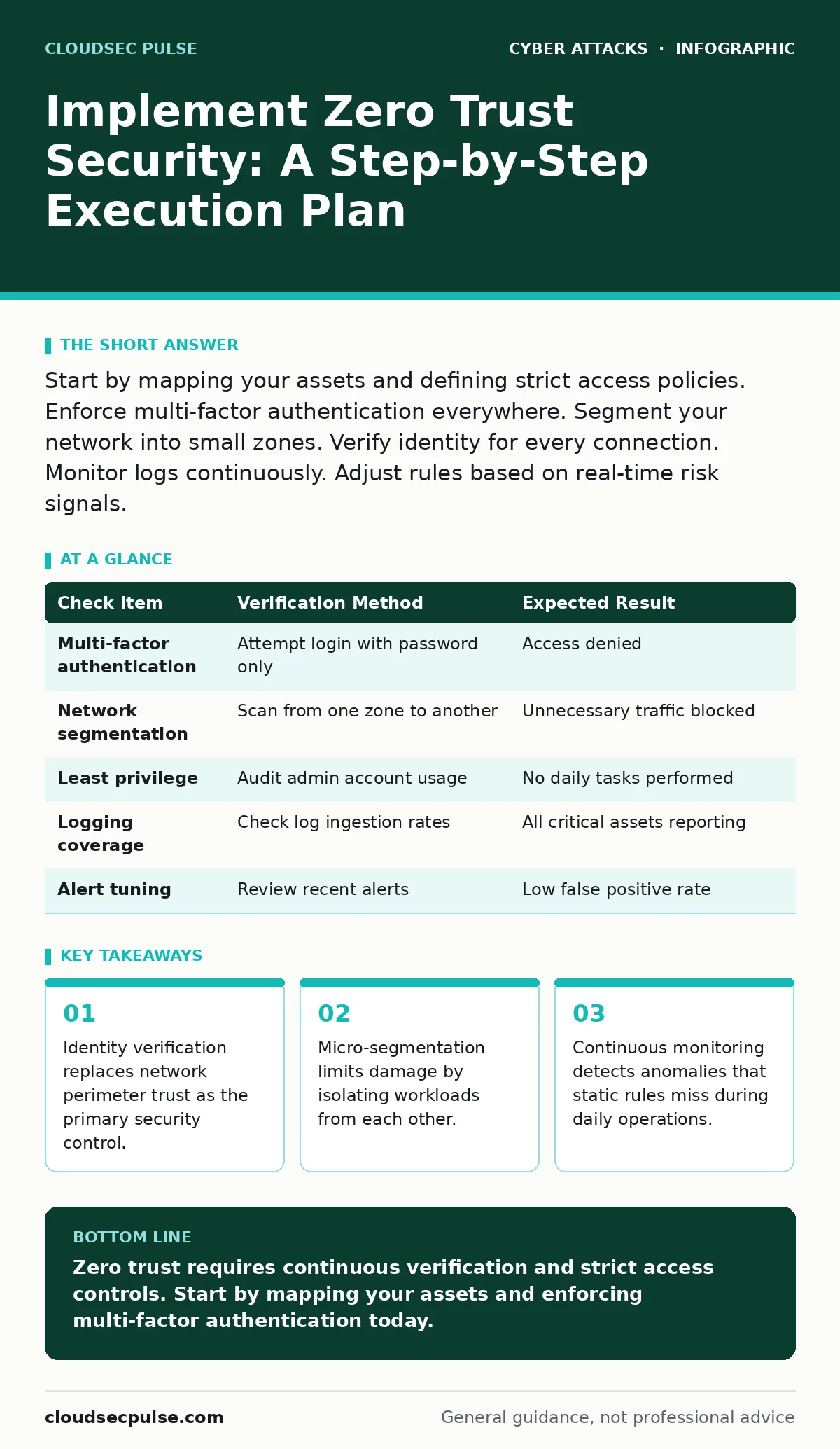
Start by mapping your assets and defining strict access policies. Enforce multi-factor authentication everywhere. Segment your network into small zones. Verify identity for every connection. Monitor logs continuously. Adjust rules based on real-time risk signals.
Define Your Trust Boundary and Assets
Zero trust security operates on the principle that no user or device is trusted by default, regardless of its location. You must first identify every asset that requires protection. This includes servers, databases, applications, and endpoints. Create an inventory that lists each item’s owner, function, and data sensitivity. Without this map, you cannot define who needs access to what.
This inventory becomes the foundation for your policy engine. The policy engine is the system that evaluates requests against your rules. If an asset is not in your inventory, it should be treated as hostile. This prevents shadow IT from creating unmanaged entry points. You must also classify data within these assets. Sensitive data requires stricter controls than public information. This classification drives the granularity of your access rules.
Establish Strong Identity Verification
Identity is the new perimeter. You must enforce multi-factor authentication for every user and service account. Single passwords are insufficient because they can be stolen or guessed. Multi-factor authentication requires two or more proofs of identity. This usually combines something you know with something you have. Service accounts often use certificates or keys instead of passwords. These credentials must be rotated regularly to limit exposure if one is compromised.
Imagine a scenario where an attacker steals a password. With multi-factor authentication in place, that password alone grants no access. The attacker still needs the second factor. This breaks the chain of compromise. You must also manage identity lifecycle events. When employees leave, their access must be revoked immediately. Delayed revocation creates orphaned accounts that attackers can exploit. Review your identity provider logs to ensure all sessions are accounted for.
Segment Your Network Into Micro-Zones
Traditional networks assume internal traffic is safe. Zero trust rejects this assumption. You must implement network segmentation to divide your environment into small zones. Each zone contains related workloads. Traffic between zones must be explicitly allowed. This prevents lateral movement. If an attacker compromises one zone, they cannot easily move to others.
Micro-segmentation takes this further by isolating individual workloads. You define rules that allow only necessary communication. For example, a web server should only talk to its database. It should not talk to the file server. This reduces the attack surface significantly. You must document these dependencies before implementing rules. Breaking a critical dependency causes operational outages. Test each rule in a staging environment first. This ensures business continuity while improving security.
Enforce Least Privilege Access
Least privilege means users and systems have only the access they need to perform their tasks. Nothing more. You must audit existing permissions and remove excessive rights. Admin accounts should not be used for daily tasks. Separate privileged accounts from standard user accounts. This limits the damage if a standard account is compromised. Privileged access management solutions help track and control these high-privilege sessions.
Access should be granted based on context. Factors include user role, device health, and location. A request from a known device in an expected location is lower risk. A request from an unknown device is higher risk. Your policy engine should evaluate these factors dynamically. If the risk is too high, deny access or require additional verification. This adaptive approach balances security with usability. You must review permissions regularly to ensure they remain appropriate.
Monitor and Analyze Traffic Continuously
Static controls are not enough. You must monitor all traffic and user activity in real time. Collect logs from endpoints, networks, and applications. Centralize these logs in a security information and event management system. This allows you to correlate events across different sources. Look for anomalies that indicate compromise. Unusual login times, large data transfers, or unexpected network connections are red flags.
Automated alerts help you respond quickly. Define thresholds for what constitutes an anomaly. Too many alerts lead to alert fatigue. Tune your rules to focus on high-fidelity signals. Investigate every alert thoroughly. Document your findings and update your policies accordingly. This feedback loop improves your detection capabilities over time. You cannot protect what you do not see. Ensure your logging covers all critical assets and activities.
See also: Tactical Threat Intelligence: Practical Indicators for Small Business Defense · Snort and Suricata Rules Checklist for Network Defense
Verify Implementation and Adjust Policies
Checking your zero trust implementation requires active testing. You must verify that access controls work as intended. Use automated tools to test permissions. Attempt to access resources you should not have access to. If you succeed, your rules are too permissive. Fix these gaps immediately. You should also simulate attacks to test your detection capabilities. Tabletop exercises help your team practice responding to incidents in a controlled environment.
Review your policies regularly. Business needs change, and so do threats. New applications may require new access rules. Old rules may become obsolete. Prune unused permissions to reduce complexity. Simplify your rule set where possible. Complex rules are harder to manage and more prone to errors. Keep your documentation updated. This ensures everyone understands the security model. Consistency is key to maintaining a strong security posture.
| Check Item | Verification Method | Expected Result |
|---|---|---|
| Multi-factor authentication | Attempt login with password only | Access denied |
| Network segmentation | Scan from one zone to another | Unnecessary traffic blocked |
| Least privilege | Audit admin account usage | No daily tasks performed |
| Logging coverage | Check log ingestion rates | All critical assets reporting |
| Alert tuning | Review recent alerts | Low false positive rate |
Maintain and Evolve Your Architecture
Zero trust is not a one-time project. It is an ongoing process. You must continuously improve your controls. Threat actors change their tactics. You must adapt to stay ahead. Regularly update your software and firmware. Patch vulnerabilities promptly. Outdated software is a common entry point for attackers.
Stay informed about emerging threats. Phishing remains a primary vector for credential theft. Baiting attacks trick users into revealing information. Invoice fraud exploits financial processes. Formjacking steals data from web forms. Understanding these threats helps you refine your defenses. Train your staff to recognize these tactics. Human factor in security is often the weakest link. Combine technical controls with education. This creates a layered defense that is harder to bypass. Review your incident response plans. Ensure they align with your zero trust architecture. Practice your response procedures. This prepares you for real-world incidents.
Key takeaways
- Identity verification replaces network perimeter trust as the primary security control.
- Micro-segmentation limits damage by isolating workloads from each other.
- Continuous monitoring detects anomalies that static rules miss during daily operations.
Zero trust requires continuous verification and strict access controls. Start by mapping your assets and enforcing multi-factor authentication today.
Frequently asked questions
Does zero trust replace firewalls?
No, firewalls still filter traffic. Zero trust adds identity verification and granular access controls inside the network.
How long does implementation take?
It depends on your environment size. Small networks may take months. Large enterprises may take years.
Is zero trust expensive to implement?
Initial costs include tools and labor. Long-term savings come from reduced breach impact and improved efficiency.
Can zero trust work with legacy systems?
Yes, but it may require additional controls like jump servers or network segmentation to protect them.
How this guide was produced: written by the CloudSec Pulse editorial team with AI assistance, checked against the public references listed below, and reviewed when the facts change. See our editorial policy or report an error.