Fast Flux DNS Explained: How Attackers Hide Infrastructure
Fast flux DNS obfuscates malicious infrastructure by rotating IP addresses faster than security tools can analyze or block them, making static blacklists ineffective.

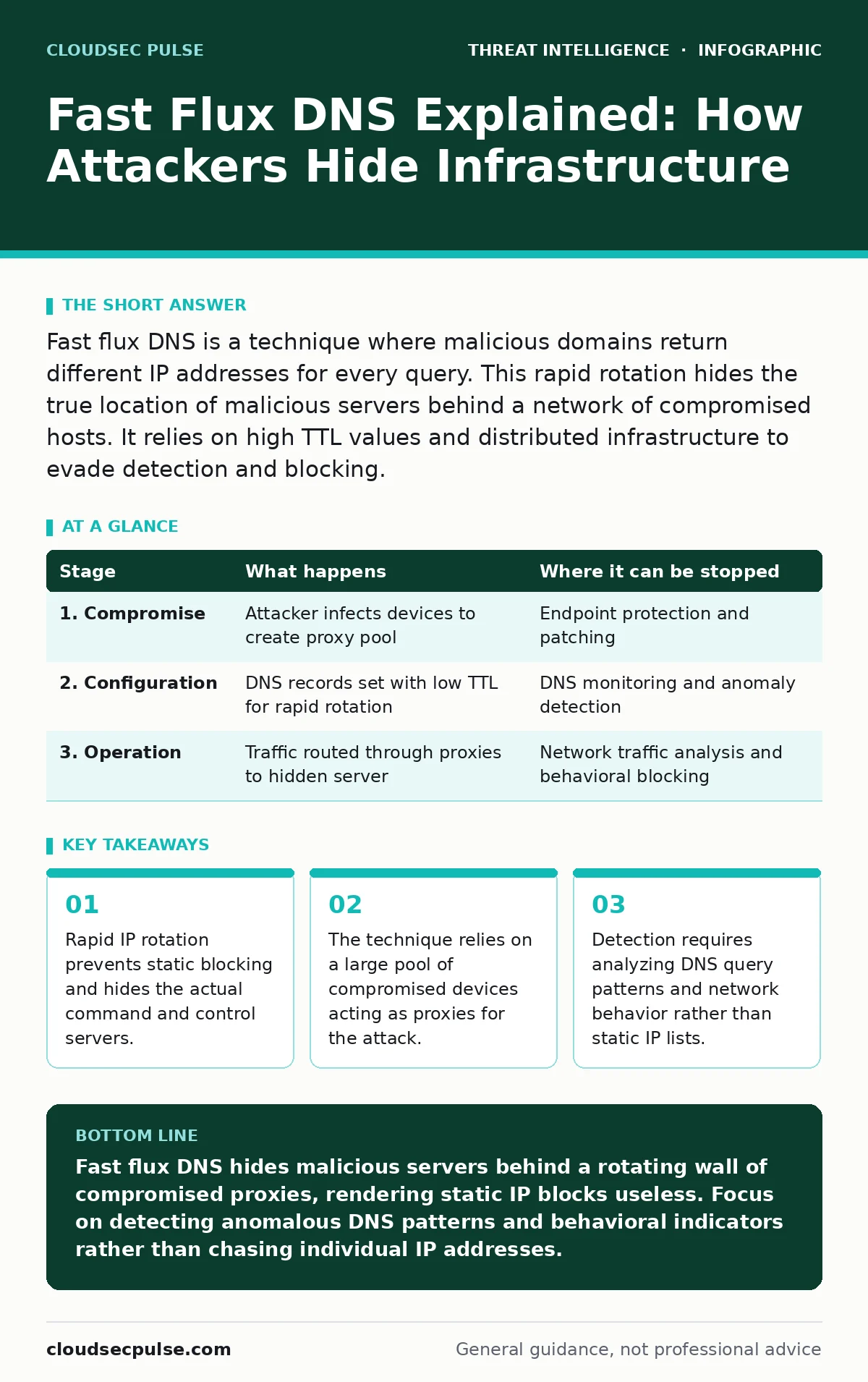
Fast flux DNS is a technique where malicious domains return different IP addresses for every query. This rapid rotation hides the true location of malicious servers behind a network of compromised hosts. It relies on high TTL values and distributed infrastructure to evade detection and blocking.
The Mechanics of Obfuscation
Fast flux DNS is a technique used to hide the location of malicious infrastructure. Instead of pointing a domain name to a single, static IP address, the attacker configures the domain to return a different IP address for every DNS query. This creates a moving target that is difficult for defenders to track or block.
The core mechanism relies on the Domain Name System (DNS), which translates human-readable domain names into machine-readable IP addresses. In a standard setup, a domain points to one server. In a fast flux setup, the domain points to a rotating pool of addresses. This pool is often composed of compromised computers around the world.
Imagine a thief who changes their address every hour. If you try to mail them a cease-and-desist letter, you will likely send it to a house that is no longer relevant. Fast flux does the same to your security tools. By the time you identify a malicious IP and block it, the attacker has already moved the service to a new location.
Stage 1: Compromising the Proxy Network
The first stage involves building the infrastructure that will hide the real attack servers. The attacker needs a large number of devices to act as proxies. These are typically computers infected with malware that allows the attacker to control their network connections.
These compromised devices are often referred to as zombies or bots. They are distributed across different geographic locations and internet service providers. This distribution is key because it makes the traffic look like normal, diverse internet activity. If all traffic came from one data center, it would be easy to spot.
The attacker installs a specific agent on these compromised machines. This agent listens for incoming connections destined for the malicious domain. It then forwards those connections to the actual command and control server. The victim of the attack never sees the real server IP. They only see the IP of the proxy machine.
Stage 2: Configuring Rapid Rotation
Once the proxy network is established, the attacker configures the DNS records for the malicious domain. The critical setting here is the Time to Live (TTL). The TTL tells DNS resolvers how long they should cache the answer before asking again.
In fast flux DNS, the TTL is set very low, often to just a few minutes or even seconds. This forces DNS resolvers to query the authoritative name server frequently. Each query can receive a different IP address from the pool. This constant change prevents any single IP from being blocked for long.
Some variants use even more aggressive rotation, changing the IPs for every single query. This is known as ultra-fast flux. It maximizes the confusion for defenders but puts a heavy load on the DNS infrastructure. The attacker must balance the speed of rotation with the stability of the service.
Stage 3: Hiding the Command and Control
The final stage is the actual operation of the malicious service. The real command and control server sits behind the curtain of proxies. It issues instructions to the malware on the victim's machine. It receives stolen data or commands new attacks.
Because the real server is never directly accessed by the victim, it remains hidden. Defenders who monitor network traffic only see connections to the proxy IPs. These IPs change so quickly that they appear to be legitimate, random traffic. The real server can be located anywhere, often in a jurisdiction with lax cyber laws.
This separation provides a layer of resilience. If a defender manages to take down one proxy, the service continues using the others. The attacker simply removes the bad proxy from the pool and adds a new one. The core infrastructure remains intact and operational.
| Stage | What happens | Where it can be stopped |
|---|---|---|
| 1. Compromise | Attacker infects devices to create proxy pool | Endpoint protection and patching |
| 2. Configuration | DNS records set with low TTL for rapid rotation | DNS monitoring and anomaly detection |
| 3. Operation | Traffic routed through proxies to hidden server | Network traffic analysis and behavioral blocking |
Detecting the Anomalies
Defending against fast flux requires looking beyond static indicators. You cannot rely on a list of bad IP addresses. Instead, you must look for patterns in how the DNS system behaves. The goal is to identify the unusual behavior rather than the specific bad actor.
One key indicator is the number of unique IP addresses associated with a single domain. If a domain resolves to dozens of different IPs in a short period, it is suspicious. Legitimate businesses do not change their server locations that frequently. This pattern is a hallmark of fast flux networks.
Another indicator is the geographic distribution of the IPs. If a small business domain resolves to servers in multiple continents simultaneously, it is likely malicious. Legitimate services usually have a consistent geographic footprint based on their user base. Fast flux networks are globally distributed by nature.
See also: Snort and Suricata Rules Checklist for Network Defense · Deploy YARA Rules for Small Business Threat Detection
Integrating with Broader Security
Understanding fast flux is part of a larger picture of network defense. It connects to concepts like network traffic analysis, where you examine the flow of data to find irregularities. It also relates to digital forensics and incident response, as you must trace the path of an attack through the proxy layers.
When you suspect fast flux activity, incident triage becomes more complex. You cannot simply block an IP. You must investigate the domain itself and the behavior of the endpoints connecting to it. This is where Sysmon can help by logging detailed system events that might reveal the malware acting as the proxy.
Be aware that aggressive monitoring can lead to false positives in threat detection. Some legitimate services, like large content delivery networks, also use many IPs. You must tune your detection rules to distinguish between normal high-availability infrastructure and malicious fast flux behavior.
The Hidden Costs of Defense
Defending against fast flux is resource-intensive. It requires continuous monitoring and analysis of DNS traffic. This adds load to your network infrastructure and your security operations team. You must process and analyze large volumes of data to find the needles in the haystack.
There is also a trade-off in performance. Aggressive DNS filtering can slow down legitimate web browsing. If you block domains too aggressively, you may disrupt business operations. You must find a balance between security and usability. This often requires sophisticated tuning and regular review of your rules.
Furthermore, the distributed nature of fast flux means you cannot simply shut it down. You can disrupt it, but you cannot eliminate it. The attacker will simply rebuild their proxy network. Your defense must be adaptive, constantly updating its understanding of what normal behavior looks like.
Moving Beyond Static Blocks
The key takeaway is that static defenses fail against dynamic attacks. You must shift from blocking known bad things to detecting abnormal behavior. This means investing in tools and processes that can analyze patterns over time. It requires a mindset that accepts the inevitability of some breaches and focuses on limiting their impact.
Consider how this fits into your overall security strategy. Does your incident triage process account for rapidly changing infrastructure? Are your network traffic analysis tools capable of spotting DNS anomalies? These questions are critical for maintaining a resilient security posture.
Key takeaways
- Rapid IP rotation prevents static blocking and hides the actual command and control servers.
- The technique relies on a large pool of compromised devices acting as proxies for the attack.
- Detection requires analyzing DNS query patterns and network behavior rather than static IP lists.
Fast flux DNS hides malicious servers behind a rotating wall of compromised proxies, rendering static IP blocks useless. Focus on detecting anomalous DNS patterns and behavioral indicators rather than chasing individual IP addresses.
Frequently asked questions
Can a firewall stop fast flux DNS attacks?
A traditional firewall that blocks specific IP addresses is ineffective because the IPs change too quickly. You need a firewall or security tool that can analyze DNS query patterns and block entire domains based on behavior.
How is fast flux different from standard DNS load balancing?
Standard load balancing distributes traffic across a few stable servers for performance. Fast flux rotates through many unstable, often compromised servers to hide the true location of the malicious service.
Do I need special software to detect fast flux?
You need tools that can monitor DNS traffic and
How this guide was produced: written by the CloudSec Pulse editorial team with AI assistance, checked against the public references listed below, and reviewed when the facts change. See our editorial policy or report an error.