What Is the Difference Between STIX and TAXII? A Structural Breakdown
STIX defines the language for threat data while TAXII provides the transport mechanism, allowing systems to speak the same dialect over secure channels.

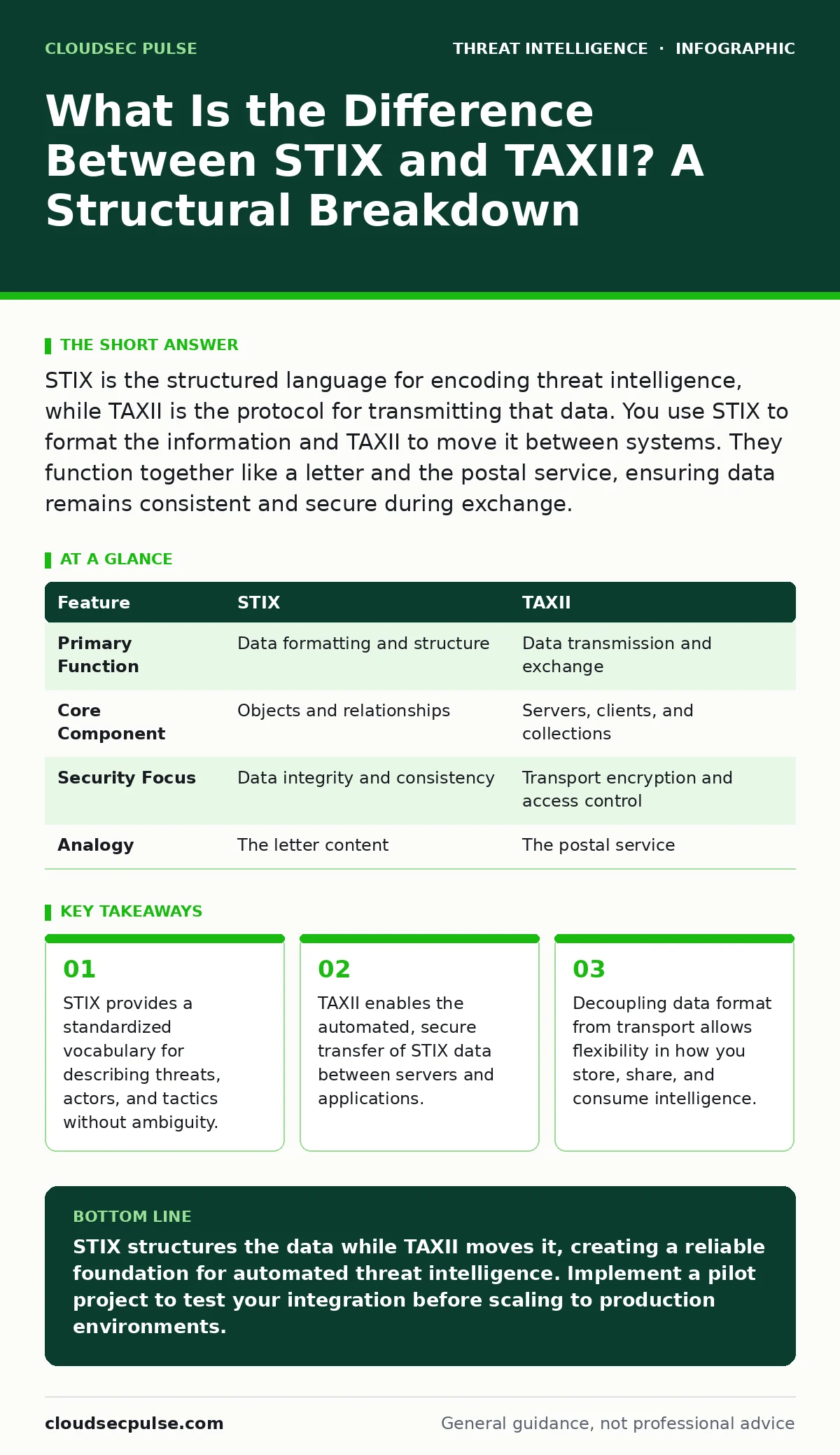
STIX is the structured language for encoding threat intelligence, while TAXII is the protocol for transmitting that data. You use STIX to format the information and TAXII to move it between systems. They function together like a letter and the postal service, ensuring data remains consistent and secure during exchange.
What is the difference between stix and taxii?
STIX defines the structure of the data while TAXII defines how that data moves across networks. STIX, or Structured Threat Information eXpression, is a language that allows you to describe cyber threats in a machine-readable format. TAXII, or Trusted Automated eXchange of Intelligence Information, is a protocol that allows you to send that structured data securely. You cannot send STIX data without a transport method, and TAXII is designed specifically to carry STIX payloads efficiently.
How do STIX objects represent threat reality?
STIX objects break down complex threats into discrete, reusable components. Instead of writing a narrative report, you define specific entities like Indicators, Malware, or Attack Patterns. Each object has a unique identifier and relationships to other objects. This structure allows different security tools to understand the same data without translation errors. You build a graph of interconnected facts rather than a flat document. This granularity supports precise automation in your detection systems.
Why does the transport protocol matter for security?
TAXII ensures that sensitive threat data reaches its destination without interception or tampering. It operates over HTTPS, providing encryption and authentication during transit. Without a dedicated protocol, you might rely on email or manual file transfers, which introduce human error and security gaps. TAXII supports both push and pull mechanisms, allowing you to send data to a partner or retrieve updates from a feed. This control over delivery timing prevents data loss during network outages.
What are the practical benefits of using both standards?
Using both standards creates a seamless pipeline from data collection to action. You can collect indicators from multiple sources, normalize them into STIX format, and distribute them via TAXII to your security tools. This separation of concerns means you can change your transport method without rewriting your data structure. It also allows you to integrate with various platforms that support these open standards. The result is reduced manual work and faster response times to emerging threats.
| Feature | STIX | TAXII |
|---|---|---|
| Primary Function | Data formatting and structure | Data transmission and exchange |
| Core Component | Objects and relationships | Servers, clients, and collections |
| Security Focus | Data integrity and consistency | Transport encryption and access control |
| Analogy | The letter content | The postal service |
How do you handle data normalization challenges?
Different sources often use varying terminology for the same threat concepts. STIX provides a common vocabulary that resolves these discrepancies. You map external data fields to standard STIX properties before ingestion. This process requires initial effort but pays off in long-term consistency. If you skip normalization, your automated systems may fail to correlate related events. Consistent data structures allow for accurate correlation across disparate security tools.
See also: Tactical Threat Intelligence: Practical Indicators for Small Business Defense · Hacktivism Explained: Defining Motives, Methods, and Mitigation
What infrastructure is required to deploy TAXII?
You need a TAXII server to host collections of STIX data and clients to request or receive it. The server manages authentication, authorization, and the storage of intelligence objects. Clients can be your SIEM, SOAR, or custom scripts that need regular updates. You must configure endpoints and collections to define what data is available and who can access it. Proper network segmentation ensures that only authorized systems can query the TAXII server.
How does this relate to incident triage?
Accurate, timely data improves the speed and accuracy of incident triage. When your tools receive standardized STIX indicators via TAXII, they can automatically flag matching activity. This reduces the time analysts spend investigating benign alerts. You can focus on genuine threats rather than noise. Integrating these standards with your incident triage workflows ensures that every alert has context and source attribution. This clarity helps prioritize actions based on actual risk levels.
What are the limitations of standardized exchange?
Standardization does not guarantee data quality or relevance. A TAXII feed might contain outdated or irrelevant indicators for your specific environment. You must filter and tune the incoming data to match your assets and threat model. Blindly trusting all received data can lead to alert fatigue. You need processes to validate indicators and update your detection rules accordingly. Regular review of your STIX objects ensures they remain useful and accurate.
How do you avoid false positives in threat detection?
Even with clean data, matches do not always indicate malicious activity. You must contextualize STIX indicators within your network environment. An indicator might match a legitimate software update or internal testing tool. You should use additional signals to confirm suspicious behavior before raising an alert. Integrating these checks with your false positives in threat detection strategy reduces unnecessary noise. This balance ensures that your security team focuses on real threats.
What advanced tactics benefit from this framework?
Sophisticated attacks often involve multiple stages and techniques. STIX allows you to map these complex chains of events. You can link initial access methods to lateral movement and exfiltration tactics. This comprehensive view helps you detect multi-stage attacks that single indicators might miss. For example, understanding the relationship between scheduled task abuse and credential theft allows for better detection logic. You can model these attack paths in your STIX data to improve your defensive posture.
How do you maintain long-term viability?
Standards evolve to address new threats and technologies. You must keep your STIX and TAXII implementations up to date. Regularly review the latest specifications and update your tools accordingly. Monitor community discussions and vendor updates for changes in best practices. This ongoing maintenance ensures that your threat intelligence pipeline remains effective against emerging threats. Staying current with standards prevents technical debt and security gaps.
What is the first step to implementation?
Begin by identifying your data sources and destinations. Determine which tools need to send or receive threat intelligence. Choose a TAXII server that supports your required volume and security requirements. Configure your tools to produce or consume STIX data in the expected format. Test the integration with a small dataset to verify connectivity and data integrity. Gradually expand to include more sources and destinations as you gain confidence.
Key takeaways
- STIX provides a standardized vocabulary for describing threats, actors, and tactics without ambiguity.
- TAXII enables the automated, secure transfer of STIX data between servers and applications.
- Decoupling data format from transport allows flexibility in how you store, share, and consume intelligence.
STIX structures the data while TAXII moves it, creating a reliable foundation for automated threat intelligence. Implement a pilot project to test your integration before scaling to production environments.
Frequently asked questions
Can I use STIX without TAXII?
Yes, you can store or share STIX data using other methods, but you lose the standardized security and automation benefits of TAXII.
Is TAXII only for STIX data?
TAXII is designed specifically for STIX, though it can technically transport other JSON data, its features are optimized for STIX objects.
Do I need a dedicated server for TAXII?
You need a TAXII server endpoint, which can be hosted on existing infrastructure, but it requires proper configuration for security and performance.
How does this help with network traffic analysis?
Standardized indicators allow you to correlate network traffic patterns with known threat behaviors, improving the accuracy of your analysis.
How this guide was produced: written by the CloudSec Pulse editorial team with AI assistance, checked against the public references listed below, and reviewed when the facts change. See our editorial policy or report an error.