What is MITRE D3FEND: Meaning, Structure, and Practical Use
MITRE D3FEND maps defensive actions to specific adversary techniques, allowing you to verify coverage gaps rather than relying on vendor marketing claims.

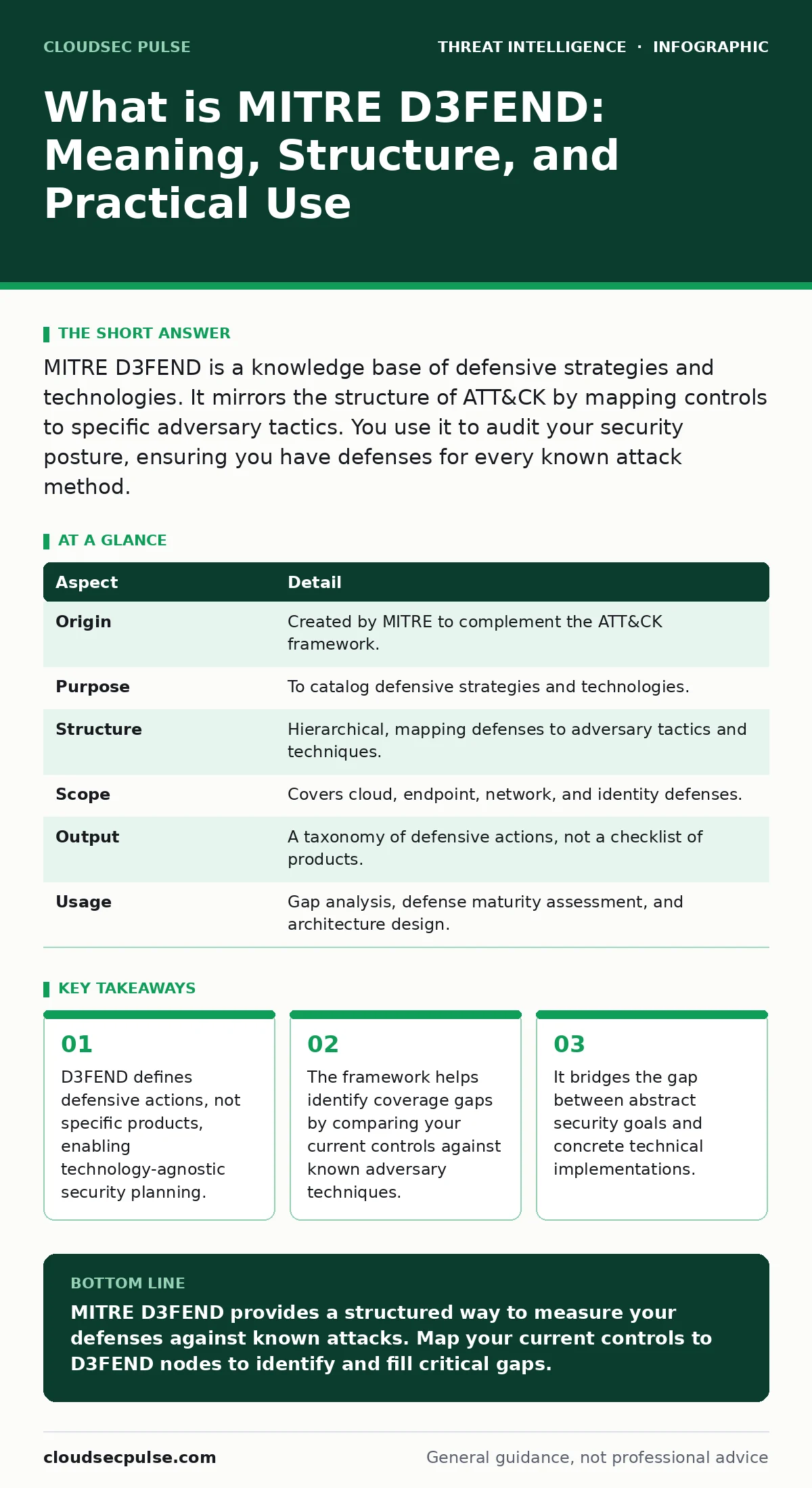
MITRE D3FEND is a knowledge base of defensive strategies and technologies. It mirrors the structure of ATT&CK by mapping controls to specific adversary tactics. You use it to audit your security posture, ensuring you have defenses for every known attack method.
The Mirror Image of Attack
Imagine a library where every book represents a way to break in. Now imagine a second library where every book represents a way to stop that specific break-in. This second library is MITRE D3FEND. It does not list firewalls or antivirus software by brand name. Instead, it lists the action those tools perform.
This structure exists because attack frameworks like MITRE ATT&CK describe how adversaries operate. Defenses need a matching structure to prove they address those operations. Without this mirror, you cannot measure if your security stack actually covers the threats you face. You might have many tools, but they may all target the same weak point while ignoring others.
D3FEND stands for "Defenses." It is a knowledge base maintained by MITRE, the same organization that created ATT&CK. It provides a common language for defenders. This allows you to discuss security in terms of capabilities rather than product features.
At a Glance: Understanding the Framework
| Aspect | Detail |
|---|---|
| Origin | Created by MITRE to complement the ATT&CK framework. |
| Purpose | To catalog defensive strategies and technologies. |
| Structure | Hierarchical, mapping defenses to adversary tactics and techniques. |
| Scope | Covers cloud, endpoint, network, and identity defenses. |
| Output | A taxonomy of defensive actions, not a checklist of products. |
| Usage | Gap analysis, defense maturity assessment, and architecture design. |
From Abstract Goals to Concrete Controls
Security goals are often vague. You might want "stronger authentication" or "better visibility." D3FEND translates these goals into specific defensive actions. For example, instead of saying "monitor logs," D3FEND defines Log Monitoring as a specific node in its hierarchy.
This node branches into more specific actions. One branch might be Endpoint Log Monitoring. Another might be Cloud Audit Log Review. Each of these has sub-nodes describing the technology or process used. This hierarchy forces you to be precise. You cannot claim to have "log monitoring" if you only monitor cloud audit logs but ignore endpoint activity.
This precision helps when integrating with digital forensics and incident response workflows. When an alert fires, you know exactly which defensive action triggered it. You can trace the logic back to the specific control that detected the anomaly. This clarity speeds up investigation and reduces noise.
Day-to-Day Application in Security Operations
You use D3FEND primarily for gap analysis. Start by listing the adversary techniques that matter to your industry. These are usually found in the ATT&CK matrix. Then, look for the corresponding D3FEND nodes.
If an adversary technique like "Phishing" has a matching defensive node like "Phishing Email Filtering," check if you have that control. If you do not, you have a gap. If you do, verify if the control is effective. This process turns security from a guess into a measurable discipline.
This method also aids in incident triage. When a breach occurs, you can map the attacker’s path to D3FEND nodes. If the attacker bypassed "Malware Analysis" but was caught by "Network Traffic Analysis," you know where your strengths and weaknesses lie. This insight guides future investments.
The Hidden Cost of Product-Centric Thinking
Many organizations buy tools based on feature lists. A vendor claims their platform "stops ransomware." In D3FEND terms, this is vague. Ransomware is an outcome, not a technique. The techniques might include "Data Encrypted for Impact" or "Inhibit Response Systems."
If you buy a tool that only addresses the encryption phase, you miss the earlier stages. D3FEND forces you to look at the entire chain. You must defend against the initial access, the lateral movement, and the data staging. This holistic view often reveals that you need more than one tool.
This is where user and entity behavior analytics becomes relevant. Behavioral controls map to different D3FEND nodes than signature-based controls. Relying on only one type leaves blind spots. D3FEND exposes these blind spots by showing you which nodes are empty.
See also: Tactical Threat Intelligence: Practical Indicators for Small Business Defense · What Is the Difference Between STIX and TAXII? A Structural Breakdown
What People Usually Get Wrong
A common mistake is treating D3FEND as a compliance checklist. It is not. Checking a box does not mean you are secure. It means you have a control that maps to a defensive action. You must still validate that the control works.
Another error is assuming D3FEND replaces ATT&CK. They are complementary. ATT&CK describes the offense; D3FEND describes the defense. You need both to understand the full picture. Using one without the other leads to an incomplete security posture.
Finally, some believe D3FEND is static. It evolves as new attacks emerge. New defensive strategies are added. You must review your mapping periodically. This ensures your defenses keep pace with the changing threat environment.
Integrating with Broader Security Practices
D3FEND fits into larger security frameworks. It connects well with red teaming exercises. After a red team test, you can map their actions to ATT&CK techniques. Then, use D3FEND to identify which defenses failed. This creates a direct link between testing and improvement.
It also supports network traffic analysis. By mapping your traffic inspection capabilities to D3FEND nodes, you can ensure you are looking for the right indicators.
For those dealing with complex environments, D3FEND helps prioritize efforts. You cannot fix everything at once. Focus on the gaps that expose you to the highest risk. This targeted approach maximizes your return on security investment.
Validating Your Defensive Coverage
To use D3FEND effectively, you must audit your current state. Start with a high-level view. Identify the major defensive categories you use. Then, drill down into the specific nodes.
Create a matrix. On one side, list the adversary techniques. On the other, list your D3FEND nodes. Mark where they intersect. This visual aid makes gaps obvious. It also helps communicate risks to leadership.
Remember that no framework provides complete protection. D3FEND is a map, not a shield. It guides your decisions, but it does not make them. You must still choose the right technologies and configure them correctly.
Key takeaways
- D3FEND defines defensive actions, not specific products, enabling technology-agnostic security planning.
- The framework helps identify coverage gaps by comparing your current controls against known adversary techniques.
- It bridges the gap between abstract security goals and concrete technical implementations.
MITRE D3FEND provides a structured way to measure your defenses against known attacks. Map your current controls to D3FEND nodes to identify and fill critical gaps.
Frequently asked questions
Is MITRE D3FEND free to use?
Yes, MITRE D3FEND is an open-source project. You can access the data and documentation without a license fee.
Does D3FEND replace other security frameworks?
No, it complements frameworks like ATT&CK. It focuses on defensive actions, while others may focus on compliance or risk management.
Can small businesses use D3FEND?
Yes. While it is detailed, it helps prioritize defenses. You can focus on the most critical nodes first, regardless of budget size.
How often is D3FEND updated?
MITre updates D3FEND regularly as new defensive strategies emerge. You should check for updates periodically to ensure your mapping remains current.
How this guide was produced: written by the CloudSec Pulse editorial team with AI assistance, checked against the public references listed below, and reviewed when the facts change. See our editorial policy or report an error.