Session Fixation Explained: How Attackers Hijack User Identities
Attackers can force your application to accept an identity they created before you ever logged in, bypassing standard authentication checks entirely.

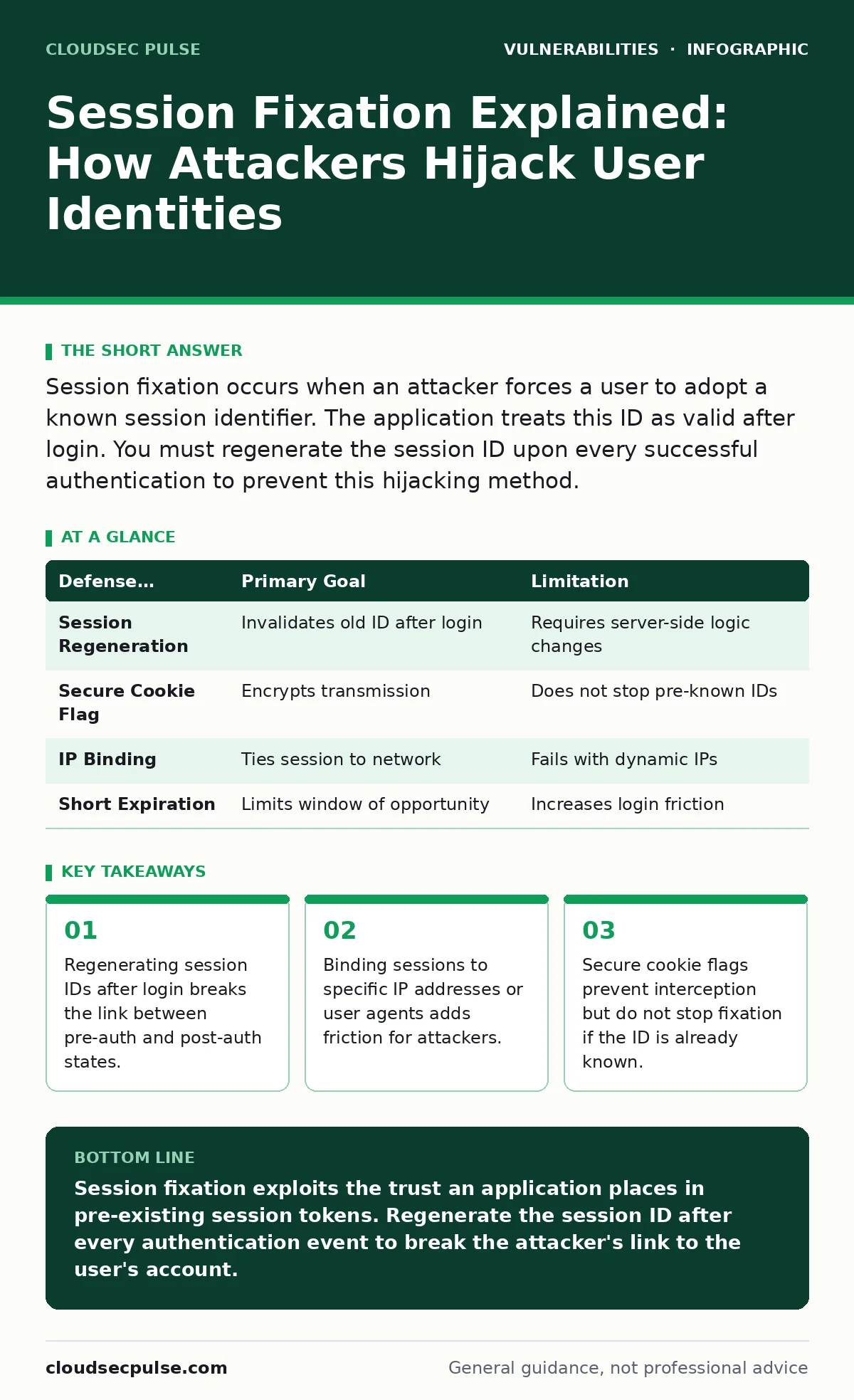
Session fixation occurs when an attacker forces a user to adopt a known session identifier. The application treats this ID as valid after login. You must regenerate the session ID upon every successful authentication to prevent this hijacking method.
What exactly is session fixation?
Session fixation is an attack where an adversary supplies a victim with a valid session identifier. The victim uses this ID to log in, and the server accepts it as the new authenticated session. The attacker then uses the same ID to access the account with the victim's privileges.
This exploit relies on the application failing to change the session identifier upon successful authentication. It turns a random, secret value into a known quantity controlled by the attacker.
How does an attacker inject a fixed session ID?
The attacker typically obtains a valid session ID by simply visiting the target website. This generates a cookie or URL parameter containing the initial, unauthenticated session token. The attacker then tricks the victim into visiting a link containing this specific session value.
Suppose an attacker sends a phishing email with a link that includes the session ID as a query parameter. When the victim clicks the link and logs in, the server continues using that pre-existing ID. The attacker now shares the active session with the victim.
Why doesn't changing the password stop this attack?
Changing the password only updates the credential check for future login attempts. It does not invalidate the current active session unless the application is explicitly programmed to do so. If the session cookie remains in the victim's browser, the server continues to trust it.
The attacker holds the same session ID. They do not need the password to maintain access. The session remains valid until it expires or is explicitly destroyed by the server.
What is the single most effective defense?
You must regenerate the session identifier every time a user authenticates. When the login process succeeds, the server should discard the old session ID and issue a completely new one. This ensures the attacker's known ID becomes invalid immediately after the victim logs in.
This mechanism breaks the continuity between the unauthenticated and authenticated states. It renders any pre-existing session tokens useless for post-login access.
Do secure cookies prevent session fixation?
Secure cookies ensure the session ID is only transmitted over encrypted HTTPS connections. This prevents network sniffers from stealing the ID in transit. However, it does not protect against fixation if the attacker already knows the ID before encryption begins.
If the attacker forces the victim to use a specific ID via a crafted link, encryption does not stop the server from accepting it. The security of the channel is irrelevant if the token itself is compromised at the application layer.
See also: Host Header Injection Response: Recovery and Prevention Steps · Server-Side Template Injection Prevention Checklist for Secure Code
How does session binding improve security?
Session binding ties the session ID to specific client characteristics, such as the IP address or user agent string. If the session is accessed from a different IP or browser, the server invalidates it. This makes it difficult for the attacker to use the ID from a remote location.
Imagine the victim logs in from home while the attacker waits in a different country. The IP mismatch triggers a rejection. This adds a layer of defense but can cause false positives for users with dynamic IPs.
What happens if I use URL-based session IDs?
URL rewriting exposes session IDs in server logs, browser history, and referral headers. This increases the chance of accidental leakage. It also makes it easier for attackers to construct fixed-session links for phishing campaigns.
Cookies are generally safer because they are opaque to the user and less likely to be cached or logged inadvertently. If you must use URLs, ensure strict access controls and short expiration times.
How does this relate to other web vulnerabilities?
Session fixation often combines with broken access control to escalate privileges. If an attacker can fixate a session for an admin account, they bypass role-based checks. It is distinct from prototype pollution, which involves manipulating JavaScript objects rather than session tokens.
Understanding these differences helps in vulnerability prioritization. You must address session management flaws separately from input validation issues.
| Defense Mechanism | Primary Goal | Limitation |
|---|---|---|
| Session Regeneration | Invalidates old ID after login | Requires server-side logic changes |
| Secure Cookie Flag | Encrypts transmission | Does not stop pre-known IDs |
| IP Binding | Ties session to network | Fails with dynamic IPs |
| Short Expiration | Limits window of opportunity | Increases login friction |
Can multi-factor authentication mitigate this risk?
Multi-factor authentication adds a second verification step. However, if the session is fixed before the MFA challenge, the attacker may still gain access if the server ties the MFA success to the existing session ID. The regeneration must occur after all authentication factors are verified.
MFA protects the credential but not the session state. Without proper ID rotation, the session remains the weak link.
What is the hidden cost of poor session management?
Poor session management often leads to excessive server load due to abandoned sessions. It also complicates exposure management by creating numerous active but unused tokens. These tokens represent potential entry points that are difficult to track without an accurate IT asset inventory.
The cost is not just technical debt. It is the risk of silent account takeovers that may go undetected for long periods.
How do I audit my current implementation?
Review your authentication flow to ensure a new session ID is issued post-login. Check server logs for anomalies where a single session ID is associated with multiple IPs. Compare your current setup against the National Vulnerability Database for known frameworks issues.
Look for instances where session IDs appear in URLs or are cached by proxies. Ensure that logout actions explicitly destroy the server-side session data, not just the client cookie.
Key takeaways
- Regenerating session IDs after login breaks the link between pre-auth and post-auth states.
- Binding sessions to specific IP addresses or user agents adds friction for attackers.
- Secure cookie flags prevent interception but do not stop fixation if the ID is already known.
Session fixation exploits the trust an application places in pre-existing session tokens. Regenerate the session ID after every authentication event to break the attacker's link to the user's account.
Frequently asked questions
Does HTTPS prevent session fixation attacks?
No. HTTPS encrypts the data in transit but does not stop an attacker from forcing a user to use a specific, known session ID before encryption begins.
Can a proxy server cause session fixation issues?
Yes. If a proxy caches pages containing session IDs or shares session state across users, it can inadvertently facilitate fixation by distributing the same token to multiple clients.
Is session fixation common in modern frameworks?
Most modern frameworks handle session regeneration automatically. However, custom authentication modules or older legacy systems often lack this protection, making them vulnerable.
How does this differ from session hijacking?
Hijacking involves stealing a valid session ID, usually through interception. Fixation involves forcing the user to use an ID the attacker already knows, bypassing the need to steal it.
How this guide was produced: written by the CloudSec Pulse editorial team with AI assistance, checked against the public references listed below, and reviewed when the facts change. See our editorial policy or report an error.