Invoice Fraud Mistakes: 7 Errors That Cost You Money
Most invoice fraud succeeds because you verify the request but fail to verify the sender through a separate communication channel.

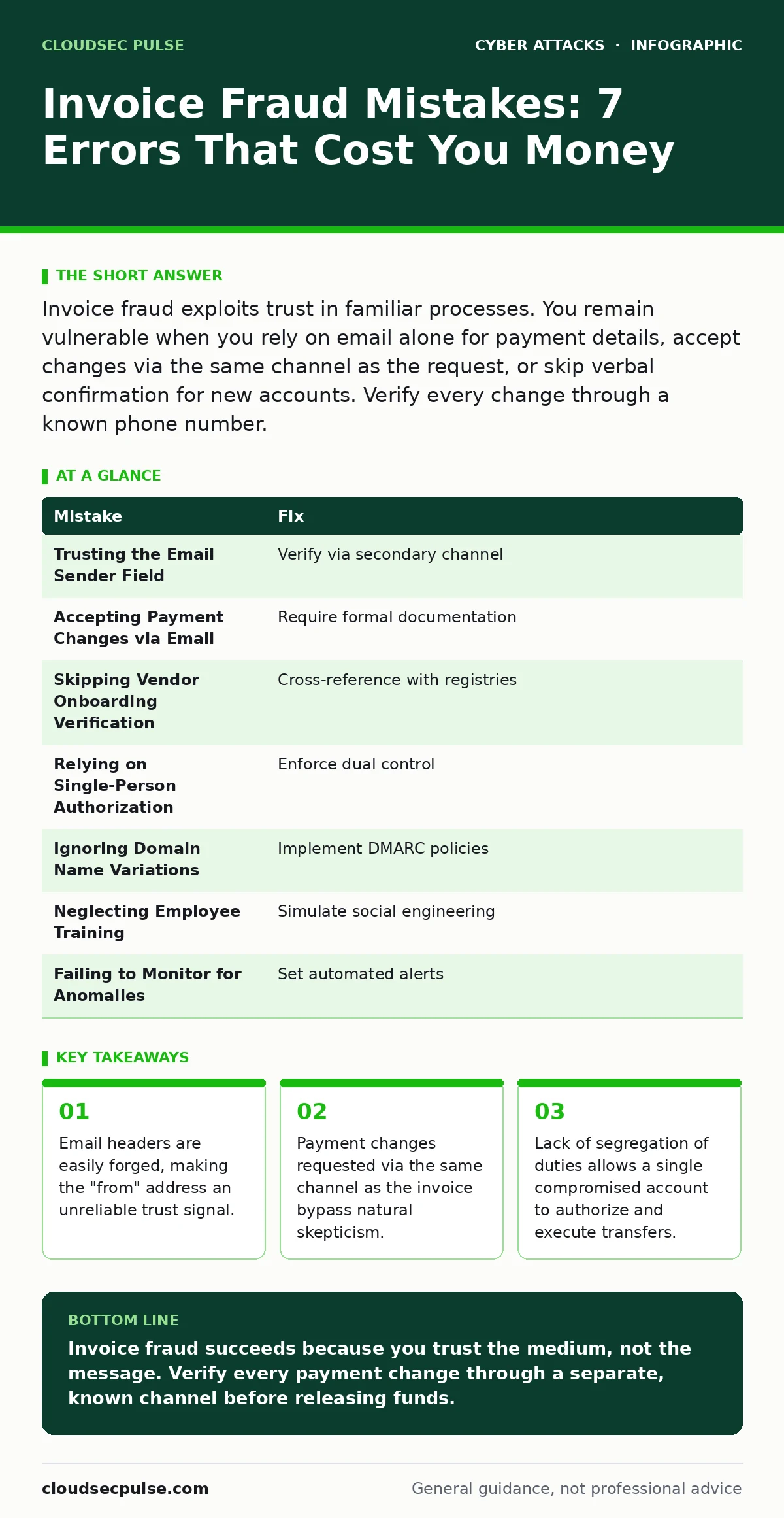
Invoice fraud exploits trust in familiar processes. You remain vulnerable when you rely on email alone for payment details, accept changes via the same channel as the request, or skip verbal confirmation for new accounts. Verify every change through a known phone number.
Mistake 1: Trusting the Email Sender Field
Email protocols do not verify the identity of the sender by default. Attackers use domain spoofing to make messages appear as if they originate from your regular suppliers or internal finance teams. You see a familiar name and logo, so you assume the request is legitimate. The underlying Simple Mail Transfer Protocol allows anyone to insert any address into the sender field without owning that domain. This technical flaw means visual confirmation provides zero security.
Why it hurts: You process payments based on a false premise of trust. The attacker controls the narrative entirely because you never questioned the origin. You send funds to an account you do not control, often to a jurisdiction with weak recovery laws. The financial loss is immediate and rarely reversible once the transfer clears.
The fix: Treat the email sender field as untrusted data. Establish a policy that requires verification of any payment instruction through a secondary channel. Call the supplier using a phone number from your existing records, not one provided in the suspicious email. This out-of-band verification breaks the attacker’s control loop.
Mistake 2: Accepting Payment Changes via Email
Attackers monitor communication patterns to identify when a vendor sends invoices. They wait for a legitimate invoice to arrive, then send a follow-up message claiming a bank account change. This message arrives in the same inbox where you read the original invoice. The context feels correct because the timing aligns with your payment cycle. You update the vendor details in your accounting software without hesitation.
Why it hurts: The attacker leverages your routine workflow against you. By embedding the fraud within a normal business process, they reduce your cognitive load and skepticism. You bypass standard checks because the request seems like a minor administrative update. The consequence is a diverted payment that looks identical to a legitimate transaction in your records.
The fix: Implement a strict rule that payment changes require formal documentation. Demand a signed letter on company letterhead or a video call with the vendor’s authorized representative. Never accept bank detail changes via email alone. This adds friction to the attack path, forcing the attacker to compromise more than just an email account.
Mistake 3: Skipping Vendor Onboarding Verification
New vendors introduce new risk vectors. You may rush to onboard a supplier to meet project deadlines, skipping thorough background checks. You accept the bank details provided in the initial proposal without cross-referencing them with public registries or bank records. This haste creates a gap in your defense in depth strategy. The attacker creates a shell company that mimics a real vendor, using similar names and logos to confuse your review process.
Why it hurts: You lack a baseline for normal behavior. Without prior history, you cannot detect anomalies in payment requests. The shell company disappears after receiving the first payment, leaving you with no recourse. You waste time and resources investigating a non-existent supplier while the financial damage is done.
The fix: Verify new vendors against official business registries. Confirm that the bank account holder name matches the legal entity name exactly. Require a meeting or call before the first payment is processed. This establishes a human connection and verifies the entity’s legitimacy before any money moves.
Mistake 4: Relying on Single-Person Authorization
Small teams often lack segregation of duties. One person receives the invoice, approves it, and initiates the payment. This concentration of power creates a single point of failure. If that person’s email account is compromised, the attacker controls the entire payment workflow. There is no second set of eyes to catch discrepancies or flag unusual amounts. This violates the principle of zero trust security, which assumes no user or device is inherently trusted.
Why it hurts: The attacker needs only one credential to succeed. They do not need to bypass multiple layers of security. The lack of oversight means fraudulent payments can proceed unnoticed for days or weeks. You lose the ability to detect errors or fraud early in the process.
The fix: Enforce dual control for all payments above a certain threshold. Require one person to approve the invoice and a different person to execute the transfer. This separation ensures that a single compromised account cannot complete a fraudulent transaction. It also provides a natural check against human error.
Mistake 5: Ignoring Domain Name Variations
Attackers register domains that look similar to your vendor’s legitimate domain. They use typosquatting to create addresses like "suppllier.com" instead of "supplier.com". You may not notice the extra letter because you scan emails quickly. This visual similarity exploits your brain’s tendency to recognize patterns rather than read every character. The email arrives from a domain that is technically unrelated to the real vendor.
Why it hurts: You trust the message because the domain looks familiar. The attacker exploits this cognitive shortcut to bypass your skepticism. You process the invoice without verifying the actual domain ownership. The payment goes to the attacker’s account, which is linked to the look-alike domain.
The fix: Implement Domain-based Message Authentication, Reporting, and Conformance (DMARC) policies for your own domain and encourage vendors to do the same. DMARC helps your email server reject messages that do not come from authorized sources. Train staff to hover over sender addresses to reveal the full domain name before opening messages.
See also: Whaling Attacks: Risks and Low-Cost Protection Strategies · Baiting Attacks: Risks and Protection for Small Businesses
Mistake 6: Neglecting Employee Training on Social Engineering
Technology alone cannot stop sophisticated social engineering attacks. Your employees are the human factor in security, and they can be manipulated into bypassing technical controls. Attackers use urgency and authority to pressure staff into acting quickly. They claim to be the CEO or a senior executive demanding an immediate wire transfer. The victim complies to avoid appearing unhelpful or slow.
Why it hurts: The attacker exploits psychological triggers rather than technical vulnerabilities. Your firewalls and anti-virus software cannot detect a convincing email that asks for a favor. The payment is made willingly by an employee who believes they are helping the business. This type of fraud is difficult to trace because it involves no malware or technical breach.
The fix: Conduct regular training sessions that simulate real-world scenarios. Teach employees to recognize signs of urgency and authority abuse. Establish a clear protocol for handling executive requests, such as verifying the request through a known channel before acting. This builds a culture of skepticism that complements your technical defenses.
Mistake 7: Failing to Monitor for Anomalies
You process payments based on historical data but rarely analyze trends. You do not notice when a vendor’s invoice amount increases slightly each month or when payment terms change unexpectedly. These small deviations are early warning signs of account takeover or fraud. Without monitoring, you miss the opportunity to catch the attack before the final transfer. This passive approach leaves your attack surface reduction efforts incomplete.
Why it hurts: The attacker operates under the radar by making small, incremental changes. You do not trigger alerts because each individual transaction looks normal. By the time you notice the discrepancy, significant funds have been diverted. The lack of proactive monitoring allows the fraud to persist undetected.
The fix: Implement automated alerts for unusual payment patterns. Flag invoices that deviate from historical averages or involve new bank accounts. Review these flagged items manually before processing. This proactive approach helps you catch fraud early and reduces the potential financial impact.
| Mistake | Fix |
|---|---|
| Trusting the Email Sender Field | Verify via secondary channel |
| Accepting Payment Changes via Email | Require formal documentation |
| Skipping Vendor Onboarding Verification | Cross-reference with registries |
| Relying on Single-Person Authorization | Enforce dual control |
| Ignoring Domain Name Variations | Implement DMARC policies |
| Neglecting Employee Training | Simulate social engineering |
| Failing to Monitor for Anomalies | Set automated alerts |
Key takeaways
- Email headers are easily forged, making the "from" address an unreliable trust signal.
- Payment changes requested via the same channel as the invoice bypass natural skepticism.
- Lack of segregation of duties allows a single compromised account to authorize and execute transfers.
Invoice fraud succeeds because you trust the medium, not the message. Verify every payment change through a separate, known channel before releasing funds.
Frequently asked questions
How do I know if an invoice email is fake?
Check the sender’s full email address for typos and verify the request by calling the vendor using a number from your existing records.
Can I block all invoice fraud with software?
No, software can filter obvious threats, but social engineering requires human verification and procedural controls to prevent.
What should I do if I already sent money to a scammer?
Contact your bank immediately to attempt a recall, then report the incident to law enforcement and your insurance provider.
Is DMARC enough to stop invoice fraud?
DMARC helps authenticate emails, but it does not prevent attackers from using legitimate-looking domains or social engineering tactics.
How this guide was produced: written by the CloudSec Pulse editorial team with AI assistance, checked against the public references listed below, and reviewed when the facts change. See our editorial policy or report an error.