Invoice Fraud Detection: How to Spot Fake Bills Before Payment
Most invoice fraud bypasses technical security controls by exploiting human trust and established payment workflows rather than hacking software directly.

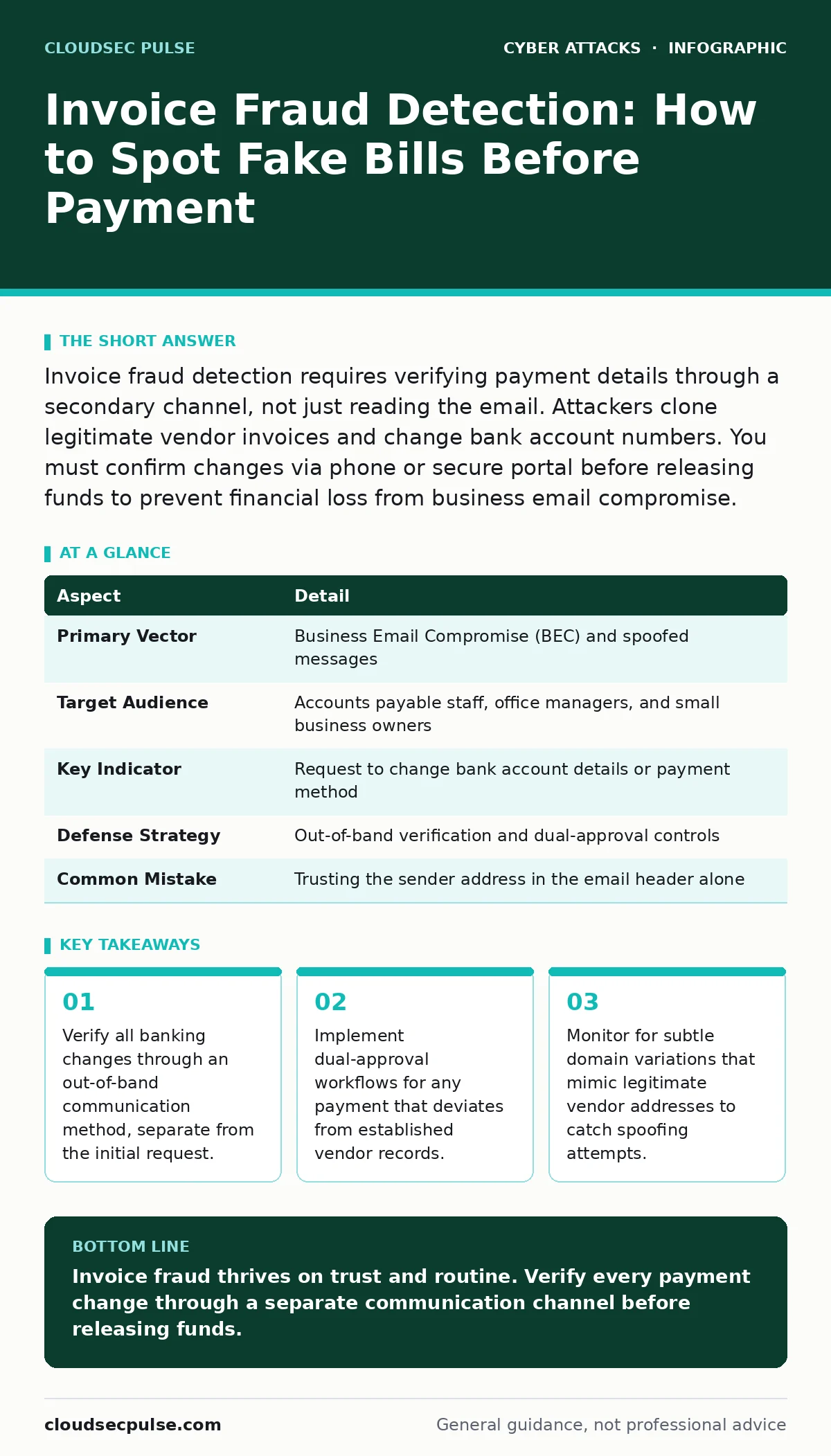
Invoice fraud detection requires verifying payment details through a secondary channel, not just reading the email. Attackers clone legitimate vendor invoices and change bank account numbers. You must confirm changes via phone or secure portal before releasing funds to prevent financial loss from business email compromise.
The Mechanics of Invoice Fraud
Imagine receiving a letter from your bank with slightly different letter spacing. You trust the logo, so you act on it. Invoice fraud operates on this same principle of familiarity. An attacker intercepts or mimics a legitimate invoice from a supplier you already pay. They change only the payment instructions, directing funds to an account they control. The document looks identical to previous bills. The email appears to come from your known vendor. The amount matches the expected invoice. This social engineering attack exploits the routine nature of accounts payable. It does not require complex hacking tools. It requires patience and access to public information about your supply chain.
| Aspect | Detail |
|---|---|
| Primary Vector | Business Email Compromise (BEC) and spoofed messages |
| Target Audience | Accounts payable staff, office managers, and small business owners |
| Key Indicator | Request to change bank account details or payment method |
| Defense Strategy | Out-of-band verification and dual-approval controls |
| Common Mistake | Trusting the sender address in the email header alone |
How Invoice Fraud Detection Works
Effective invoice fraud detection relies on breaking the chain of trust that attackers establish. You cannot rely on the email interface to tell you the truth. Attackers use domain spoofing to make their emails appear to originate from legitimate addresses. They may register a domain that differs by only one letter from your vendor’s actual domain. Your email client might display the correct name due to cached contact information. The technical headers, however, will show the true origin. Detection starts with questioning any request that introduces friction or urgency. Legitimate vendors rarely ask for sudden changes to payment methods without prior notice through official channels.
Who It Affects and Why
Small organizations are frequent targets because they often lack segregated duties in finance. One person may receive invoices, approve them, and initiate payments. This concentration of authority removes natural checks and balances. Attackers scout for businesses that use simple payment methods like wire transfers or ACH credits. These methods are difficult to reverse once executed.
The fraud affects anyone who receives goods or services and pays via electronic transfer. It does not discriminate by industry. Construction firms, retail suppliers, and service providers all fall victim. The impact is immediate financial loss and the administrative burden of recovering funds. Unlike data breaches, the damage is direct and tangible.
What People Usually Get Wrong
Many organizations believe that installing advanced firewalls will stop invoice fraud. This is a fundamental misunderstanding of the threat model. Firewalls protect network infrastructure from external intrusion. They do not inspect the content of legitimate emails for malicious intent. Attackers do not need to breach your network to succeed. They only need to send an email to an inbox that is already accessible. Another common error is trusting the "From" field in an email client. This field can be manipulated to display any name or address. The actual sender identity resides in the message headers, which most users never inspect. Relying on visual cues leads to costly errors.
Practical Steps for Prevention
You must implement procedural controls that force verification. Start by maintaining a master list of approved vendor bank details. Store this list securely and update it only through verified channels. When an invoice arrives, compare the payment instructions against this master record. Any discrepancy triggers a mandatory pause. You must contact the vendor using a phone number you already have on file. Do not use the contact information provided in the suspicious email. Ask specific questions about the invoice number and the requested change. This out-of-band verification confirms the identity of the requester.
- Establish a dual-approval policy for all payments above a certain threshold.
- Require a second manager to authorize any change to vendor banking details.
- Train staff to recognize urgency tactics and pressure to bypass procedures.
- Regularly audit payment logs for unusual patterns or new payees.
See also: Fake event ticket websites and how to spot the hidden traps
Integrating Security Frameworks
A layered defense reduces the risk of successful fraud. Zero trust security principles apply here by assuming no request is trustworthy by default. Every payment request must be verified, regardless of its source. Privileged access management ensures that only authorized personnel can initiate large transfers. This limits the damage if an account is compromised. You should also be aware of phishing campaigns that aim to steal credentials used for these approvals. If an attacker gains access to an administrator account, they can approve fraudulent invoices internally. Strong authentication mechanisms, such as multi-factor authentication, add a necessary layer of defense.
Handling Detected Fraud
When you suspect invoice fraud, act quickly to stop the payment. Contact your bank immediately to attempt a recall of the funds. While success is not guaranteed, early action improves the chances. Document every step of the incident. Save the original email, including full headers. Record the time and date of your verification calls. This documentation is vital for law enforcement reports and insurance claims. Notify your legitimate vendor about the impersonation attempt. They may be a target for other customers as well. Review your internal processes to identify how the fraud slipped through. Adjust your controls to close the gap.
The Role of Verification Culture
Technical tools alone cannot solve invoice fraud. You need a culture that encourages skepticism and verification. Employees should feel safe questioning requests, even from senior management. Attackers often impersonate executives to pressure staff into bypassing procedures. This is known as CEO fraud. If your team feels pressured to act quickly, they are more likely to make mistakes. Encourage a "slow down" approach for any financial transaction. Make verification a standard part of the workflow, not an exception. Regular training sessions can reinforce these habits. Simulate attacks to test your team’s response. This prepares them for real-world scenarios.
Key takeaways
- Verify all banking changes through an out-of-band communication method, separate from the initial request.
- Implement dual-approval workflows for any payment that deviates from established vendor records.
- Monitor for subtle domain variations that mimic legitimate vendor addresses to catch spoofing attempts.
Invoice fraud thrives on trust and routine. Verify every payment change through a separate communication channel before releasing funds.
Frequently asked questions
Can I use software to automatically detect fake invoices?
Automated tools can flag anomalies, but they cannot replace human verification. They help identify suspicious patterns but cannot confirm the intent of the sender.
What is the difference between invoice fraud and phishing?
Phishing aims to steal credentials or install malware. Invoice fraud aims to redirect payments. Both may use similar email tactics, but the end goal differs.
Should I stop using email for invoices entirely?
Email is convenient but risky. Use secure portals for large transactions. If you must use email, enforce strict verification rules for any payment instructions.
How do I recover lost funds from invoice fraud?
Contact your bank immediately to request a recall. File a report with law enforcement. Success depends on speed and the cooperation of the receiving bank.
How this guide was produced: written by the CloudSec Pulse editorial team with AI assistance, checked against the public references listed below, and reviewed when the facts change. See our editorial policy or report an error.