Tailgating Cyber Security: How Physical Access Breaks Digital Defenses
Tailgating bypasses digital firewalls by exploiting human courtesy, turning a simple door hold into a direct path to your most sensitive data systems.

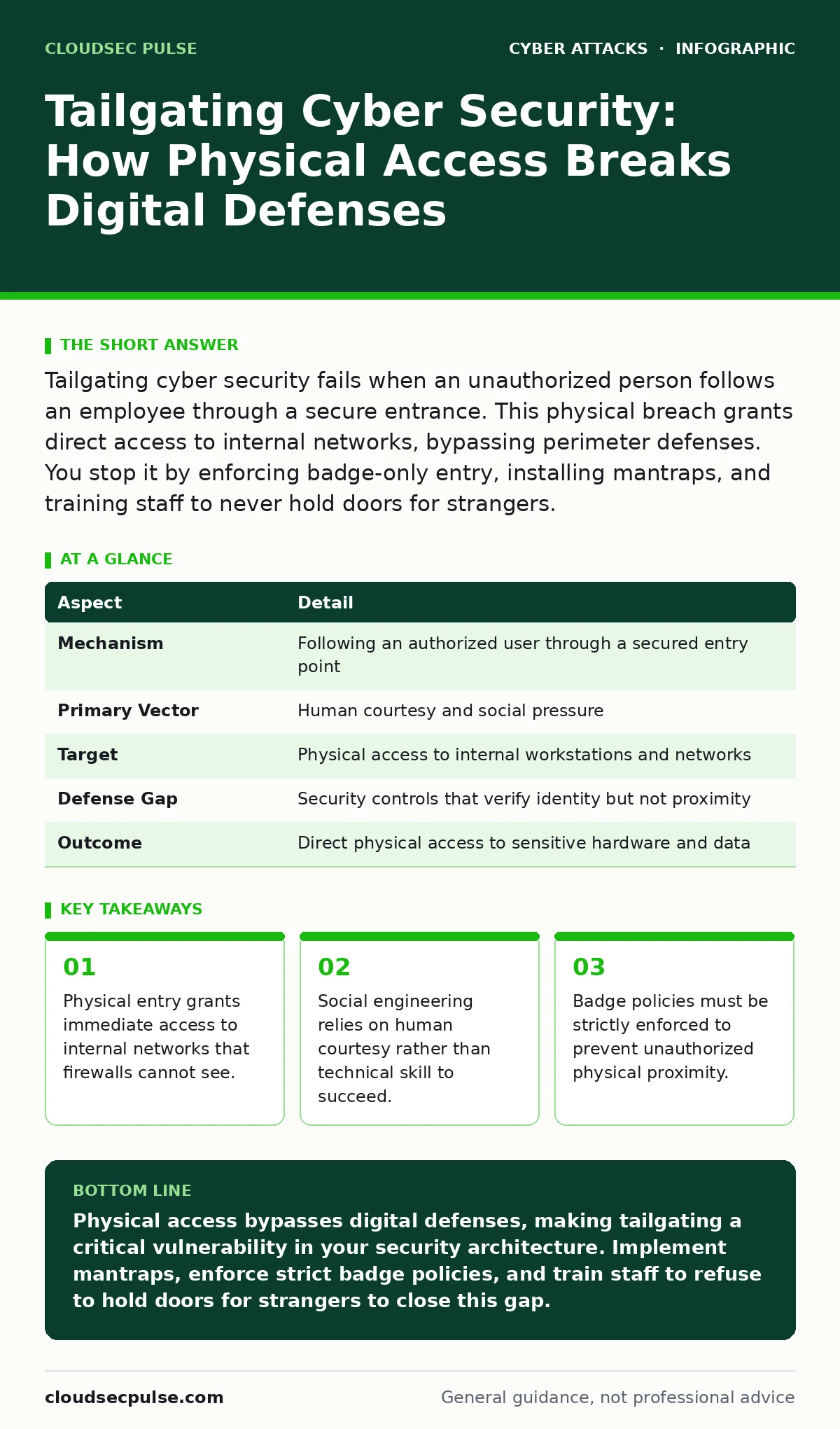
Tailgating cyber security fails when an unauthorized person follows an employee through a secure entrance. This physical breach grants direct access to internal networks, bypassing perimeter defenses. You stop it by enforcing badge-only entry, installing mantraps, and training staff to never hold doors for strangers.
The Open Door Analogy
Imagine carrying a heavy box up three flights of stairs. You reach the top, unlock the front door, and step inside. Behind you, a stranger slips past before the latch clicks. You do not notice them. They are now inside your home, free to wander your rooms, open your drawers, and copy your documents. You locked the door, but you did not control who crossed the threshold with you.
This scenario mirrors tailgating cyber security risks. The lock works perfectly. The digital perimeter is intact. The breach occurs in the gap between the door closing and the person entering. Attackers exploit the physical space where digital rules stop applying and human behavior takes over.
What Is Tailgating in Security?
Tailgating is an unauthorized entry method where an intruder follows an authorized person through a secure access point. The intruder gains entry without using valid credentials, relying entirely on the victim to open the door. This tactic bypasses electronic locks, card readers, and biometric scanners.
The attacker does not need to hack a system. They need only to look harmless and time their approach correctly. They may carry a laptop, wear a uniform, or pretend to be lost. The goal is never the door itself. The goal is the network connected to the desks behind that door.
| Aspect | Detail |
|---|---|
| Mechanism | Following an authorized user through a secured entry point |
| Primary Vector | Human courtesy and social pressure |
| Target | Physical access to internal workstations and networks |
| Defense Gap | Security controls that verify identity but not proximity |
| Outcome | Direct physical access to sensitive hardware and data |
How Tailgating Bypasses Digital Defenses
Digital security assumes that the network edge is the first line of defense. Firewalls filter incoming traffic. Intrusion detection systems monitor packets. These tools work well against remote attacks. They fail completely against someone sitting at a desk inside the building.
When an attacker walks in behind an employee, they bypass the firewall entirely. They are already on the internal network. Internal traffic is often trusted by default. This trust allows the attacker to move laterally to servers, file shares, and management consoles. They can plug a device into an Ethernet port or a USB drive into a computer. The system sees a trusted local connection, not an external threat.
This physical access undermines privileged access management. Even if passwords are complex and multi-factor authentication is enabled, a person standing at the keyboard can bypass these controls. They can wait for the screen to unlock. They can observe a PIN entry. They can insert a hardware keylogger. Digital hygiene matters less when the attacker is in the same room.
Who Gets Targeted and Why
Tailgating affects any organization with physical security boundaries. Small offices, corporate headquarters, and data centers are all vulnerable. The target is not the building; it is the people inside. Attackers choose locations where staff are polite, busy, or unaware of protocol.
Receptionists are frequent targets because they are expected to be helpful. Engineers are targeted because they often carry equipment that suggests legitimate business. New employees are vulnerable because they are unsure of the rules. The attacker looks for someone who wants to avoid conflict. They exploit the social cost of saying "no" to a smiling face.
This method is particularly dangerous for industries handling sensitive data. A breach here leads to direct data theft. It also enables follow-on attacks. Once inside, the attacker can stage phishing campaigns from the internal network. These emails appear to come from trusted colleagues, making them harder to detect. This connects tailgating to broader strategies like invoice fraud or baiting attacks.
What People Usually Get Wrong
Many organizations believe that a card reader solves the tailgating problem. The card reader validates identity, but it does not validate proximity. If the door swings open and two people enter, the system records one valid entry. It records no breach. This false sense of security leaves the physical gap unmonitored.
Another common mistake is relying on cameras alone. Cameras record what happened after the fact. They do not prevent the entry. By the time security reviews the footage, the attacker has already copied data or installed malware. Surveillance is useful for investigation, not for prevention.
Staff training often focuses on digital threats. Employees learn to spot phishing emails. They learn to verify sender addresses. They rarely learn to verify the person holding the door. This imbalance creates a blind spot. The human firewall is trained to stop digital tricks but remains open to physical ones.
Implementing Physical Countermeasures
Defense in depth requires layers that cover both digital and physical risks. You must treat the door as a security control, not just a convenience. The goal is to make tailgating difficult, noticeable, and socially unacceptable.
- Install mantraps or turnstiles. These physical barriers allow only one person to pass at a time. The outer door must close and lock before the inner door opens. This eliminates the possibility of following someone through.
- Require badge-in for every entry. Some systems allow a single badge tap to open the door for a group. Disable this feature. Each person must present their own credential.
- Post clear signage. Signs that state "No Tailgating" or "Badge Required for Entry" set expectations. They give employees a polite reason to refuse to hold the door.
- Train staff on refusal scripts. Employees should know what to say. A simple "I’m sorry, policy requires I wait for you to badge in" removes the social friction.
Monitoring and Response Protocols
Physical security logs are often ignored. You must treat badge data as valuable intelligence. Look for anomalies. Multiple badges used at the same time on the same reader suggest tailgating. Entries at unusual hours may indicate unauthorized access.
Integrate physical logs with digital security tools. If a badge is used at the front door and a login occurs on a server minutes later, correlate the events. This helps identify if a physical breach led to a digital compromise. This approach complements protections against formjacking or password spraying, which rely on different attack vectors.
When a tailgating incident is suspected, respond immediately. Escort the unauthorized person out. Check nearby workstations for signs of tampering. Change credentials for systems accessed from that area. Report the incident to security leadership. Treat it as a potential breach, not just a policy violation.
Integrating Physical and Digital Security
Tailgating cyber security is not a separate issue. It is a fundamental part of your overall security posture. Digital tools cannot protect you from someone sitting at your desk. Physical tools cannot protect you from someone hacking your email. You need both.
Review your access controls regularly. Ensure that badge systems are updated. Remove access for former employees immediately. Check that doors lock automatically. Verify that security cameras cover all entry points.
Train your team on the connection between physical and digital risks. Explain how a held door leads to data theft. Make security a shared responsibility. When everyone understands the risk, the culture shifts. Courtesy no longer overrides security. The door becomes a boundary, not a convenience.
Key takeaways
- Physical entry grants immediate access to internal networks that firewalls cannot see.
- Social engineering relies on human courtesy rather than technical skill to succeed.
- Badge policies must be strictly enforced to prevent unauthorized physical proximity.
Physical access bypasses digital defenses, making tailgating a critical vulnerability in your security architecture. Implement mantraps, enforce strict badge policies, and train staff to refuse to hold doors for strangers to close this gap.
Frequently asked questions
Does tailgating only affect large companies?
No, tailgating affects any organization with physical entry points. Small businesses are often targeted because they have fewer security staff and may rely more on courtesy than strict protocols.
Can software prevent tailgating?
Software alone cannot prevent physical entry. However, security information and event management systems can alert you to anomalous badge usage patterns, helping you detect tailgating after it occurs.
Is it rude to not hold the door?
Security policy overrides social courtesy. Posting clear signs and providing staff with polite refusal scripts helps reduce the social friction associated with enforcing access controls. Q
How this guide was produced: written by the CloudSec Pulse editorial team with AI assistance, checked against the public references listed below, and reviewed when the facts change. See our editorial policy or report an error.