What Is Password Spraying: Mechanism, Risks, and Defense
Password spraying bypasses account lockout policies by using one common password across many accounts, making detection nearly impossible without behavioral analysis.

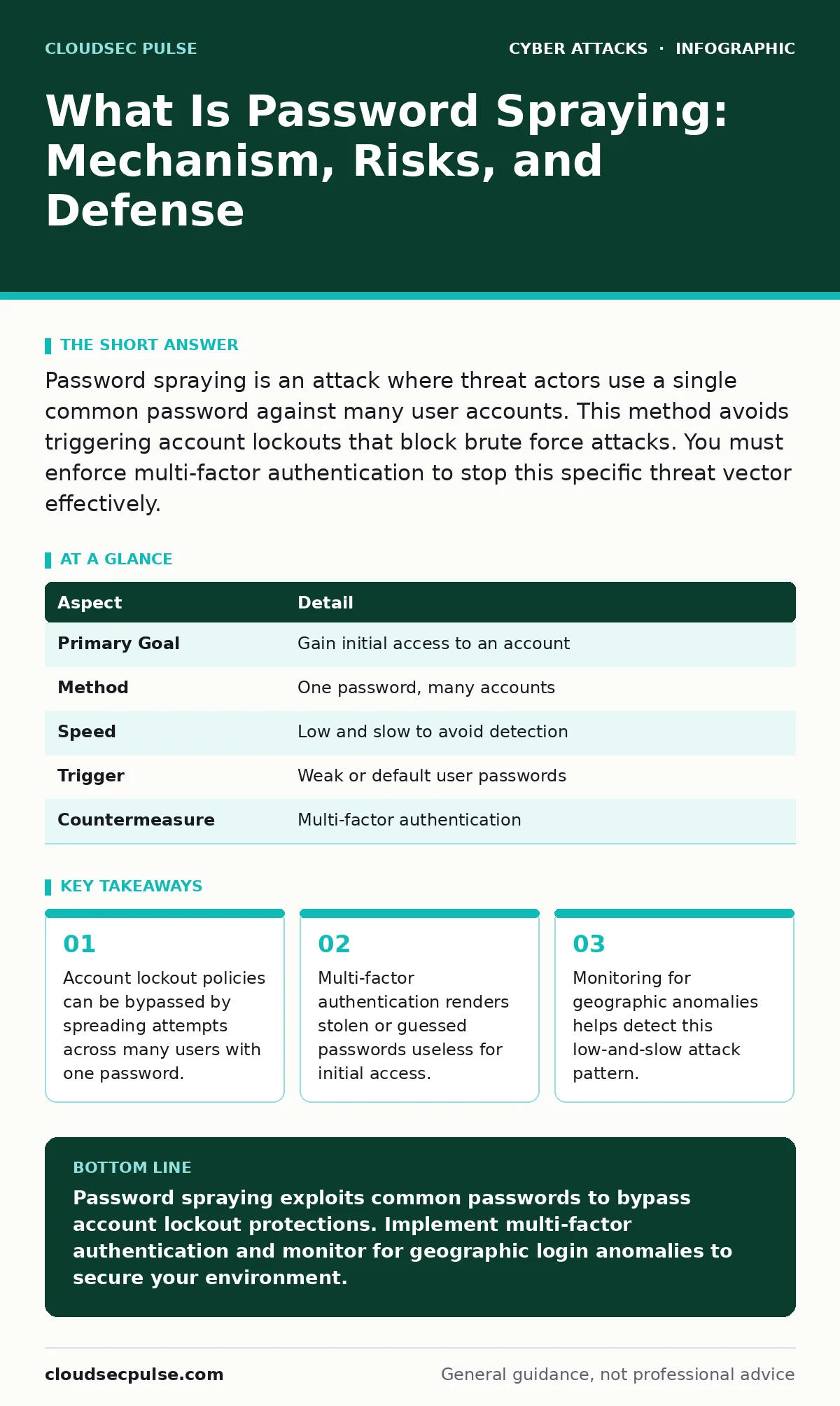
Password spraying is an attack where threat actors use a single common password against many user accounts. This method avoids triggering account lockouts that block brute force attacks. You must enforce multi-factor authentication to stop this specific threat vector effectively.
Everyday Analogy to Understand the Threat
Imagine a thief trying to enter a building with 100 offices. A traditional brute force attack is like trying every possible key combination on one door until it opens or security locks the door permanently. Password spraying is different. The thief takes a single, commonly used key—like a master key from a generic set—and tries it on every door in the hallway. They move slowly to avoid triggering alarms. If one door opens, they have entry. This analogy explains why volume matters less than persistence and commonality in this attack method.
What Is Password Spraying
Password spraying is a credential stuffing technique where attackers use a small number of common passwords against a large number of user accounts. Unlike brute force attacks that target one user with many passwords, this method targets many users with one password. The goal is to find at least one account that uses a weak or default password. This approach exploits human behavior rather than system vulnerabilities. Users frequently choose predictable strings like "Password1" or seasonal terms. Attackers compile these lists from public data breaches and common usage patterns. The attack succeeds when a user fails to change their default or simple password.
| Aspect | Detail |
|---|---|
| Primary Goal | Gain initial access to an account |
| Method | One password, many accounts |
| Speed | Low and slow to avoid detection |
| Trigger | Weak or default user passwords |
| Countermeasure | Multi-factor authentication |
How the Attack Mechanism Works
The attacker selects a single, high-probability password. They then send login requests to thousands of accounts in the target organization. Each request uses the same password but a different username. The system processes these requests as independent login attempts. Because each user receives only one failed attempt, account lockout policies do not trigger.
Most systems lock an account after 5 or 10 failed attempts for that specific user. Spraying ensures no single user exceeds this threshold. The attacker waits between requests to mimic normal human behavior. This low-and-slow approach evades simple rate-limiting controls. The attack continues until a valid credential pair is found. Once inside, the attacker can move laterally or exfiltrate data.
Who Is Affected by This Attack
Any organization with online authentication is a target. Small businesses are particularly vulnerable because they often lack advanced monitoring tools. Large enterprises face higher rewards, making them attractive targets for ransomware groups. Remote work environments increase the attack surface significantly. Users logging in from home networks or public Wi-Fi are easier targets.
Organizations with poor password policies suffer the most. If users are allowed to set simple passwords, the success rate of spraying increases. Industries with high turnover also struggle. New employees often keep default passwords longer than established staff. The attack affects anyone who relies solely on passwords for security. It bypasses the assumption that complexity alone provides safety.
What People Usually Get Wrong
Many security teams believe account lockout policies stop this attack. This belief is dangerous. Lockouts protect against brute force, not spraying. When an attacker tries one password per user, the lockout never activates. Another common mistake is assuming unique passwords per site are enough. If the password is weak, uniqueness does not matter. Attackers do not need to guess your specific password.
They need you to have chosen a common one. Users also ignore the risk of default credentials. Leaving default passwords on IoT devices or new accounts is an invitation. Security awareness training often focuses on phishing. It rarely covers the mechanics of credential attacks. Understanding this difference changes how you design your defenses. You must look beyond password strength to authentication methods.
See also: Implement MFA for Cloud Accounts: A Step-by-Step Rollout Plan
Effective Defense Strategies
Multi-factor authentication is the primary defense. Even if an attacker guesses your password, they cannot log in without the second factor. This factor could be a hardware token, a mobile app code, or a biometric scan. Implementing this adds a layer that passwords alone cannot provide. You should also monitor login patterns for anomalies. Look for multiple failed logins from the same IP address.
Geographic impossibility is a strong indicator. If a user logs in from New York and then London within minutes, block the session. Enforce password complexity and expiration policies. Force users to change default passwords immediately. Use a password manager to encourage unique, random passwords. These steps reduce the pool of usable passwords for attackers.
Integrating Broader Security Practices
Password spraying is rarely an isolated event. It often serves as the entry point for larger campaigns. Attackers use gained access to deploy malware or steal intellectual property. You must integrate your defense against spraying into a broader strategy. This aligns with the principles of defense in depth. No single control should be your only line of defense. Regular tabletop exercises help your team respond to credential compromises.
These simulations reveal gaps in your incident response plan. You should also review your cyber hygiene regularly. Weak links in your security posture invite automated attacks. Consider how domain spoofing might complement these attacks. Attackers may use fake emails to trick users into revealing more information. Understanding these connections helps you prioritize your security efforts.
Detecting and Responding to Incidents
Detection requires behavioral analysis, not just threshold counting. Standard firewalls may not inspect the content of login requests. You need identity protection tools or advanced logging. Look for spikes in failed login attempts across many users. Correlate these events with successful logins. A single successful login after many failures is a red flag. Investigate the source IP and the user account immediately.
Reset the password for the compromised account. Review the account activity for unauthorized changes. Check for new administrative privileges or data exports. Document the incident for future improvement. Use this data to refine your detection rules. Continuous monitoring is necessary because attackers adapt their tactics. They may change the password they are spraying or the time of day they attack.
Key takeaways
- Account lockout policies can be bypassed by spreading attempts across many users with one password.
- Multi-factor authentication renders stolen or guessed passwords useless for initial access.
- Monitoring for geographic anomalies helps detect this low-and-slow attack pattern.
Password spraying exploits common passwords to bypass account lockout protections. Implement multi-factor authentication and monitor for geographic login anomalies to secure your environment.
Frequently asked questions
Does changing my password often stop password spraying?
Changing passwords reduces the window of opportunity if a password is leaked, but it does not stop spraying. If the new password is common, the attack will still succeed. Multi-factor authentication is a more effective control.
Can I use a firewall to block password spraying?
Standard firewalls filter network traffic but do not inspect authentication logic. You need identity-aware proxies or conditional access policies to detect and block these attempts based on user behavior and context.
Is multi-factor authentication enough to prevent all attacks?
Multi-factor authentication stops credential-based attacks like spraying. It does not protect against social engineering, malware, or insider threats. You still need other security measures like endpoint protection and user training.
How do I know if my organization has been sprayed?
Review your authentication logs for multiple failed logins from the same source IP. Look for patterns where many users fail with the same error code. Correlate these failures with any successful logins that occurred shortly after.
How this guide was produced: written by the CloudSec Pulse editorial team with AI assistance, checked against the public references listed below, and reviewed when the facts change. See our editorial policy or report an error.