SAML Authentication Bypass Prevention Checklist for Secure Identity
Misconfigured assertion validation allows attackers to forge valid identity tokens and access protected resources without proper credentials.

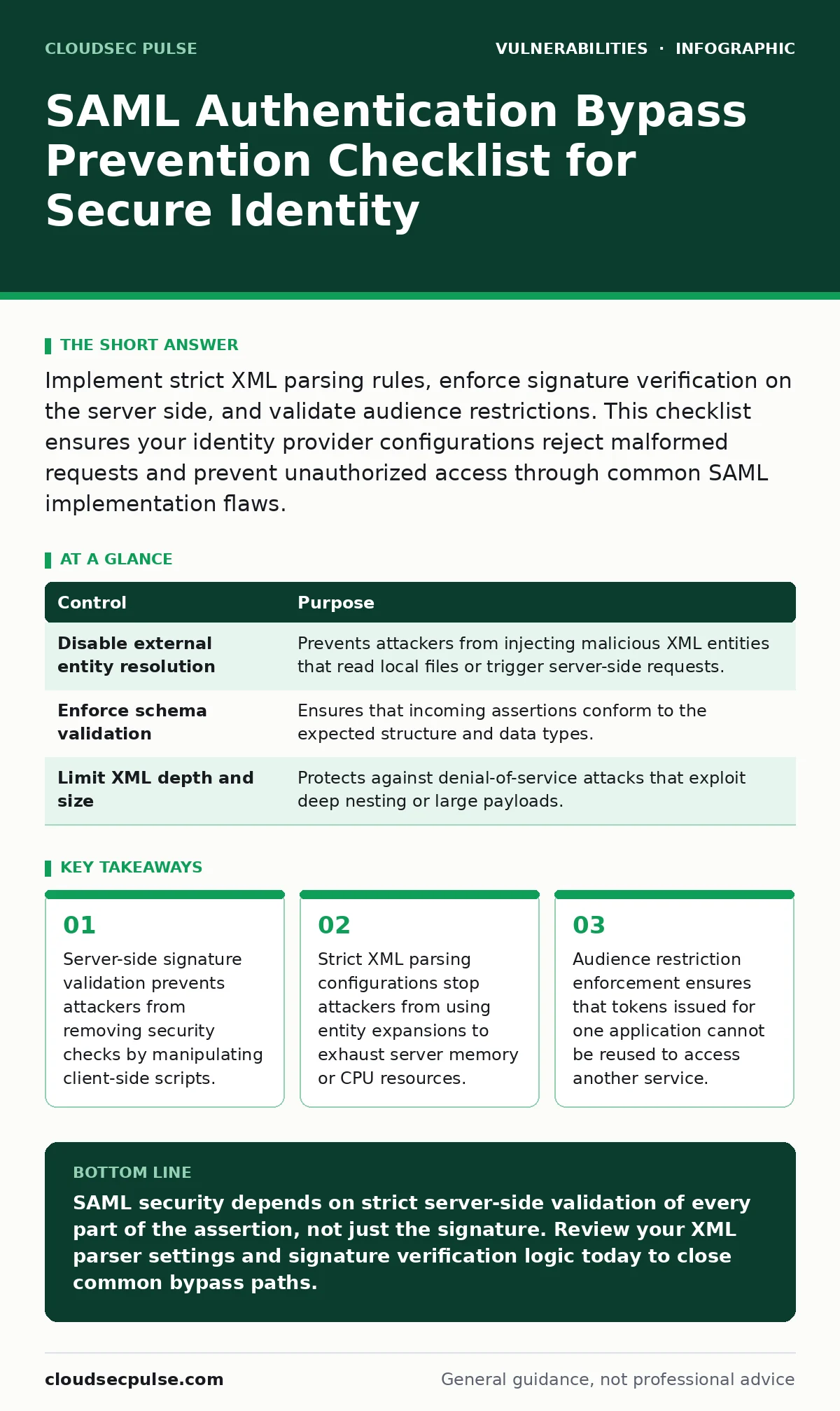
Implement strict XML parsing rules, enforce signature verification on the server side, and validate audience restrictions. This checklist ensures your identity provider configurations reject malformed requests and prevent unauthorized access through common SAML implementation flaws.
Understanding the Attack Surface
SAML authentication bypass exploits weaknesses in how identity providers and service providers handle security tokens. The protocol relies on XML-based assertions that contain user identity information. If the service provider fails to validate these assertions correctly, an attacker can craft a fake assertion that appears legitimate. This allows the attacker to assume any identity, including administrative roles, without knowing the actual password.
The risk stems from the complexity of XML processing and the distributed nature of SAML deployments. Many organizations configure their identity providers once and assume the default settings are secure. Defaults often prioritize compatibility over security, leaving gaps that attackers can exploit. You must treat the SAML integration as a critical boundary that requires continuous monitoring and strict validation rules.
XML Processing and Parsing Controls
| Control | Purpose |
|---|---|
| Disable external entity resolution | Prevents attackers from injecting malicious XML entities that read local files or trigger server-side requests. |
| Enforce schema validation | Ensures that incoming assertions conform to the expected structure and data types. |
| Limit XML depth and size | Protects against denial-of-service attacks that exploit deep nesting or large payloads. |
- Disable external entity resolution in your XML parser: prevents attackers from using XML External Entity injection to read sensitive files or perform server-side request forgery.
- Enforce strict schema validation on all incoming assertions: ensures that malformed or unexpected data structures are rejected before processing begins.
- Limit XML document depth and total size: protects your servers from resource exhaustion attacks that exploit complex nested structures or excessively large payloads.
Signature and Encryption Verification
- Validate signatures on the server side only: prevents attackers from bypassing security checks by removing or altering client-side JavaScript validation logic.
- Verify the certificate chain of the identity provider: ensures that the signature comes from a trusted and authorized source, not a forged certificate.
- Check for signature wrapping attacks: prevents attackers from moving a valid signature from one part of the assertion to another to hide malicious modifications.
Assertion Content Validation
- Enforce audience restriction checks: ensures that the SAML token was intended for your specific service provider and cannot be replayed against other applications.
- Validate the NotBefore and NotOnOrAfter timestamps: prevents the use of expired or future-dated tokens that might have been stolen or leaked.
- Check the issuer field against a whitelist: ensures that tokens only come from known and trusted identity providers, blocking tokens from unauthorized sources.
- Reject assertions with unsigned or unencrypted attributes: ensures that critical identity claims cannot be tampered with during transmission or storage.
- Validate the NameID format: ensures that the identifier format matches your expected user directory structure, preventing confusion between different user types.
Session and State Management
- Bind the SAML session to the browser session: ensures that if the browser session ends, the SAML session also terminates, preventing session fixation attacks.
- Implement short-lived SAML assertions: reduces the window of opportunity for attackers to capture and replay stolen tokens.
- Log and monitor failed authentication attempts: allows you to detect brute-force attacks or automated exploitation attempts targeting your SAML endpoint.
See also: Implement MFA for Cloud Accounts: A Step-by-Step Rollout Plan
Monitoring and Incident Response
- Set up alerts for unusual assertion patterns: detects automated attacks that send many malformed or suspicious requests in a short period.
- Monitor for signature validation failures: identifies potential exploitation attempts where attackers are trying to bypass security checks.
- Regularly test your SAML integration with security tools: ensures that your configurations remain secure as you update software or change network architectures.
- Include SAML endpoints in your vulnerability prioritization process: ensures that security teams focus on fixing high-risk issues before they are exploited in the wild.
- Document your SAML security architecture: helps new team members understand the security controls and reduces the risk of misconfiguration during changes.
Integration with Other Security Controls
SAML security does not exist in isolation. You must integrate your identity controls with other security measures. For example, output encoding practices protect your web applications from injection attacks that could compromise the SAML token handling logic. Similarly, web application firewall tuning can help block common SAML-related attacks before they reach your application servers.
You should also consider the broader context of your security posture. Server-side template injection vulnerabilities can allow attackers to execute arbitrary code, which might include tools that bypass SAML protections. Ensuring that your IT asset inventory is up to date helps you track all systems that rely on SAML authentication, making it easier to apply consistent security controls.
Key takeaways
- Server-side signature validation prevents attackers from removing security checks by manipulating client-side scripts.
- Strict XML parsing configurations stop attackers from using entity expansions to exhaust server memory or CPU resources.
- Audience restriction enforcement ensures that tokens issued for one application cannot be reused to access another service.
SAML security depends on strict server-side validation of every part of the assertion, not just the signature. Review your XML parser settings and signature verification logic today to close common bypass paths.
Frequently asked questions
Can I use client-side JavaScript to validate SAML signatures?
No, client-side validation is easily bypassed by attackers who can modify or remove the validation code. All signature verification must occur on the server side.
How do I detect a SAML bypass attack in progress?
Monitor for unusual patterns in assertion validation failures, such as a high volume of signature errors or requests from unexpected identity providers.
Should I encrypt the entire SAML assertion?
Encrypting the assertion protects the contents from eavesdropping, but it does not prevent tampering. You still need signature verification to ensure integrity and authenticity.
What is the risk of disabling external entity resolution?
Disabling external entity resolution prevents XML External Entity injection attacks, which can lead to sensitive file disclosure or server-side request forgery.
How this guide was produced: written by the CloudSec Pulse editorial team with AI assistance, checked against the public references listed below, and reviewed when the facts change. See our editorial policy or report an error.