Tabletop Exercises: Real Benefits and Hidden Costs
Tabletop exercises reveal coordination gaps that technical controls cannot fix, but they fail without realistic scenarios and honest participation.

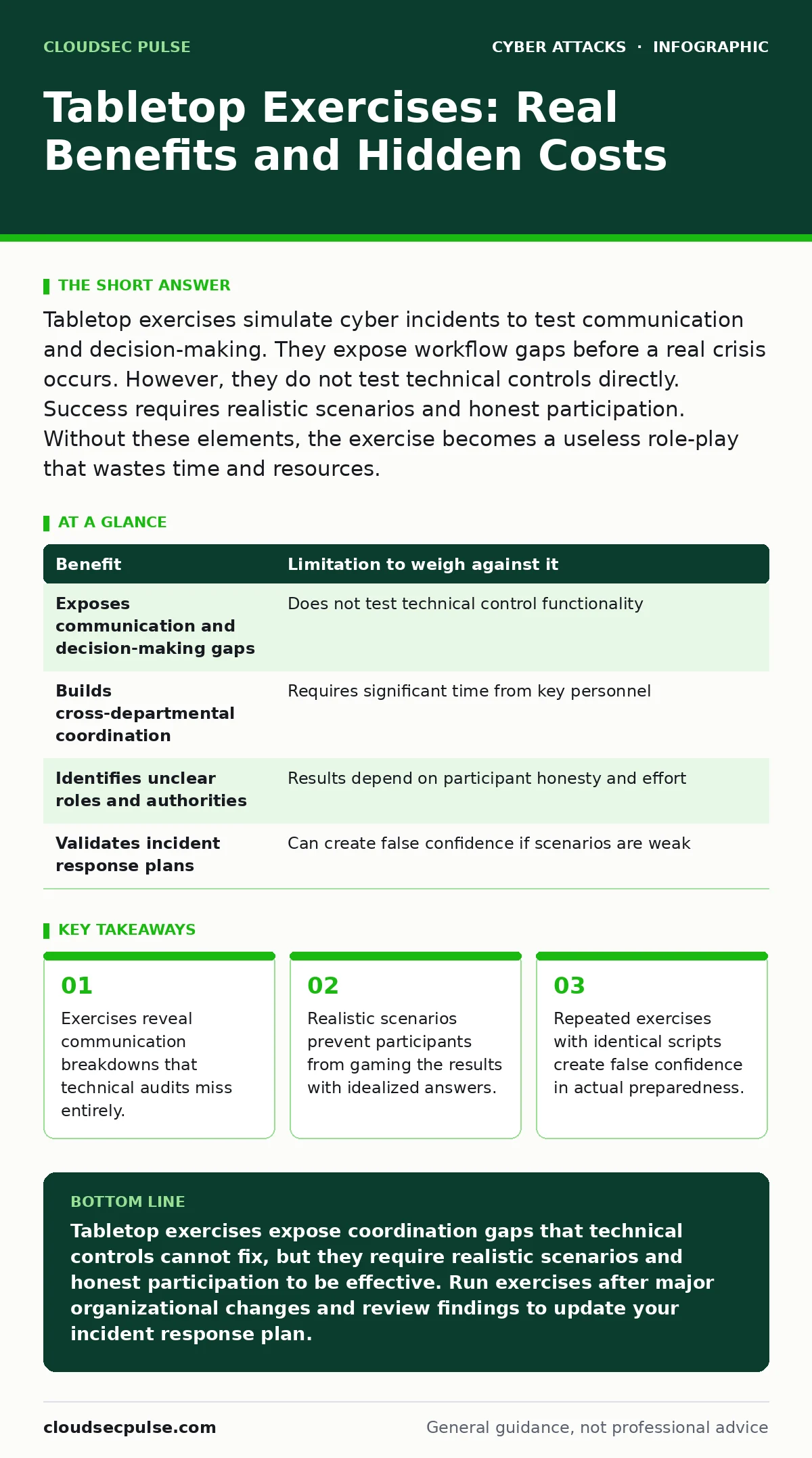
Tabletop exercises simulate cyber incidents to test communication and decision-making. They expose workflow gaps before a real crisis occurs. However, they do not test technical controls directly. Success requires realistic scenarios and honest participation. Without these elements, the exercise becomes a useless role-play that wastes time and resources.
Why Tabletop Exercises Reveal Hidden Risks
Tabletop exercises simulate a cyber incident using discussion rather than technical execution. You gather key stakeholders to walk through a hypothetical breach step by step. The goal is not to test whether a firewall blocks traffic. The goal is to test whether your team knows who to call and what to say. Technical controls often work in isolation but fail during coordinated chaos. These exercises expose those coordination failures before they cause real damage.
You discover which roles are unclear during an emergency. You find out who has the authority to shut down systems. You identify where communication bottlenecks form under pressure. This process builds muscle memory for crisis response. It forces people to confront uncomfortable decisions in a safe environment. The value lies in the conversation, not the technical details.
The Cost of Poorly Designed Scenarios
A tabletop exercise fails when the scenario feels abstract or irrelevant. If participants treat the exercise as a theoretical debate, they will provide idealized answers. These answers do not reflect reality. You gain no insight into actual behavior. The exercise becomes a box-checking activity that provides false comfort. You must design scenarios that challenge assumptions and force difficult choices.
Bad scenarios often ignore the human factor in security. They assume perfect information and rational decision-making. Real incidents involve fear, uncertainty, and incomplete data. If your scenario does not introduce ambiguity, it does not test your resilience. You must simulate the chaos of a real event. This includes conflicting information from different sources. It includes pressure from executives to resume operations prematurely.
Balancing Communication Gains Against Technical Blind Spots
Tabletop exercises improve communication protocols but do not validate technical defenses. You cannot determine if your backup restoration works by discussing it. You cannot verify if your intrusion detection system triggers correctly through conversation. This limitation requires you to pair exercises with technical testing. The exercise tells you if the team talks. Technical tests tell you if the tools work.
The table below compares the primary benefit of each approach against its inherent limitation.
| Benefit | Limitation to weigh against it |
|---|---|
| Exposes communication and decision-making gaps | Does not test technical control functionality |
| Builds cross-departmental coordination | Requires significant time from key personnel |
| Identifies unclear roles and authorities | Results depend on participant honesty and effort |
| Validates incident response plans | Can create false confidence if scenarios are weak |
When It Is Worth Investing Time
Tabletop exercises are worth the effort when your organization relies on complex coordination. If a single person can resolve an incident, you do not need a group exercise. Most organizations require multiple teams to respond effectively. This includes IT, legal, communications, and executive leadership. When dependencies exist between these groups, an exercise becomes necessary.
You should run an exercise after major changes to your infrastructure or staff. New systems change how incidents are detected and contained. New staff members need to understand their roles in a crisis. The exercise ensures everyone knows their responsibilities. It also helps integrate new employees into the security culture. This aligns with zero trust security principles by verifying that access and response protocols are understood by all parties.
Imagine a scenario where a new cloud provider is adopted. The old response plan no longer applies. An exercise reveals which steps are missing. It highlights where the new team lacks authority. This prevents delays during a real incident. The investment pays off by reducing mean time to containment.
When It Is Not Worth The Effort
Tabletop exercises waste resources when they lack realistic stakes. If participants know the outcome is predetermined, they will not engage honestly. You cannot force genuine participation. Without it, the exercise yields no actionable insights. Do not run an exercise simply to satisfy a compliance requirement. Compliance checklists do not measure actual readiness.
Avoid exercises if you cannot secure key decision-makers. The value of the exercise lies in the presence of those who can authorize actions. If the CEO or legal counsel is absent, the simulation is incomplete. You cannot test the decision chain if the chain is broken. It is better to delay the exercise than to run it with incomplete representation. This ensures that the lessons learned are applicable to real-world authority structures.
Suppose your team is too small to simulate multiple roles. You may not have enough people to play the attacker, the defender, and the observer. In this case, a focused discussion may be more effective than a full exercise. Keep the scope narrow and the goals specific. This maintains the quality of the interaction. It prevents the exercise from becoming a superficial role-play.
See also: Digital Forensics and Incident Response: 8 Field-Proven Practices · Honeypots Checklist: Deploy Decoys to Catch Intruders Early
Integrating Exercises With Broader Security Strategies
Tabletop exercises complement other security measures but do not replace them. They work best when combined with attack surface reduction efforts. Reducing the attack surface limits the entry points for attackers. The exercise then focuses on how to respond to the breaches that do occur. This creates a layered approach to security.
You should also consider the human factor in security during planning. Phishing and social engineering often bypass technical controls. An exercise should include scenarios where human error is the primary cause. This tests whether your team can identify and contain such incidents. It reinforces the importance of user awareness and verification procedures.
Ensuring Continuous Improvement
A single exercise provides a snapshot of current readiness. It does not guarantee future success. You must repeat exercises regularly to maintain proficiency. Skills degrade over time. New threats and technologies emerge constantly. Your response plan must evolve to address these changes.
Review the findings from each exercise thoroughly. Identify specific actions to improve communication and coordination. Assign owners to these actions and track progress. This turns insights into tangible improvements. It creates a cycle of continuous refinement. This approach ensures that your incident response capabilities remain effective over time. It also supports defense in depth by strengthening the human element of your security posture.
Key takeaways
- Exercises reveal communication breakdowns that technical audits miss entirely.
- Realistic scenarios prevent participants from gaming the results with idealized answers.
- Repeated exercises with identical scripts create false confidence in actual preparedness.
Tabletop exercises expose coordination gaps that technical controls cannot fix, but they require realistic scenarios and honest participation to be effective. Run exercises after major organizational changes and review findings to update your incident response plan.
Frequently asked questions
How often should we run tabletop exercises?
Run tabletop exercises at least once a year. More frequent exercises are beneficial after major changes to infrastructure, staff, or incident response plans. Regular practice maintains proficiency and adapts to evolving threats.
Who should participate in a tabletop exercise?
Include key stakeholders from IT, legal, communications, and executive leadership. Non-technical staff should also participate to understand their roles. Ensure that people with decision-making authority are present to test the response chain.
Can small organizations benefit from tabletop exercises?
Yes, small organizations benefit by clarifying roles and communication paths. Keep scenarios focused and realistic for your size. Even a small team can identify gaps in coordination and decision-making during a simulated incident.
What makes a tabletop exercise scenario realistic?
A realistic scenario includes ambiguity, pressure, and incomplete information. It should challenge assumptions and force difficult choices. Avoid scenarios with a single correct answer, as they encourage guessing rather than critical thinking and coordination.
How this guide was produced: written by the CloudSec Pulse editorial team with AI assistance, checked against the public references listed below, and reviewed when the facts change. See our editorial policy or report an error.