Managed Detection and Response Misunderstandings and Correct Views
Managed detection and response shifts the burden of alert triage to experts, but it does not replace the need for internal access controls and clear incident response protocols.

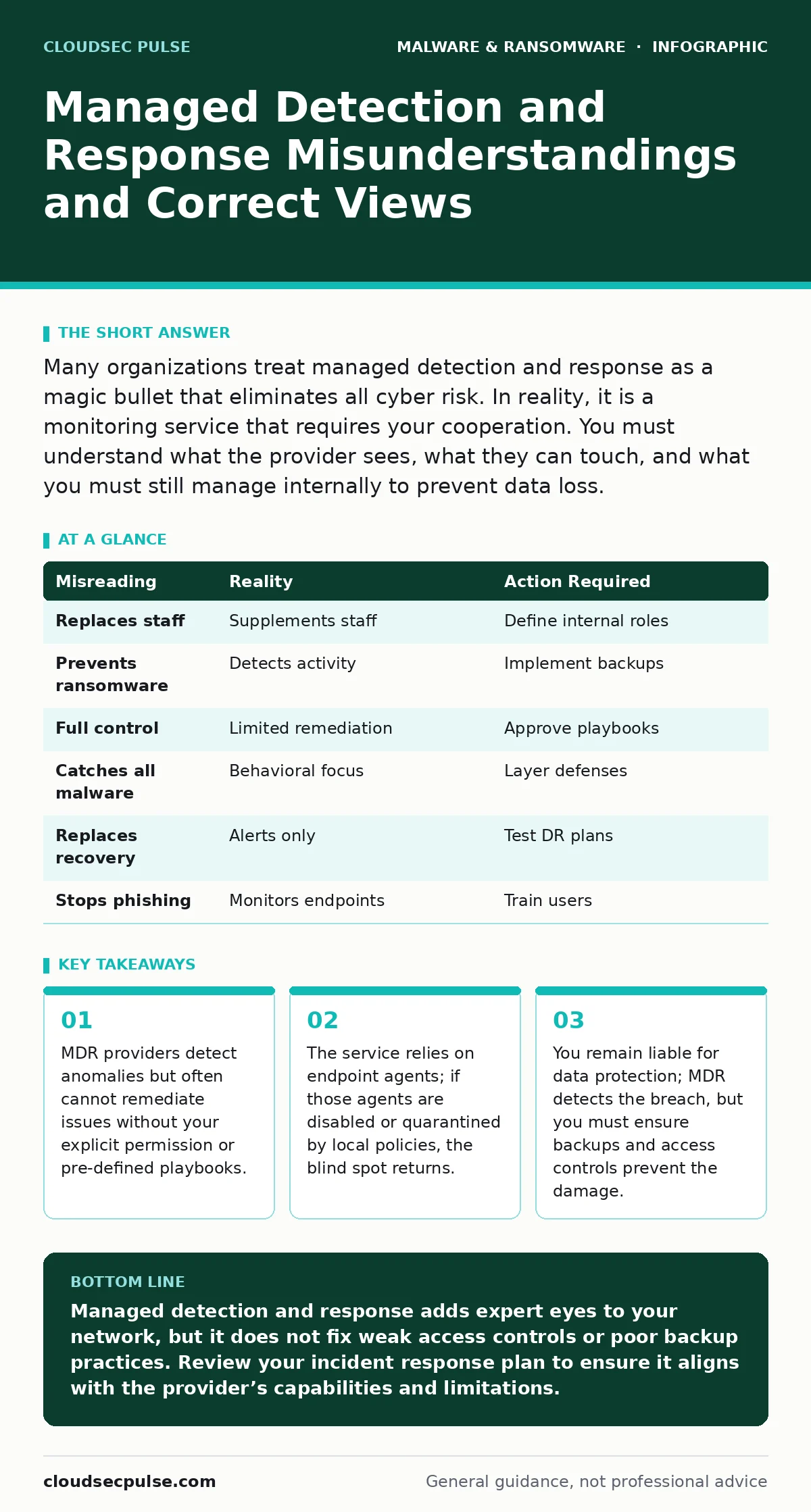
Many organizations treat managed detection and response as a magic bullet that eliminates all cyber risk. In reality, it is a monitoring service that requires your cooperation. You must understand what the provider sees, what they can touch, and what you must still manage internally to prevent data loss.
Misreading: MDR replaces the need for internal security staff
Correct reading: Managed detection and response supplements your team rather than replacing it. The provider monitors logs and endpoints for threats, but they do not manage your user accounts, configure your firewalls, or train your employees. You still need someone internally to enforce least privilege access and validate that the MDR provider has the necessary permissions to act. Without internal ownership, the provider’s alerts become noise you cannot contextualize.
Misreading: MDR prevents ransomware from encrypting files
Correct reading: Detection is not prevention. Managed detection and response identifies malicious behavior after it begins. If an attacker uses a legitimate tool to move laterally, the MDR system may flag the anomaly, but the encryption process might already be underway. You must combine MDR with application whitelisting and immutable backups. See ransomware decryption tools for why relying on reversal after the fact is rarely viable. Prevention requires blocking the initial execution, which MDR alone does not do.
Misreading: The provider has full control to remediate threats
Correct reading: Most managed detection and response contracts limit remediation to containment actions like isolating a single device. They rarely have permission to change system configurations, delete files, or reset credentials without your direct approval. This delay is intentional to prevent accidental business disruption. You must define exactly which actions the provider can take automatically. Clear playbooks reduce the time between detection and effective containment, but they require your prior consent for specific technical steps.
Misreading: MDR catches all types of malware immediately
Correct reading: No detection system sees everything. Managed detection and response relies on behavioral analysis and threat intelligence feeds. Polymorphic malware changes its code signature with each infection, often evading static checks. If the malware behaves like a normal process, the MDR system may not flag it. You must maintain layered defenses. Static malware analysis helps researchers understand new threats, but your live environment needs behavioral monitoring and network segmentation to limit the spread of unknown variants.
Misreading: MDR eliminates the need for disaster recovery plans
Correct reading: Detection does not restore your business. If an attacker exfiltrates data or encrypts critical servers, the MDR provider will alert you, but they will not rebuild your infrastructure. You need documented disaster recovery plans that specify how to restore systems from clean backups. The MDR service tells you what happened; your recovery plan tells you how to continue operating. Without a tested restoration process, detection is merely a notification of failure.
See also: Disaster Recovery Plan Checklist: Restore Operations After Attack · Why do browser hijackers exist: The hidden economics of attention theft
Misreading: MDR protects against social engineering and phishing
Correct reading: Managed detection and response monitors technical endpoints, not human behavior. If an employee clicks a link in a fake software update email and enters their credentials, the MDR system sees a successful login, not a crime. The theft happens in the user’s mind, not on the server logs. You must train staff to recognize fake antivirus software prompts and suspicious URLs. Technical detection catches the aftermath, but education stops the initial compromise. Browser hijackers often install before MDR agents can react, making user awareness the first line of defense.
Misreading: MDR is a set-and-forget solution
Correct reading: Managed detection and response requires ongoing tuning. False positives occur when normal business activities mimic malicious behavior. If you do not review alerts with the provider, they cannot refine their detection rules for your specific environment. You must schedule regular reviews to adjust sensitivity levels. This collaboration ensures the system focuses on real threats rather than routine administrative tasks. Neglecting this feedback loop leads to alert fatigue and missed incidents.
| Misreading | Reality | Action Required |
|---|---|---|
| Replaces staff | Supplements staff | Define internal roles |
| Prevents ransomware | Detects activity | Implement backups |
| Full control | Limited remediation | Approve playbooks |
| Catches all malware | Behavioral focus | Layer defenses |
| Replaces recovery | Alerts only | Test DR plans |
| Stops phishing | Monitors endpoints | Train users |
Key takeaways
- MDR providers detect anomalies but often cannot remediate issues without your explicit permission or pre-defined playbooks.
- The service relies on endpoint agents; if those agents are disabled or quarantined by local policies, the blind spot returns.
- You remain liable for data protection; MDR detects the breach, but you must ensure backups and access controls prevent the damage.
Managed detection and response adds expert eyes to your network, but it does not fix weak access controls or poor backup practices. Review your incident response plan to ensure it aligns with the provider’s capabilities and limitations.
Frequently asked questions
How quickly does MDR respond to a threat?
Response times vary by contract tier, but most providers aim to triage alerts within minutes. Actual remediation depends on whether they have pre-approved permissions to act without your input.
Can MDR detect insider threats?
Yes, managed detection and response monitors for anomalous user behavior, such as accessing files outside normal hours or exfiltrating large data sets. It flags deviations from baseline activity for investigation.
Do I need an SIEM if I have MDR?
It depends on your data volume and retention needs. MDR providers often include basic SIEM capabilities, but large organizations may need a dedicated SIEM for long-term log storage and custom correlation rules.
What happens if the MDR provider is breached?
Reputable providers use strict isolation and encryption for client data. However, you should verify their security posture and incident response capabilities during the vendor selection process to mitigate this risk.
How this guide was produced: written by the CloudSec Pulse editorial team with AI assistance, checked against the public references listed below, and reviewed when the facts change. See our editorial policy or report an error.