How Red Teaming Works: The Hidden Mechanics of Security Testing
Red teaming bypasses standard defenses by simulating human decision-making and adaptive tactics, revealing gaps that automated scans consistently miss.

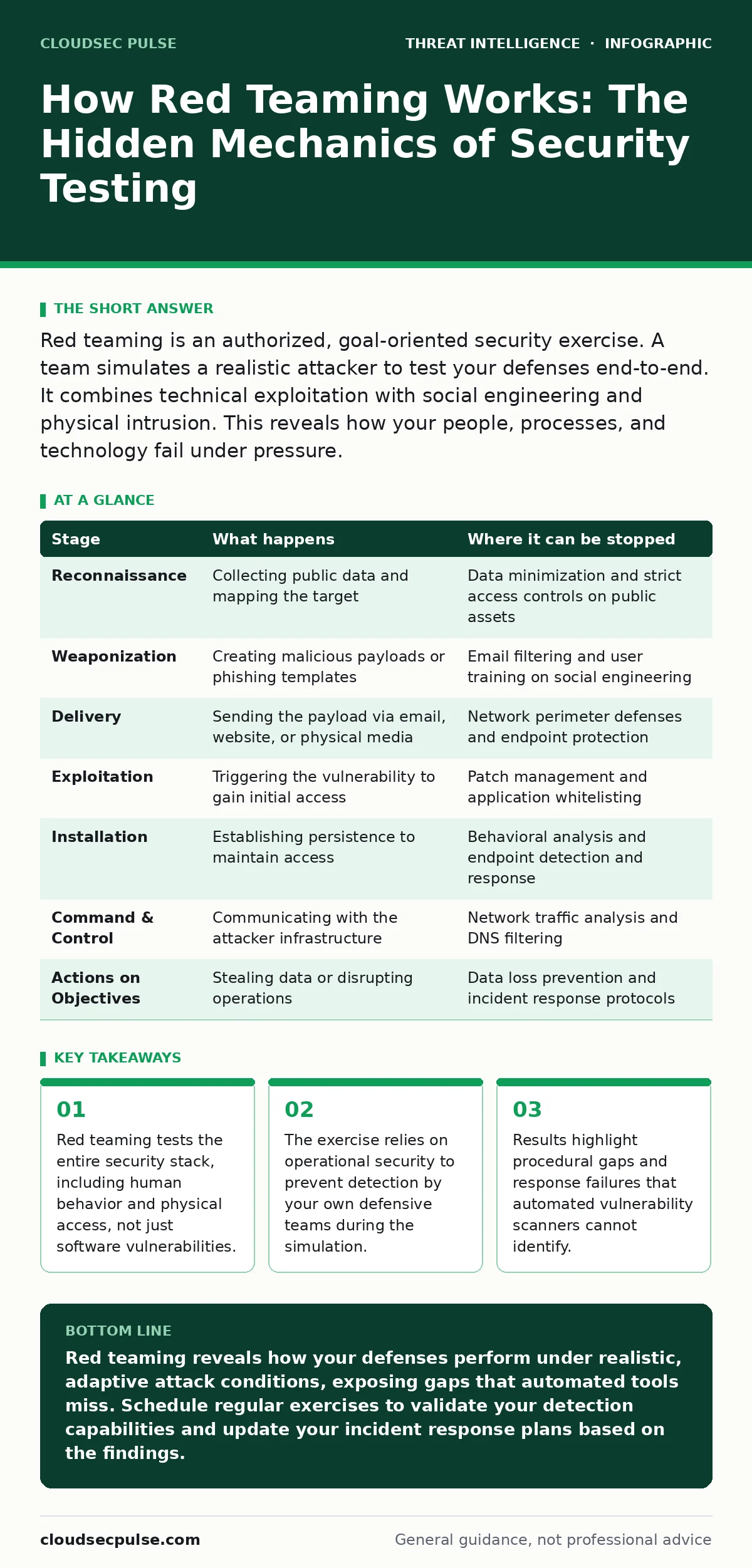
Red teaming is an authorized, goal-oriented security exercise. A team simulates a realistic attacker to test your defenses end-to-end. It combines technical exploitation with social engineering and physical intrusion. This reveals how your people, processes, and technology fail under pressure.
Defining the Scope and Rules of Engagement
Red teaming differs significantly from penetration testing or vulnerability assessment. While those methods check for specific weaknesses in isolation, red teaming evaluates your organization's ability to detect and respond to a sophisticated, persistent threat. You must define clear boundaries before the exercise begins. This includes which systems are in scope, which are off-limits, and what actions are prohibited.
Without strict rules of engagement, the test can cause unintended disruption. Imagine a scenario where the red team successfully compromises a production database to prove a point. This might trigger a real incident response that drains resources and alarms customers. The goal is to measure security, not to break business operations.
Planning and Intelligence Gathering
The red team begins with open-source intelligence. They research your organization’s public footprint. This includes employee profiles, technology stacks, and architectural diagrams found in public repositories. This phase mirrors how real adversaries target organizations. They look for low-hanging fruit that requires minimal effort.
This stage is critical because it reveals how much information your organization leaks. Even if your firewalls are strong, a misplaced configuration file on a public server can provide a roadmap. The red team uses this data to craft targeted phishing emails or identify weak entry points. It is not about hacking into your network directly; it is about finding the path of least resistance.
| Stage | What happens | Where it can be stopped |
|---|---|---|
| Reconnaissance | Collecting public data and mapping the target | Data minimization and strict access controls on public assets |
| Weaponization | Creating malicious payloads or phishing templates | Email filtering and user training on social engineering |
| Delivery | Sending the payload via email, website, or physical media | Network perimeter defenses and endpoint protection |
| Exploitation | Triggering the vulnerability to gain initial access | Patch management and application whitelisting |
| Installation | Establishing persistence to maintain access | Behavioral analysis and endpoint detection and response |
| Command & Control | Communicating with the attacker infrastructure | Network traffic analysis and DNS filtering |
| Actions on Objectives | Stealing data or disrupting operations | Data loss prevention and incident response protocols |
Initial Access and Social Engineering
Technical exploits are often just one part of the strategy. Red teams frequently use social engineering to bypass technical controls. They might call an employee pretending to be IT support, asking for remote access credentials. This tests whether your staff follows verification procedures. If an employee hands over credentials without proper verification, the technical defenses become irrelevant.
This approach highlights a non-obvious consequence of security training. Users may know how to spot a phishing email but fail to recognize a voice-based attack. The red team exploits this gap. They rely on the assumption that human interaction is less scrutinized than digital traffic. This stage often reveals that your weakest link is not your firewall, but your culture of trust.
Establishing Persistence and Moving Laterally
Once inside the network, the red team seeks to maintain access. They install backdoors or create hidden user accounts. This ensures they can return even if the initial entry point is closed. Next, they move laterally. They use stolen credentials to access other systems. This phase tests your internal segmentation.
If your network is flat, the red team can move freely. Proper segmentation limits the blast radius of a compromise. The red team will look for trusts between domains or misconfigured permissions. They may use living-off-the-land attacks, which involve using legitimate system tools for malicious purposes. This makes detection difficult because the tools are already trusted by your security software.
Detection and Response Evaluation
The primary goal of red teaming is to test your detection capabilities. The red team monitors what the blue team, your defensive team, sees. They note which actions trigger alerts and which do not. If the blue team fails to notice the lateral movement, the red team has succeeded in demonstrating a detection gap.
This evaluation is not about the red team winning. It is about identifying blind spots. You need to understand if your security information and event management system is configured correctly. You must verify that your digital forensics and incident response plans are actionable. If the blue team detects the threat but cannot contain it, the process fails regardless of the alert.
See also: Tabletop Exercises: Real Benefits and Hidden Costs · Digital Forensics and Incident Response: 8 Field-Proven Practices
Reporting and Remediation Priorities
After the exercise, the red team produces a detailed report. This document outlines the attack path, the gaps found, and the time to detection. It does not just list vulnerabilities; it explains the business impact. The report helps you prioritize remediation efforts based on risk rather than technical severity.
Remediation should focus on closing the gaps that allowed the attack to succeed. This might mean improving monitoring, updating policies, or retraining staff. You must address the root cause, not just the symptom. If the gap was a lack of user verification, technical fixes alone will not solve the problem.
Limits and Operational Costs
Red teaming has significant limits. It is resource-intensive and requires skilled personnel. It cannot test every possible attack vector. The exercise is a snapshot in time. New vulnerabilities emerge daily, and your environment changes. The results are valid only for the duration of the test.
There is also a risk of false positives in threat detection during the exercise. Your defensive systems may generate noise that overwhelms your analysts. This can lead to alert fatigue, where real threats are missed because the team is focused on the simulation. You must coordinate closely with your security operations center to manage this noise.
Additionally, red teaming does not guarantee security. It demonstrates that specific attacks succeeded. It does not prove that other attacks would fail. You must combine red teaming with other methods, such as network traffic analysis and regular vulnerability scanning, to build a layered defense.
Key takeaways
- Red teaming tests the entire security stack, including human behavior and physical access, not just software vulnerabilities.
- The exercise relies on operational security to prevent detection by your own defensive teams during the simulation.
- Results highlight procedural gaps and response failures that automated vulnerability scanners cannot identify.
Red teaming reveals how your defenses perform under realistic, adaptive attack conditions, exposing gaps that automated tools miss. Schedule regular exercises to validate your detection capabilities and update your incident response plans based on the findings.
Frequently asked questions
How does red teaming differ from penetration testing?
Penetration testing focuses on finding technical vulnerabilities in specific systems. Red teaming simulates a full adversary campaign, including social engineering and physical intrusion, to test your organization's overall detection and response capabilities.
How long does a red team exercise typically last?
The duration depends on the scope and objectives. Smaller exercises may last a few weeks, while comprehensive campaigns can take several months. The timeline should allow enough time for the red team to establish persistence and for the blue team to detect and respond.
Can red teaming disrupt business operations?
Yes, if not properly scoped. The red team may inadvertently trigger security alerts or access critical systems. Strict rules of engagement and constant communication with the defensive team are necessary to minimize disruption and prevent accidental damage to production environments.
How often should we conduct red teaming exercises?
You should conduct them regularly, especially after significant changes to your infrastructure, personnel, or security architecture. Annual exercises are common, but more frequent testing may be necessary for high-risk environments or after major security incidents.
How this guide was produced: written by the CloudSec Pulse editorial team with AI assistance, checked against the public references listed below, and reviewed when the facts change. See our editorial policy or report an error.